SEOUL, South Korea: South Korea summoned the Russian ambassador to protest the country’s new defense pact with North Korea on Friday, as border tensions continued to rise with vague threats and brief, seemingly accidental incursions by North Korean troops.
Earlier Friday, the powerful sister of North Korean leader Kim Jong Un issued a vague threat of retaliation after South Korean activists flew balloons carrying anti-Pyongyang propaganda leaflets across the border, and South Korea’s military said it had fired warning shots the previous day to repel North Korean soldiers who briefly crossed the rivals’ land border for the third time this month.
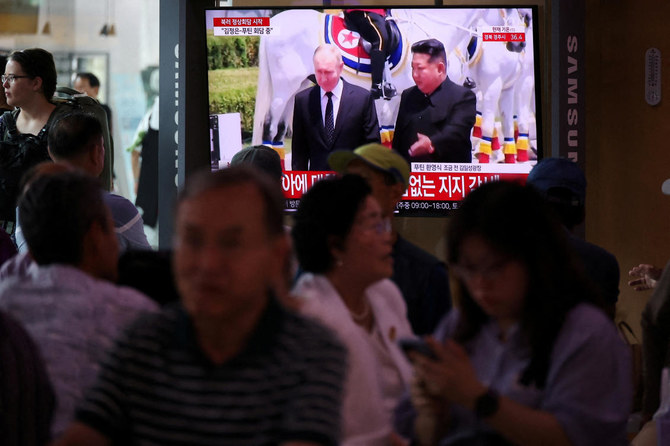
That came two days after Moscow and Pyongyang reached a pact vowing mutual defense assistance if either is attacked, and a day after Seoul responded by saying it would consider providing arms to Ukraine to fight Russia’s invasion.
South Korean Vice Foreign Minister Kim Hong Kyun summoned Russian Ambassador Georgy Zinoviev to protest the deal between Russian President Vladimir Putin and Kim Jong Un and called for Moscow to immediately halt its alleged military cooperation with Pyongyang.
Kim, the South Korean diplomat, stressed that any cooperation that directly or indirectly helps the North build up its military capabilities would violate UN Security Council resolutions and pose a threat to the South’s security, and warned of consequences for Seoul’s relations with Moscow.
Zinoviev replied that he would convey Seoul’s concerns to his superiors in Moscow, the ministry said.
Leafletting campaigns by South Korean civilian activists in recent weeks have prompted a resumption of Cold War-style psychological warfare along the inter-Korean border.
The South Korean civilian activists, led by North Korean defector Park Sang-hak, said it sent 20 balloons carrying 300,000 propaganda leaflets, 5,000 USB sticks with South Korean pop songs and TV dramas, and 3,000 US dollar bills from the South Korean border town of Paju on Thursday night.
Pyongyang resents such material and fears it could demoralize front-line troops and residents and eventually weaken Kim Jong Un’s grip on power, analysts say.
In a statement carried by North Korea’s official Korean Central News Agency, Kim Yo Jong, one of her brother’s top foreign policy officials, called the activists “defector scum” and issued what appeared to be a threat of retaliation.
“When you do something you were clearly warned not to do, it’s only natural that you will find yourself dealing with something you didn’t have to,” she said, without specifying what the North would do.
After previous leafletting by South Korean activists, North Korea launched more than 1,000 balloons that dropped tons of trash in South Korea, smashing roof tiles and windows and causing other property damage. Kim Yo Jong previously hinted that balloons could become the North’s standard response to leafletting, saying that the North would respond by “scattering dozens of times more rubbish than is being scattered on us.”
In response, South Korea resumed anti-North Korea propaganda broadcasts with military loudspeakers installed at the border for the first time in years, to which Kim Yo Jong, in another state media statement, warned that Seoul was “creating a prelude to a very dangerous situation.”
Tensions between the Koreas are at their highest in years as Kim Jong Un accelerates his nuclear weapons and missile development and attempts to strengthen his regional footing by aligning with Russian President Vladimir Putin in a standoff against the US-led West.
South Korea, a growing arms exporter with a well-equipped military backed by the United States, says it is considering upping support for Ukraine in response. Seoul has already provided humanitarian aid and other support while joining US-led economic sanctions against Moscow. But it has not directly provided arms, citing a long-standing policy of not supplying weapons to countries actively engaged in conflict.
Putin told reporters in Hanoi, Vietnam, on Thursday that supplying weapons to Ukraine would be “a very big mistake,” and said South Korea “shouldn’t worry” about the agreement if it isn’t planning aggression against Pyongyang.
South Korea’s Foreign Ministry said Minister Cho Tae-yul on Friday held separate phone calls with US Secretary of State Antony Blinken and Japanese Foreign Minister Yoko Kamikawa to discuss the new pact. The diplomats agreed that the agreement poses a serious threat to peace and stability in the region and vowed to strengthen trilateral coordination to deal with the challenges posed by the alignment between Moscow and Pyongyang, Cho’s ministry said in a statement.
North Korea is extremely sensitive to criticism of Kim’s authoritarian rule and efforts to reach its people with foreign news and other media.
In 2015, when South Korea restarted loudspeaker broadcasts for the first time in 11 years, North Korea fired artillery rounds across the border, prompting South Korea to return fire, according to South Korean officials. No casualties were reported.
South Korea’s military said there are signs that North Korea was installing its own speakers at the border, although they weren’t yet working.
In the latest border incident, South Korea’s Joint Chiefs of Staff said several North Korean soldiers engaged in unspecified construction work briefly crossed the military demarcation line that divides the two countries at around 11 a.m. Thursday.
The South Korean military broadcast a warning and fired warning shots, after which the North Korean soldiers retreated. The joint chiefs didn’t immediately release more details, including why it was releasing the information a day late.
South Korea’s military says believes recent border intrusions were not intentional, as the North Korean soldiers have not returned fire and retreated after the warning shots.
The South’s military has observed the North deploying large numbers of soldiers in frontline areas to build suspected anti-tank barriers, reinforce roads and plant mines in an apparent attempt to fortify their side of the border. Seoul believes the efforts are likely aimed at preventing North Korean civilians and soldiers from escaping to the South.


![]()

South Korea summons Russian ambassador as tensions rise with North Korea
Short Url
https://arab.news/cm8at
South Korea summons Russian ambassador as tensions rise with North Korea
- Earlier Friday, the powerful sister of North Korean leader Kim Jong Un issued a vague threat of retaliation after South Korean activists flew balloons carrying anti-Pyongyang propaganda leaflets across the border
- South Korean Vice Foreign Minister Kim Hong Kyun summoned Russian Ambassador Georgy Zinoviev to protest the deal between Russian President Vladimir Putin and Kim Jong Un


Latest updates


Recommended


© 2026 SAUDI RESEARCH & PUBLISHING COMPANY, All Rights Reserved And subject to Terms of Use Agreement.