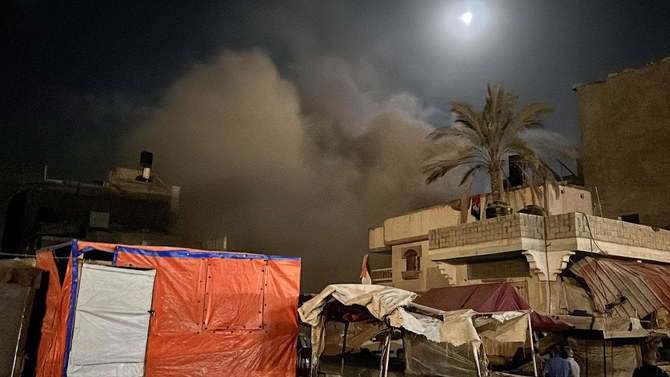
CAIRO: Israeli forces pounded Rafah and other areas across the Gaza Strip and engaged in close-quarter combat with fighters led by Palestinian Islamist group Hamas, residents and Israel’s military said.
Residents said the Israelis appeared to by trying to complete their capture of Rafah, the city on the enclave’s southern edge that has been the focus of an Israeli assault since early May.
Tanks were forcing their way into the western and northern parts of the city, having already captured the east, south and center. Israeli forces fired from planes, tanks and ships off the coast, forcing a new wave of displacement from the city, which had been sheltering more than a million displaced people, most of whom have been forced to flee again.
The Israeli military said on Friday its forces were conducting “precise, intelligence-based” actions in the Rafah area, where troops were involved in close-quarter combat and had located tunnels used by militants. It also reported actions elsewhere in the enclave.
Some residents said the pace of the Israeli raid has been accelerated in the past two days. They said sounds of explosions and gunfire indicating fierce fighting have been almost non-stop.
More than eight months into the war in Gaza, Israel’s advance is now focused on the two last areas its forces had yet to storm: Rafah on Gaza’s southern edge and the area surrounding Deir Al-Balah in the center.
“The entire city of Rafah is an area of Israeli military operations,” Ahmed Al-Sofi, the mayor of Rafah, said in a statement carried by Hamas media on Friday.
“The city lives through a humanitarian catastrophe and people are dying inside their tents because of Israeli bombardment,” he added.
Sofi said there was no medical facility functioning in the city, and that remaining residents and displaced families lacked the minimum of their daily needs of food and water.
Palestinian and UN figures show that fewer than 100,000 people may have remained in the far western side of the city, which had been sheltering more than half of Gaza’s 2.3 million people before the Israeli assault began in early May.
The military accused Hamas of using Palestinian civilians as human shields, an allegation Hamas denies.
“The soldiers located inside a civilian residence large quantities of weapons hidden in wardrobes, including grenades, explosives, a launcher and anti-tank missiles, ammunition, and arms,” the military said in a statement late on Thursday.
Hamas’ armed wing said on Thursday its fighters had hit two Israeli tanks with anti-tank rockets in the Shaboura camp in Rafah, and killed soldiers who tried to flee through the alleys. There was no Israeli immediate comment on the Hamas claim.
In nearby Khan Younis, an Israeli air strike on Friday killed three people, including a father and son, medics said.
In parallel, Israeli forces continued a new push back into some Gaza City suburbs in the north of the enclave, where they fought with Hamas-led militants. Residents said the army forces had destroyed many homes in the heart of Gaza City on Thursday.
Later on Friday, an Israeli air strike on a main road in Gaza City killed four Palestinians, medics said.
Israel’s ground and air campaign was triggered when Hamas-led militants stormed into southern Israel on Oct. 7, killing around 1,200 people and seizing more than 250 hostages, according to Israeli tallies.
The offensive has left Gaza in ruins, killed more than 37,400 people, according to Palestinian health authorities, and left nearly the entire population homeless and destitute.


![]()

Israeli forces step up bombardment across Gaza, amid fierce fighting
Short Url
https://arab.news/99kdb
Israeli forces step up bombardment across Gaza, amid fierce fighting
- Tanks forcing their way into the western and northern parts of the city, having already captured the east, south and center.
- Residents said the Israelis appeared to by trying to complete their capture of Rafah


Latest updates


© 2026 SAUDI RESEARCH & PUBLISHING COMPANY, All Rights Reserved And subject to Terms of Use Agreement.