Israeli forces step up bombardment across Gaza, amid fierce fighting

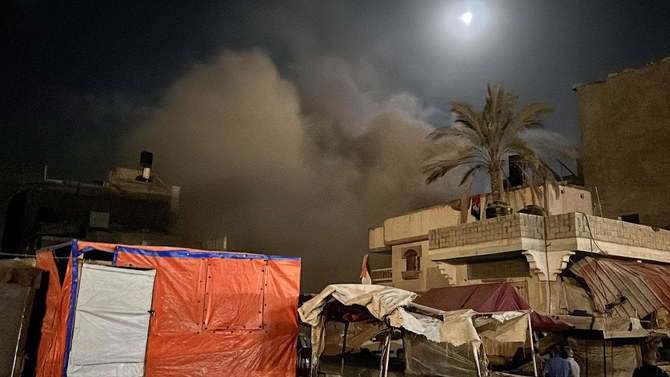
Smoke rises after an Israeli air strike on a house, amid the Israel-Hamas conflict, in Khan Younis, in the southern Gaza Strip, June 20, 2024. (REUTERS)
Short Url
Updated 21 June 2024
Follow

Israeli forces step up bombardment across Gaza, amid fierce fighting

  • Tanks forcing their way into the western and northern parts of the city, having already captured the east, south and center.
  • Residents said the Israelis appeared to by trying to complete their capture of Rafah

CAIRO: Israeli forces pounded Rafah and other areas across the Gaza Strip and engaged in close-quarter combat with fighters led by Palestinian Islamist group Hamas, residents and Israel’s military said.
Residents said the Israelis appeared to by trying to complete their capture of Rafah, the city on the enclave’s southern edge that has been the focus of an Israeli assault since early May.
Tanks were forcing their way into the western and northern parts of the city, having already captured the east, south and center. Israeli forces fired from planes, tanks and ships off the coast, forcing a new wave of displacement from the city, which had been sheltering more than a million displaced people, most of whom have been forced to flee again.
The Israeli military said on Friday its forces were conducting “precise, intelligence-based” actions in the Rafah area, where troops were involved in close-quarter combat and had located tunnels used by militants. It also reported actions elsewhere in the enclave.
Some residents said the pace of the Israeli raid has been accelerated in the past two days. They said sounds of explosions and gunfire indicating fierce fighting have been almost non-stop.
More than eight months into the war in Gaza, Israel’s advance is now focused on the two last areas its forces had yet to storm: Rafah on Gaza’s southern edge and the area surrounding Deir Al-Balah in the center.
“The entire city of Rafah is an area of Israeli military operations,” Ahmed Al-Sofi, the mayor of Rafah, said in a statement carried by Hamas media on Friday.
“The city lives through a humanitarian catastrophe and people are dying inside their tents because of Israeli bombardment,” he added.
Sofi said there was no medical facility functioning in the city, and that remaining residents and displaced families lacked the minimum of their daily needs of food and water.
Palestinian and UN figures show that fewer than 100,000 people may have remained in the far western side of the city, which had been sheltering more than half of Gaza’s 2.3 million people before the Israeli assault began in early May.
The military accused Hamas of using Palestinian civilians as human shields, an allegation Hamas denies.
“The soldiers located inside a civilian residence large quantities of weapons hidden in wardrobes, including grenades, explosives, a launcher and anti-tank missiles, ammunition, and arms,” the military said in a statement late on Thursday.
Hamas’ armed wing said on Thursday its fighters had hit two Israeli tanks with anti-tank rockets in the Shaboura camp in Rafah, and killed soldiers who tried to flee through the alleys. There was no Israeli immediate comment on the Hamas claim.
In nearby Khan Younis, an Israeli air strike on Friday killed three people, including a father and son, medics said.
In parallel, Israeli forces continued a new push back into some Gaza City suburbs in the north of the enclave, where they fought with Hamas-led militants. Residents said the army forces had destroyed many homes in the heart of Gaza City on Thursday.
Later on Friday, an Israeli air strike on a main road in Gaza City killed four Palestinians, medics said.
Israel’s ground and air campaign was triggered when Hamas-led militants stormed into southern Israel on Oct. 7, killing around 1,200 people and seizing more than 250 hostages, according to Israeli tallies.
The offensive has left Gaza in ruins, killed more than 37,400 people, according to Palestinian health authorities, and left nearly the entire population homeless and destitute.


MSF says conditions for Gaza medics ‘as hard as it’s ever been’ despite truce

Updated 4 sec ago
Follow

MSF says conditions for Gaza medics ‘as hard as it’s ever been’ despite truce

DOHA: Conditions for medics and patients in Gaza are as severe as ever despite a nearly two-month truce in the territory, the president of medical charity Doctors Without Borders (MSF) said in an AFP interview.
Israel and Palestinian militant group Hamas agreed in October to a US-backed truce deal for Gaza which stipulated an influx of aid to the territory devastated by two years of war and in the grip of a humanitarian crisis.
“It’s as hard as it’s ever been,” Javid Abdelmoneim said of conditions for medical staff operating in Gaza’s hospitals, speaking on the sidelines of the annual Doha Forum on diplomacy on Sunday.
“While we’re able to continue doing operations, deliveries, wound care, you’re using protocols or materials and drugs that are inferior, that are not the standard. So you’ve got substandard care being delivered,” he explained.
Abdelmoneim, who worked as a doctor in Gaza in 2024, said the ongoing truce was only a “ceasefire of sorts” with “still several to dozens of Palestinians being killed every day by Israel.”
Despite the truce, 376 Palestinians have been killed in Gaza, according to local health authorities, as well as three Israeli soldiers.
“We’re seeing the injured patients in the emergency rooms in which we work throughout the strip,” he added.
Aid agencies are pushing for more access for humanitarian convoys to enter Gaza while Israel has resisted calls to allow aid through the Rafah crossing from Egypt.
Aid ‘weaponized’
The MSF president said that since the truce began, aid “hasn’t come in to the level that’s necessary.”
“There isn’t a substantial change and it is being weaponized... So as far as we’re concerned that is an ongoing feature of the genocide. It’s being used as a chip and that’s something that should not happen with humanitarian aid,” Abdelmoneim said.
In 2024, MSF said its medical teams had witnessed evidence on the ground in Gaza and concluded that genocide was taking place.
Israel’s foreign ministry rejected the report saying at the time that it was “fabricated.”
Abdelmoneim said both the lack of supplies and the destruction of hospitals in the Palestinian territory — still not offset by the provision so far of field hospitals — meant care remained inadequate.
“Those two things together mean increased infection rates, increased stays and greater risk of complications. So it is a substandard level of care that you’re able to deliver,” he said.
The MSF president also sounded the alarm over the safety of medical staff in Sudan where at the end of October the paramilitary Rapid Support Forces (RSF) seized the North Darfur capital of El-Fasher, the army’s last stronghold in the western region.
The paramilitaries’ final advance after a bitter 18-month siege was followed by reports of widespread atrocities.
“One feature that has been consistent, no matter where you are in Sudan, no matter who controls the territory, are attacks on health care and blockages to supply movements and provision of health care,” Abdelmoneim said.
’Freedom, protection access’
The World Health Organization said at the end of October that it had received reports that more than 460 patients and their companions had been shot dead at a maternity hospital in El-Fasher during its capture by the RSF and of six health workers being abducted.
On Thursday, an RSF drone attack on the army-held town of Kalogi in Sudan’s South Kordofan state hit a children’s nursery and a hospital, killing dozens of civilians including children, a local official told AFP.
“Both sides need to allow humanitarian and medical workers freedom, protection and access to the population, and that includes supplies,” said Abdelmoneim, who also worked as a doctor in Omdurman in Sudan in February.
The MSF president said the charity’s medical teams receiving displaced people in Sudan and neighboring Chad were encountering “harrowing tales of sexual violence, tales of ethnically targeted violence, extortion” as well of “evidence that really does point to famine-like conditions.”
In Tawila, a town now sheltering more than 650,000 people fleeing El-Fasher and nearby Zamzam camp, also under RSF control, Abdelmoneim said the MSF had been told by survivors “that family members are detained and never seen again.”
“So our question is, what has happened to that population?” he said.
The medical charity was backing calls by the UN Human Rights Council for an enquiry into the reported violations.
“We would encourage all member states to support that, an independent investigation inside El-Fasher,” Abdelmoneim said.