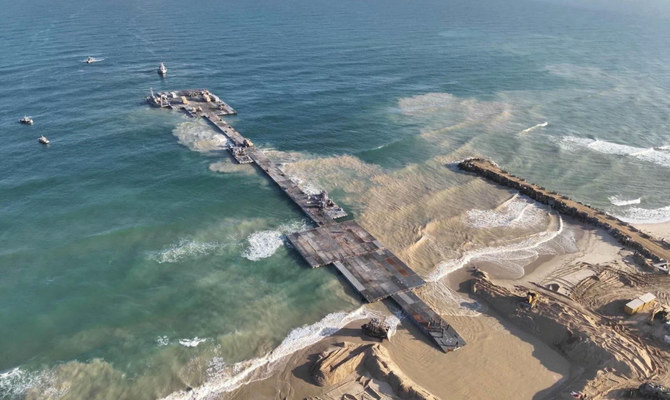
WASHINGTON: The controversial US effort to boost Gaza aid deliveries by building a temporary pier has faced repeated problems, with bad weather damaging the structure and causing other interruptions to the arrival of desperately needed assistance.
More than 4,100 metric tons (nine million pounds) of aid has been delivered via the $230 million pier project so far, but it has only been operational for limited periods, falling short of President Joe Biden’s pledge that it would enable a “massive increase” in assistance reaching Gaza “every day.”
The coastal territory has been devastated by more than eight months of Israeli operations against Palestinian militant group Hamas, uprooting Gaza’s population and leaving them in dire need of aid.
“The Gaza pier regretfully amounted to an extremely expensive distraction from what is truly needed, and what is also legally required,” said Michelle Strucke, director of the Center for Strategic and International Studies Humanitarian Agenda.
That is “safe and unimpeded humanitarian access for humanitarian organizations to provide aid for a population in Gaza that is suffering historic levels of deprivation,” she said.
US forces have also dropped aid by air, but that plus deliveries via the pier “were never meant to substitute for scaled, sustainable access to land crossings that provided safe access by humanitarian workers to provide aid,” Strucke said.
“Pursuing them took away decision makers’ time, energy, and more than $200 million US taxpayer dollars.”
Biden announced during his State of the Union address in March that the US military would establish the pier and American troops began constructing it the following month, initially working offshore.
But in a sign of issues to come, high seas and winds required construction to be relocated to the Israeli port of Ashdod.
The pier was completed in early May, but weather conditions meant it was unsafe to immediately move it into place, and it was not attached to the Gaza coast until the middle of the month.
High seas caused four US Army vessels supporting the mission to break free of their moorings on May 25, beaching two of them, and the pier was damaged by bad weather three days later, requiring sections to be repaired and rebuilt at Ashdod.
It was reattached to the coast on June 7, but aid deliveries were soon paused for two days due to bad weather conditions.
The pier then had to be removed from the shore and moved to Ashdod on June 14 to protect it from high seas. It was returned to Gaza this week and aid deliveries have now resumed.
Raphael Cohen, a senior political scientist at the RAND Corporation research group, said the “pier effort has yet to produce the results that the Biden administration hoped.”
“Aside from the weather issues, it’s been quite expensive and has not fixed the operational challenges of getting aid into Gaza,” he said.
Cohen said that despite the issues with the pier, it does provide another entry point for aid and allows assistance to be brought in even when land crossings are closed — a persistent problem that has worsened the dire humanitarian situation in Gaza.
And he said the effort may also help improve future deployments of the military’s temporary pier capability, which was last used operationally more than a decade ago in Haiti.
In addition to weather, the project is facing a major challenge in terms of the distribution of aid that arrives via the pier, which the UN World Food Programme decided to halt while it assesses the security situation — an evaluation that is still ongoing.
That announcement came after Israel conducted a nearby operation earlier this month that freed four hostages but which health officials in Hamas-ruled Gaza said killed more than 270 people.
The UN has said it welcomes all efforts to bring in aid, but that land routes are the most important routes for the arrival of assistance.
Strucke emphasized that “what Gazans need is not the appearance of aid — they need actual aid to reach them.”
Washington “should be very careful not to support actions that may look good on paper to increase routes to provide assistance, but do not result in aid actually reaching Palestinians in need at scale,” she said.


![]()


US’s Gaza aid pier effort hit by repeated setbacks
Short Url
https://arab.news/rgjpq
US’s Gaza aid pier effort hit by repeated setbacks
- The UN has said it welcomes all efforts to bring in aid, but that land routes are the most important routes for the arrival of assistance


Iran missile barrage sparks explosions over Tel Aviv
TEL AVIV: The latest Iranian missile barrage sparked a wave of explosions across Tel Aviv as firefighters worked to contain a blaze at a residential building near Israel’s commercial hub on Friday.
The blasts came after Israel expanded its campaign against Hezbollah, vowing retribution against the Tehran-backed militant group for joining the conflict following the killing on Saturday of Iran’s supreme leader, Ayatollah Ali Khamenei.
Iran’s state broadcaster said Tehran had fired missiles “against targets in the heart of Tel Aviv,” after Israel’s military said it was working to intercept incoming Iranian fire late Thursday.
AFP journalists in Tel Aviv heard two near-simultaneous waves of explosions reverberating across the city.
Rocket trails also lit up the sky in Netanya, a city north of Tel Aviv on Israel’s Mediterranean coast.
After the barrage, Israel’s emergency services, the Magen David Adom (MDA), said its teams had visited several reported impact sites but that there were no casualties.
Israeli police said it was “currently handling scenes involving fallen projectiles in central Israel,” adding that there was “damage” but no injuries.
A projectile hit a building on the outskirts of Tel Aviv, forcing residents to evacuate.
At another residential site near Israel’s economic hub, firefighters worked to put out a blaze caused by falling debris after an Iranian rocket fire was intercepted.
Israel’s Home Front Command issues several rocket fire warnings early Friday for communities near the Lebanon border.
The blasts came after Israel expanded its campaign against Hezbollah, vowing retribution against the Tehran-backed militant group for joining the conflict following the killing on Saturday of Iran’s supreme leader, Ayatollah Ali Khamenei.
Iran’s state broadcaster said Tehran had fired missiles “against targets in the heart of Tel Aviv,” after Israel’s military said it was working to intercept incoming Iranian fire late Thursday.
AFP journalists in Tel Aviv heard two near-simultaneous waves of explosions reverberating across the city.
Rocket trails also lit up the sky in Netanya, a city north of Tel Aviv on Israel’s Mediterranean coast.
After the barrage, Israel’s emergency services, the Magen David Adom (MDA), said its teams had visited several reported impact sites but that there were no casualties.
Israeli police said it was “currently handling scenes involving fallen projectiles in central Israel,” adding that there was “damage” but no injuries.
A projectile hit a building on the outskirts of Tel Aviv, forcing residents to evacuate.
At another residential site near Israel’s economic hub, firefighters worked to put out a blaze caused by falling debris after an Iranian rocket fire was intercepted.
Israel’s Home Front Command issues several rocket fire warnings early Friday for communities near the Lebanon border.
Latest updates


© 2026 SAUDI RESEARCH & PUBLISHING COMPANY, All Rights Reserved And subject to Terms of Use Agreement.