

South Sudan’s vice president expresses concern over ongoing peace talks

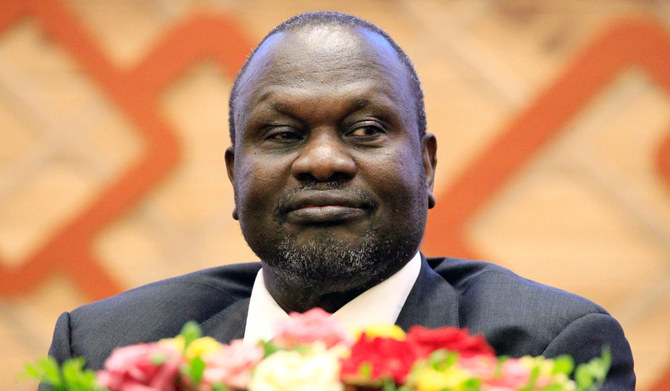
South Sudan rebel leader Riek Machar Kiir attends the signing in Khartoum, Sudan of an accord with the South Sudan government aimed at ending the country's civil war, June 27, 2018. (REUTERS)
Short Url
Updated 21 June 2024
Follow

South Sudan’s vice president expresses concern over ongoing peace talks

  • The former rebel leader signed an agreement with President Salva Kiir in 2018 that ended a five-year civil war that killed about 400,000 people

JUBA, South Sudan: South Sudan ‘s vice president said Thursday that peace talks in neighboring Kenya have failed to acknowledge the country’s peace agreement established in 2018, alleging a new draft agreement is aimed at replacing the original peace deal.
Riek Machar in a protest letter to the talks’ mediator said the draft established alternative institutions to replace or run in parallel with those established by the previous peace agreement. He added that the current peace talks should complement and not obliterate the original deal.
The former rebel leader signed an agreement with President Salva Kiir in 2018 that ended a five-year civil war that killed about 400,000 people. Machar and Kiir were on opposite sides in the war and Machar was appointed vice president after the 2018 deal. His group isn’t part of the current talks, which are for groups that were not included in the 2018 agreement.
Despite the peace deal, violence in South Sudan has continued, most of it attributed to rebel groups and warring ethnic groups.
The body mandated with monitoring the implementation of the 2018 peace deal raised concerns in May over the slow implementation of election related tasks with only a few months left until December elections.
Opposition groups that were not part of the 2018 peace agreement have been in talks in Kenya since May 9 aimed at bringing groups on board ahead of the December elections.
The talks have resulted in a draft agreement that recommends an extension of the transitional period to provide more time for election preparations.
President Kiir on Thursday received a progress report from government representatives in the ongoing talks with the government spokesperson telling media that participants in the talks are close to reaching a final agreement.


Iran unrest persists, top judge warns protesters

Updated 08 January 2026
Follow

Iran unrest persists, top judge warns protesters

  • Demonstrations sparked by soaring inflation
  • Western provinces worst affected

DUBAI: Iran’s top judge warned protesters on Wednesday there would be “no ​leniency for those who help the enemy against the Islamic Republic,” while accusing Israel and the US of pursuing hybrid methods to disrupt the country.
The current protests, the biggest wave of dissent in three years, began last month in Tehran’s Grand Bazaar by shopkeepers condemning the currency’s free fall. 
Unrest has since spread nationwide amid deepening distress over economic hardships, including rocketing inflation driven by mismanagement and Western sanctions, and curbs on political and ‌social freedoms.
“Following announcements ‌by Israel and the US president, there is no excuse for those coming ‌to the ​streets for ‌riots and unrest, chief justice Gholamhossein Mohseni Ejei, the head of Iran’s judiciary, was quoted as saying by state media.
“From now on, there will be no leniency for whoever helps the enemy against the Islamic Republic and the calm of the people,” Ejei said.
Iranian authorities have not given ‌a death toll for protesters, but have said at least two members of the security services have died and more than a dozen have been injured.
Iran’s western provinces have witnessed the most violent protests.
“During the funeral of two people ​in Malekshahi on Tuesday, a number of attendees began chanting harsh, anti-system slogans,” said Iran’s Fars, news agency.
After the funeral, Fars said, “about 100 mourners went into the city and trashed three banks ... Some started shooting at the police trying to disperse them.”
The semi-official Mehr news agency said protesters stormed a food store and emptied bags of rice, which has been affected by galloping inflation that has made ordinary staples increasingly unaffordable for many Iranians.