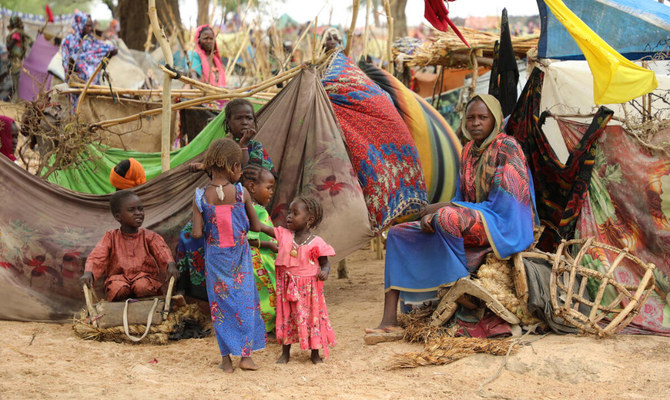
CAIRO: South Darfur saw a slight increase in critical aid when the UN’s World Food Program delivered life-saving food and nutrition to some families across the violence-riddled western Sudanese state, the organization said. But more assistance is needed, humanitarian organizations say.
The WFP mission in Sudan said Tuesday that more than 50,000 people in hunger hotspots across South Darfur are receiving much-needed food assistance in collaboration with relief agency World Vision.
WFP didn’t give a time frame for when the aid was distributed or say how WFP delivered the supplies. Several spokespersons for the organization did not immediately respond to requests for additional information.
Famine looms in parts of Sudan, which has been engulfed by violence since April of last year, when tensions between the Sudanese military and the paramilitary Rapid Support Forces erupted into intense fighting across the country.
“The number of people in South Darfur that suffer from hunger is vast and on top of that, there is a significant shortage of funds,” Yonas Mesele, deputy country director for Sudan with the French humanitarian organization Action Against Hunger, told The Associated Press on Wednesday.
Mesele said that of the estimated $581.2 million needed to meet humanitarian needs in Sudan, only 26 percent was secured, citing an announcement at a meeting for the Food Security and Livelihoods Cluster Coordination on June 13.
The fighting in Sudan has displaced over 4.6 million people, according to the UN migration agency, including more than 3.6 million who were internally displaced and over 1 million others who fled to neighboring countries.
Violence in Sudan quickly extended to the Darfur region in the country’s west, which has seen some of the most brutal attacks since the conflict began. The population in the state of South Darfur is at risk of soon dying from hunger, a recent report by a Dutch think-tank warned.
The Clingendael Institute report said last month that around 2.5 million people in Sudan could die from hunger by the end of September 2024, with about 15 percent of the population in the regions of Darfur and Kordofan being likely the worst affected.
“Time is running out to avoid a rapid deterioration of the conflict-induced food insecurity crisis,” Samy Guessabi, country director for Sudan with Action Against Hunger, told the AP. “The international community and the parties to the conflict must take immediate action to alleviate hunger and prevent a catastrophic malnutrition emergency.”
In May, the WFP said in a report that at least 1.7 million people are already experiencing emergency levels of hunger in Darfur, including in Al Fasher, the capital of North Darfur state that is besieged by RSF.
Despite the “devastating levels of hunger” that civilians are facing in the greater Darfur region, deliveries of food assistance have been “intermittent due to fighting and endless bureaucratic hurdles,” WFP said.
In April, the UN said it started distributing food in Darfur for the first time in months.


![]()

Some life-saving food assistance entered South Darfur, UN says, but aid groups say more is needed
Short Url
https://arab.news/nvydm
Some life-saving food assistance entered South Darfur, UN says, but aid groups say more is needed
- Violence in Sudan quickly extended to the Darfur region in the country’s west, which has seen some of the most brutal attacks since the conflict began


Latest updates


© 2026 SAUDI RESEARCH & PUBLISHING COMPANY, All Rights Reserved And subject to Terms of Use Agreement.