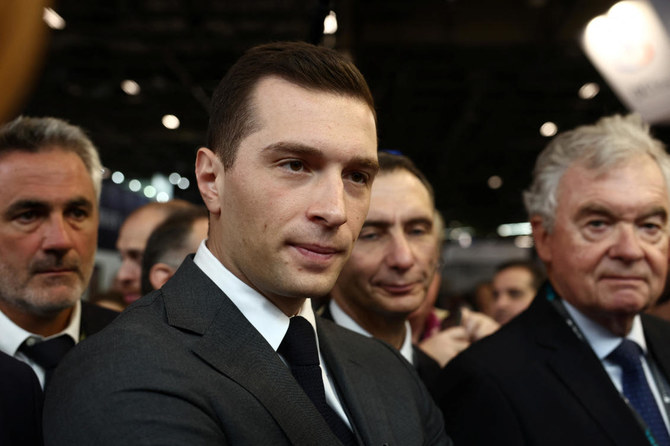
PARIS: French far-right leader Jordan Bardella said he would turn down the chance to be prime minister if voters do not hand his party an absolute majority in a parliamentary election.
Opinion polls see Bardella’s euroskeptic, anti-immigration National Rally (RN) winning the June 30 and July 7 ballot following President Emmanuel Macron’s decision this month to dissolve parliament.
But the absolute majority that would guarantee its ability to govern and pass laws without allies could be out of reach.
“If tomorrow I’m in a position to be appointed to the Matignon (prime minister’s office) and I do not have an absolute majority because the French have not given me an absolute majority, I will refuse to be appointed,” Bardella told France 2 TV late on Tuesday.
The RN has said 28-year-old Bardella would be its choice for prime minister, rather than long-time leader Marine Le Pen, who would be its candidate for the 2027 presidential election.
“I tell the French people that to act, I need an absolute majority,” Bardella told reporters on Wednesday. “A prime minister ... with a relative majority cannot change things, I would not be able to act in the daily lives of French people, on the country’s policies.”
Macron’s centrist party has been running a minority government since it won most seats, but lost its absolute majority, two years ago.
But it could be more difficult to run a minority government this time, with pollsters seeing parliament divided into three groups — the far right, Macron’s centrist group, and a left-wing alliance.
The French constitution says the president appoints the prime minister, but it does not say which criteria he should use. This means Macron has a range of options.
If the RN wins the election without an absolute majority but does not want to run the government, Macron could offer the prime minister’s post to the second-biggest party or try to pull together a coalition of mainstream parties.
Whatever the scenario, there could be a risk of political paralysis, analysts say.
The constitution says there can be no new parliamentary election for another year, so a repeat election is not an option.


![]()

I won’t take PM role without an absolute majority, says French far-right leader Bardella
Short Url
https://arab.news/6rj8k
I won’t take PM role without an absolute majority, says French far-right leader Bardella
- The absolute majority that would guarantee its ability to govern and pass laws without allies could be out of reach.
- The RN has said 28-year-old Bardella would be its choice for prime minister, rather than long-time leader Marine Le Pen


Latest updates


© 2026 SAUDI RESEARCH & PUBLISHING COMPANY, All Rights Reserved And subject to Terms of Use Agreement.