

Unveiling Tunis: mural celebrates ‘invisible’ talents

1 / 5
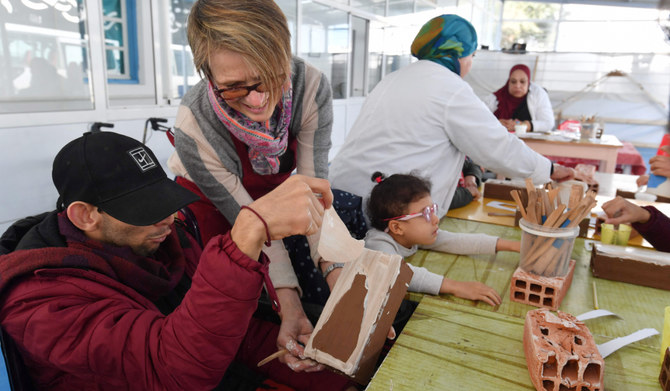
A group of young people with disabilities participate in the creation of a collaborative work of art at an institute that offers educational, artistic and social programs in La Marsa, a suburb of Tunis, on February 22, 2024. (AFP)
2 / 5
A group of young people with disabilities participate in the creation of a collaborative work of art at an institute that offers educational, artistic and social programs in La Marsa, a suburb of Tunis, on February 22, 2024. (AFP)
3 / 5
Swiss artist Anne Francey instructs a group of young people with disabilities during a session of collaborative work of art at an institute that offers educational, artistic and social programs in La Marsa, a suburb of Tunis, on February 22, 2024. (AFP)
4 / 5
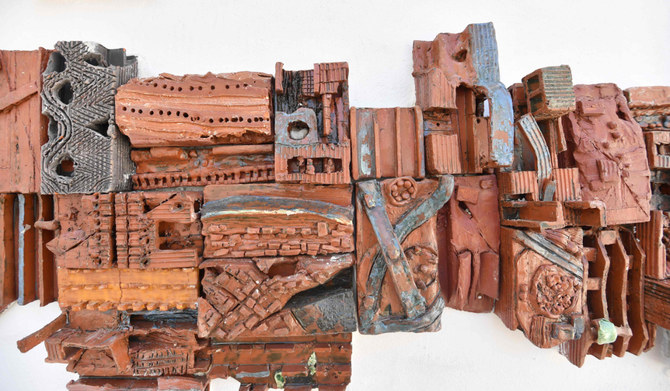
Artistic bricks are displayed at the inauguration of the '1001 Bricks Fresco', a participatory artwork by more than 500 inhabitants of Tunis led by Swiss artist Anne Francey, illustrating the diversity of the city, with the bas relief installed on the edge of the medina, the old town listed by UNESCO, in the capital's El-Hafsia district on June 7, 2024. (AFP)
5 / 5
A group of young people with disabilities participate in the creation of a collaborative work of art at an institute that offers educational, artistic and social programs in La Marsa, a suburb of Tunis, on February 22, 2024. (AFP)
Short Url
Updated 19 June 2024
Follow

Unveiling Tunis: mural celebrates ‘invisible’ talents

  • Supported by a Swiss foundation, the project utilized clay bricks for their availability and wide use in Tunisian construction

TUNIS: In the old medina of Tunis, a wall installation titled “1001 Bricks” showcases the talents of “invisible” creators, including art students, people with disabilities and school dropouts.
Led by Swiss artist Anne Francey, the project took shape over a year through workshops that culminated in a large bas-relief made of carved and painted clay bricks, reimagining the cityscape.
The massive artwork now graces a square in the UNESCO-listed old town of the Tunisian capital.
Its main creators are “the invisible, all these people who are on the margins of society, who have disabilities” and whom “we tend keep in the shadows and not really acknowledge,” said Francey, 68.
Despite challenges, the project engaged a wide spectrum of 550 participants including art professionals, students and members of AGIM, an association for people with motor disorders.
Mohamed Boulila, an AGIM trainer, said all those who contributed to the project left a personal touch.
“We have the power to do things despite everything and show society that we shouldn’t only be considered disabled,” Boulila, who also lives with a disability, said during a workshop.

Samia Souid, 56, a longtime teacher at AGIM, said the project had a positive impact on youths.
“Children who cannot speak expressed their feelings and their ideas” through the project, she said.
Each group of creators “imagined a metaphorical city,” with AGIM participants focusing on a city of challenges, producing sculptures akin to contemporary art.
Supported by a Swiss foundation, the project utilized clay bricks for their availability and wide use in Tunisian construction.
The initiative follows Francey’s 2019 project “1001 Hands,” inspired by the “One Thousand and One Nights” fairytale, emphasising stories that intersect endlessly, she said.
Francey noted the rarity and difficulty, on a global scale, of such a “participatory art project,” since it challenges the tradition of top-down artworks.
The installation helped blend the creations of “people of all social status,” from architecture students to youths in reintegration — people facing unemployment, substance abuse and other forms of social invisibility.
It is “a way of coming together around a constructive project that makes us dream of a harmonious society despite the hardships the country is going through,” she said.

Beyond that, the mural is a statement on public space, as the square it occupies has endured years of neglect, serving as a garbage dump and parking lot until recent renovations.
Raouf Haddad, a 42-year-old porter in the commercial neighborhood of Hafsia, said he checks in on the artwork every day and helps whenever needed.
“The entire medina should have initiatives like this,” he said.
“There are collapsing roofs and walls, alleys devoid of public lighting where people cannot pass.”
He hopes the square will one day become like Batman Alley — a once-neglected passageway in Brazil’s Sao Paulo which artists turned into a tourist attraction with a myriad of graffiti tags.
For now, however, what matters most is that “1001 Bricks will lead to new projects” in a neighborhood full of “abandoned and unexploited public spaces,” said Firas Khlifi, a 28-year-old project manager working on children’s awareness on global warming in the neighborhood.
The installation “will bring more animation because there are several festivals” in the medina each year likely to use the square for artistic performances and exhibitions, said Khlifi.
“With families there and children playing, it will increase the community’s commitment and belonging to the project.”


In southeast Pakistan, Ramadan brings Hindus and Muslims closer

Updated 11 March 2026
Follow

In southeast Pakistan, Ramadan brings Hindus and Muslims closer

MITHI: Partab Shivani, a Hindu in Muslim-majority Pakistan, has fasted on and off during Ramadan for years, but this time is different as he practices abstinence for the entire holy month.
Every year, he and his friends in the southeastern city of Mithi arrange iftar, when Muslims break their daily fast, to foster peace and solidarity between the two religions.
“I believe we need to promote interfaith harmony. First, we are humans — religions came later,” Shivani, a 48-year-old social activist, told AFP, adding that he also reads the teachings of the Buddha.
“His message is about peace and ending war. Peace can spread through solidarity and by standing with one another. Distance only widens the gap between people,” he added.
Ninety-six percent of Pakistan’s 240 million people are Muslim. Just two percent are Hindu, most of them living in rural areas of Sindh province where Mithi is located.
In Mithi itself, most of the 60,000 inhabitants are Hindu.
Many of the city’s Hindus also observe Ramadan and iftar has become a social gathering where people from both faiths happily participate.
“This has been a wonderful tradition of ours for a very long time,” said Mir Muhammad Buledi, a 51-year-old Muslim friend who attended Shivani’s iftar gathering.
“It is a beautiful example of harmony between the two communities.”
Like brothers
Discrimination against minorities runs deep in Pakistan.
Following the end of British rule in South Asia in 1947, the subcontinent was partitioned into mainly Hindu India and Muslim-majority Pakistan.
That triggered widespread religious bloodshed in which hundreds of thousands were killed and millions displaced.
According to the Human Rights Commission of Pakistan, freedom of religion or belief is under constant threat, with religiously motivated violence and discrimination increasing yearly.
State authorities, often using religious unrest for political gain, have failed to address the crisis, the independent non-profit says.
But such tensions are absent in Mithi.
“I am a Hindu but I keep all the fasts during this month,” said Sushil Malani, a local politician. “I feel happy standing with my Muslim brothers.
“We celebrate Eid together as well. This tradition in the region is very old.”
Restaurants and tea stalls are closed across Pakistan during Ramadan.
Ramesh Kumar, a 52-year-old Hindu man who sells sweets and savoury items outside a Muslim shrine, keeps his push cart covered and closed until iftar.
“There is no discrimination among us if someone is Muslim or Hindu. I have been seeing this since my childhood that we all live together like brothers,” he said.
Muslim shrine, Hindu caretaker
Locals say Mithi’s peaceful religious coexistence can be traced to its remote location, emerging from the sand dunes of the Tharparkar desert, which borders the modern Indian state of Rajasthan.
Cows — considered sacred in Hinduism — roam freely in Mithi city, as they do in neighboring India.
At two Sufi Muslim shrines in the middle of the city, Hindu families arrange meals, bringing fruit, meals and juices for their Muslim neighbors to break their fasts.
“We respect Muslims,” said Mohan Lal Malhi, a Hindu caretaker of one of the shrines.
Mohan said his parents and elders taught him to respect people regardless of religion or color, and the traditions pass from one generation to the next.
Local residents said both communities consider their social relationships more important than their religious identity.
“You will see a (Sikh) gurdwara, a mosque, and a shrine standing side by side here,” Mohan said. “The atmosphere of this area teaches humanity.”