

Unveiling Tunis: mural celebrates ‘invisible’ talents

1 / 5
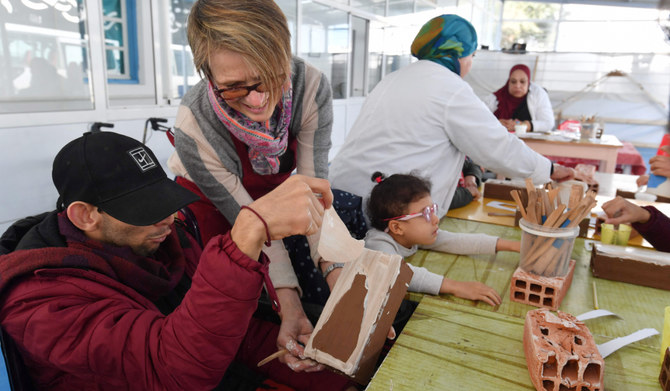
A group of young people with disabilities participate in the creation of a collaborative work of art at an institute that offers educational, artistic and social programs in La Marsa, a suburb of Tunis, on February 22, 2024. (AFP)
2 / 5
A group of young people with disabilities participate in the creation of a collaborative work of art at an institute that offers educational, artistic and social programs in La Marsa, a suburb of Tunis, on February 22, 2024. (AFP)
3 / 5
Swiss artist Anne Francey instructs a group of young people with disabilities during a session of collaborative work of art at an institute that offers educational, artistic and social programs in La Marsa, a suburb of Tunis, on February 22, 2024. (AFP)
4 / 5
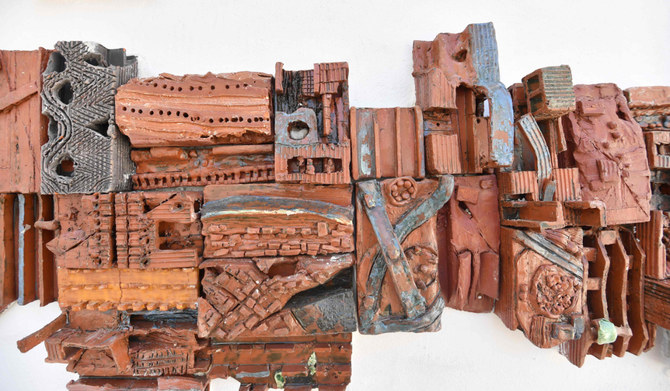
Artistic bricks are displayed at the inauguration of the '1001 Bricks Fresco', a participatory artwork by more than 500 inhabitants of Tunis led by Swiss artist Anne Francey, illustrating the diversity of the city, with the bas relief installed on the edge of the medina, the old town listed by UNESCO, in the capital's El-Hafsia district on June 7, 2024. (AFP)
5 / 5
A group of young people with disabilities participate in the creation of a collaborative work of art at an institute that offers educational, artistic and social programs in La Marsa, a suburb of Tunis, on February 22, 2024. (AFP)
Short Url
Updated 19 June 2024
Follow

Unveiling Tunis: mural celebrates ‘invisible’ talents

  • Supported by a Swiss foundation, the project utilized clay bricks for their availability and wide use in Tunisian construction

TUNIS: In the old medina of Tunis, a wall installation titled “1001 Bricks” showcases the talents of “invisible” creators, including art students, people with disabilities and school dropouts.
Led by Swiss artist Anne Francey, the project took shape over a year through workshops that culminated in a large bas-relief made of carved and painted clay bricks, reimagining the cityscape.
The massive artwork now graces a square in the UNESCO-listed old town of the Tunisian capital.
Its main creators are “the invisible, all these people who are on the margins of society, who have disabilities” and whom “we tend keep in the shadows and not really acknowledge,” said Francey, 68.
Despite challenges, the project engaged a wide spectrum of 550 participants including art professionals, students and members of AGIM, an association for people with motor disorders.
Mohamed Boulila, an AGIM trainer, said all those who contributed to the project left a personal touch.
“We have the power to do things despite everything and show society that we shouldn’t only be considered disabled,” Boulila, who also lives with a disability, said during a workshop.

Samia Souid, 56, a longtime teacher at AGIM, said the project had a positive impact on youths.
“Children who cannot speak expressed their feelings and their ideas” through the project, she said.
Each group of creators “imagined a metaphorical city,” with AGIM participants focusing on a city of challenges, producing sculptures akin to contemporary art.
Supported by a Swiss foundation, the project utilized clay bricks for their availability and wide use in Tunisian construction.
The initiative follows Francey’s 2019 project “1001 Hands,” inspired by the “One Thousand and One Nights” fairytale, emphasising stories that intersect endlessly, she said.
Francey noted the rarity and difficulty, on a global scale, of such a “participatory art project,” since it challenges the tradition of top-down artworks.
The installation helped blend the creations of “people of all social status,” from architecture students to youths in reintegration — people facing unemployment, substance abuse and other forms of social invisibility.
It is “a way of coming together around a constructive project that makes us dream of a harmonious society despite the hardships the country is going through,” she said.

Beyond that, the mural is a statement on public space, as the square it occupies has endured years of neglect, serving as a garbage dump and parking lot until recent renovations.
Raouf Haddad, a 42-year-old porter in the commercial neighborhood of Hafsia, said he checks in on the artwork every day and helps whenever needed.
“The entire medina should have initiatives like this,” he said.
“There are collapsing roofs and walls, alleys devoid of public lighting where people cannot pass.”
He hopes the square will one day become like Batman Alley — a once-neglected passageway in Brazil’s Sao Paulo which artists turned into a tourist attraction with a myriad of graffiti tags.
For now, however, what matters most is that “1001 Bricks will lead to new projects” in a neighborhood full of “abandoned and unexploited public spaces,” said Firas Khlifi, a 28-year-old project manager working on children’s awareness on global warming in the neighborhood.
The installation “will bring more animation because there are several festivals” in the medina each year likely to use the square for artistic performances and exhibitions, said Khlifi.
“With families there and children playing, it will increase the community’s commitment and belonging to the project.”


These shy, scaly anteaters are the most trafficked mammals in the world

Updated 21 February 2026
Follow

These shy, scaly anteaters are the most trafficked mammals in the world

CAPE TOWN, South Africa: They are hunted for their unique scales, and the demand makes them the most trafficked mammal in the world.
Wildlife conservationists are again raising the plight of pangolins, the shy, scaly anteaters found in parts of Africa and Asia, on World Pangolin Day on Saturday.
Pangolins or pangolin products outstrip any other mammal when it comes to wildlife smuggling, with more than half a million pangolins seized in anti-trafficking operations between 2016 and 2024, according to a report last year by CITES, the global authority on the trading of endangered plant and animal species.
The World Wildlife Fund estimates that over a million pangolins were taken from the wild over the last decade, including those that were never intercepted.
Pangolins meat is a delicacy in places, but the driving force behind the illegal trade is their scales, which are made of keratin, the protein also found in human hair and fingernails. The scales are in high demand in China and other parts of Asia due to the unproven belief that they cure a range of ailments when made into traditional medicine.
There are eight pangolin species, four in Africa and four in Asia. All of them face a high, very high or extremely high risk of extinction.
While they’re sometimes known as scaly anteaters, pangolins are not related in any way to anteaters or armadillos.
They are unique in that they are the only mammals covered completely in keratin scales, which overlap and have sharp edges. They are the perfect defense mechanism, allowing a pangolin to roll up into an armored ball that even lions struggle to get to grip with, leaving the nocturnal ant and termite eaters with few natural predators.
But they have no real defense against human hunters. And in conservation terms, they don’t resonate in the way that elephants, rhinos or tigers do despite their fascinating intricacies — like their sticky insect-nabbing tongues being almost as long as their bodies.
While some reports indicate a downward trend in pangolin trafficking since the COVID-19 pandemic, they are still being poached at an alarming rate across parts of Africa, according to conservationists.
Nigeria is one of the global hot spots. There, Dr. Mark Ofua, a wildlife veterinarian and the West Africa representative for the Wild Africa conservation group, has rescued pangolins for more than a decade, which started with him scouring bushmeat markets for animals he could buy and save. He runs an animal rescue center and a pangolin orphanage in Lagos.
His mission is to raise awareness of pangolins in Nigeria through a wildlife show for kids and a tactic of convincing entertainers, musicians and other celebrities with millions of social media followers to be involved in conservation campaigns — or just be seen with a pangolin.
Nigeria is home to three of the four African pangolin species, but they are not well known among the country’s 240 million people.
Ofua’s drive for pangolin publicity stems from an encounter with a group of well-dressed young men while he was once transporting pangolins he had rescued in a cage. The men pointed at them and asked him what they were, Ofua said.
“Oh, those are baby dragons,” he joked. But it got him thinking.
“There is a dark side to that admission,” Ofua said. “If people do not even know what a pangolin looks like, how do you protect them?”