

India to investigate railway collision that killed nine, injured dozens

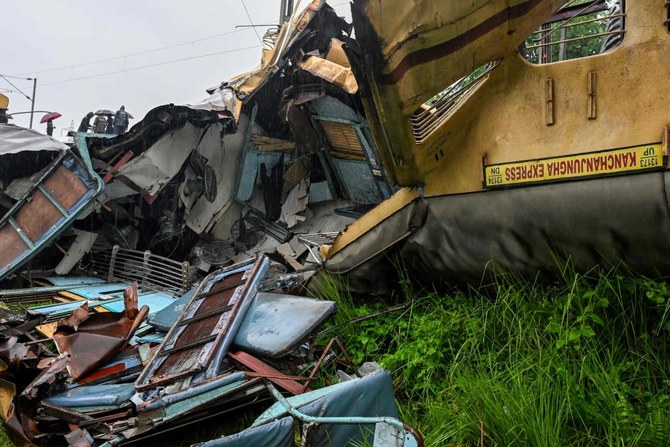
The freight train driver disregarded a signal, leading to the crash with the Kanchanjunga Express, which had halted near a railway station in the district of Darjeeling, according to India’s top railway official. (AFP)
Short Url
Updated 18 June 2024
Follow

India to investigate railway collision that killed nine, injured dozens

  • Death toll revised down to nine from 15 after Monday’s accident in the state of West Bengal
  • Freight train driver disregarded a signal, leading to the crash with the Kanchanjunga Express, which had halted near a railway station

KOLKATA, India: India will launch an investigation on Tuesday into a train collision that killed nine people in the state of West Bengal and injured more than 50, a day after a top railway official blamed the incident on driver error.

The death toll was revised down to nine from 15 after Monday’s accident, in which a freight train rammed into a passenger train heading for the state capital of Kolkata from the northeastern state of Tripura.

The investigation by India’s top railway safety official will start on Tuesday, Chetan Kumar Shrivastava, general manager of the Northeast Frontier railway, where the accident happened, told Reuters.

“The inquiry will involve eye-witness accounts, scrutiny of official documents and statements from railway officials, regarding signaling and other mandatory safety issues,” he added.

On Monday, India’s top railway official said the driver of the freight train, who was among the dead, disregarded a signal, leading to the crash with the Kanchanjunga Express, which had halted near a railway station in the district of Darjeeling.

There were 1,400 people aboard, a railway spokesperson said.

But media said an automatic signaling system had not been working from Monday morning, prompting authorities to advise train drivers to proceed slower than usual, in a process known as “paper signals.”

India’s opposition leaders criticized the railway safety record of Prime Minister Narendra Modi’s government, attributing it to negligence.

The incident came a little over a year after about 288 people were killed in one of India’s worst rail crashes in the neighboring state of Odisha, caused by a signaling error.

State-run Indian Railways, notorious for overcrowding, is the world’s fourth largest train network, carrying 13 million people a day, along with nearly 1.5 billion tons of freight in 2022.

In remarks to media on Monday, top railway official Jaya Varma Sinha, who chairs India’s railway board, called for human error to be reduced, adding that an anti-collision system was being set up nationwide.

Partial services resumed on the affected tracks on Tuesday, with some trains diverted and others running slower than usual, railway officials said.


35 million Nigerians ‘risk hunger after global funding collapse’

Updated 5 sec ago
Follow

35 million Nigerians ‘risk hunger after global funding collapse’

  • The UN can only aim to ‌deliver $516 million to provide lifesaving aid to 2.5 million people this year, down from 3.6 million in 2025, which in turn was about half the previous year’s level

ABUJA: Nearly 35 million Nigerians are at risk of hunger this year, including 3 million children facing severe malnutrition, ​the UN said, following the collapse of global aid budgets.
Speaking at the launch of the 2026 humanitarian plan in Abuja, UN Resident and Humanitarian Coordinator Mohammed Malick Fall said the long-dominant, foreign-led aid model in Nigeria is no longer sustainable and ‌that Nigeria’s ‌needs have grown. 
Conditions in ‌the conflict-hit ​northeast ‌are dire, Fall said, with civilians in Borno, Adamawa, and Yobe states facing rising violence. 

BACKGROUND

UN Resident and Humanitarian Coordinator Mohammed Malick Fall said the foreign-led aid model in Nigeria is no longer sustainable and ‌that the country’s needs have grown.

A surge in terror attacks killed more than 4,000 people in the first eight months of 2025, matching the toll for all of 2023, he said.
The UN can only aim to ‌deliver $516 million to provide lifesaving aid to 2.5 million people this year, down from 3.6 million in 2025, which in turn was about half the previous year’s level.
“These are not statistics. These numbers represent lives, futures, and Nigerians,” Fall said.
He also said ​the UN had no choice but to focus on “the most lifesaving” interventions given the drop in available funding. 
Shortfalls last year led the World Food Programme to also warn that millions could go hungry in Nigeria as its resources ran out in December and it was forced to cut support for more than 300,000 children. 
Fall said Nigeria was showing growing national ownership of the crisis response in recent months through measures such as local funding for ‌lean-season food support and early-warning action on flooding.