


The African National Congress said that South Africa’s new government has five parties in it so far, representing more than two-thirds of the seats in the National Assembly, and talks with other parties were ongoing.
Following last month’s election, the ANC was forced to forge alliances with other political parties after failing to win a parliamentary majority for the first since the 1994 election that marked the end of apartheid.
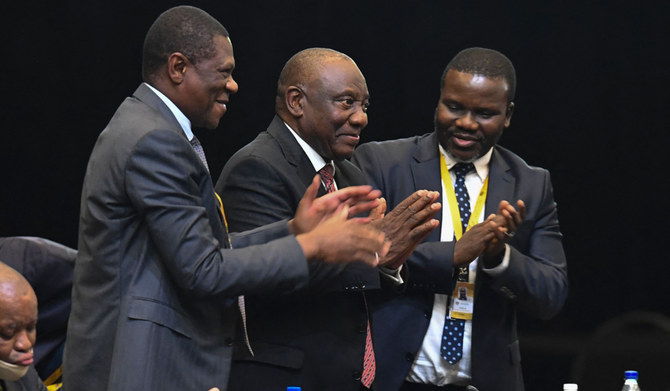
ANC leader Cyril Ramaphosa was reelected as South Africa’s president by parliament on Friday, as his party drew support from its largest rival, the white-led, pro-business Democratic Alliance, as well as two smaller parties — the socially conservative Inkatha Freedom Party and the right-wing Patriotic Alliance.
The ANC said on Monday that another smaller party, GOOD, had also signed up to be part of the unity government pact.
This collective represents 273 seats in the National Assembly or 68 percent, the ANC said in a statement.
South Africa’s parliament has 400 seats.
The ANC won 159 seats, the DA was the second-largest party with 87 seats, the IFP had 17 seats, the PA had 9 seats, and GOOD had a single seat.
The ANC said the unity government would ensure representation in government for all participating parties and would make decisions by consensus.
Among its priorities, the unity government is set to focus on rapid, inclusive, and sustainable economic growth, the promotion of fixed capital investment, job creation, land reform, and infrastructure development, the ANC said.
“The president will exercise the prerogative to appoint the Cabinet, in consultation with leaders of GNU (government of national unity) parties, adhering to existing protocols on government decision-making and budgeting,” the ANC said, adding it was still in discussions with more parties to join the government.
The Marxist Economic Freedom Fighters party, which has 39 seats, has said it will not be part of a government that includes the DA or the Freedom Front Plus — two parties that draw support from the white minority.
The uMkhonto we Sizwe party, led by former President Jacob Zuma, is also not part of the unity government.
With 58 seats in the National Assembly, it has said it will join an alliance of smaller opposition parties in parliament called the “Progressive Caucus,” which includes the EFF and the center-left United Democratic Movement.
This alliance will be the official opposition to the unity government.
“With populist parties choosing to reject the GNU, and the ANC’s bigger partners in the governing coalition center-leaning and favoring more liberal economic policies, we think the GNU opens the possibility for more growth-friendly structural reforms and prudent macroeconomic policy choices,” HSBC economist David Faulkner said in a note.
“But the GNU could also face ideological divisions and exacerbate fractures within the ANC, factors that could make establishing a stable policy framework difficult.”


