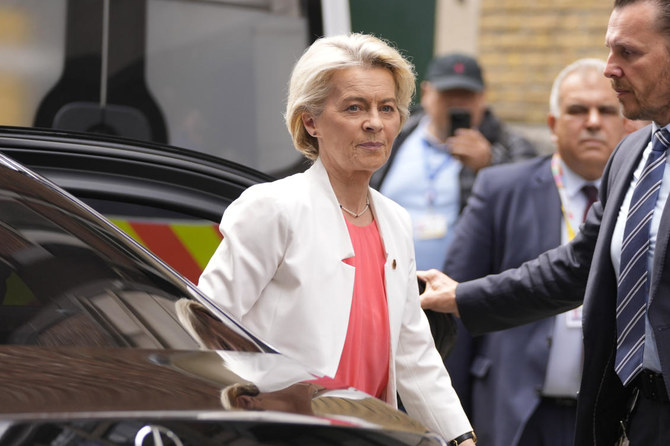
BRUSSELS: EU leaders meeting in Brussels Monday appeared increasingly to line up behind Ursula von der Leyen for a new term heading the powerful European Commission — but a push from her conservative camp for a bigger slice of the bloc’s top jobs threatened to drag out the horse-trading.
Far-right gains in EU-wide elections in early June, which triggered snap polls and political upheaval in France, had seemed to focus minds around the positions helming the bloc — negotiated with an eye to geographic and political balance.
Leaders were aiming to forge the contours of a deal on who takes the EU’s top three jobs — heading the commission, chairing summits, and stewarding the bloc’s diplomacy — before making a formal choice at a summit on June 27-28.
“I am sure we can find an agreement in the shortest possible time,” German Chancellor Olaf Scholz said as he arrived for the evening talks.
Dutch Prime Minister Mark Rutte echoed that, saying there seemed to be an “increasing amount of consensus” around the post of commission chief in particular.
But hopes of a quick agreement floundered after diplomats said leaders from von der Leyen’s center-right European People’s Party (EPP) made a surprise bid to split another of the top jobs.
The other roles to be decided are: president of the European Council, which represents member states and is currently filled by Charles Michel; and the “high representative” — the EU’s foreign policy chief — currently Josep Borrell.
The EPP was the biggest winner in the June 6-9 EU Parliament elections, cementing the German conservative’s bid for five more years leading the executive body of the world’s second-largest economy.
The second-biggest group in parliament, the Socialists and Democrats (S&D), had their sights set on the Council position, with Antonio Costa, Portugal’s 62-year-old former prime minister, seen as the frontrunner.
But Costa has a cloud hanging over him after he became embroiled in a corruption probe that forced his resignation, even if the case has since appeared to come apart.
Diplomats said EPP leaders suggested the council chief role should be split, with the socialists getting it for 2.5 years and the conservatives getting it for the rest of the five years.
“They are playing hardball,” said a European diplomat.
The high representative position, meanwhile, could go to Kaja Kallas, 46, current premier of Estonia and an outspoken Kremlin critic — in a strong signal to the EU’s east.
The bloc’s biggest eastern power Poland announced ahead of the talks that it was backing Kallas for the role.
A fourth job in play is that of European Parliament president, which is decided by the legislature, not the leaders.
It is likely to return to the incumbent, the EPP’s Roberta Metsola, 45, for another two-and-a-half-year term — but could form part of a swap deal with the socialists to oil the wheels.
To secure the nod from EU leaders, von der Leyen, 65, needs support from a “qualified majority” of 15 out of 27 countries, covering at least 65 percent of the bloc’s population.
A dozen leaders come from her EPP political grouping, but she also needs to win over Macron, from the centrist Renew Europe group, and Scholz of the S&D.
Both leaders of the French-German axis at the heart of the European Union have emerged weakened after being beaten by far-right parties in the EU Parliament elections.
Most spectacularly, in France the National Rally (RN) of Marine Le Pen trounced the party of the president, who now faces the prospect of the RN’s leader — the 28-year-old TikTok-friendly Jordan Bardella — potentially becoming his prime minister.
Conversely, the elections strengthened the hand of Italy’s prime minister, Giorgia Meloni, who diplomats suggest may want to let the dust settle in the new EU parliament — where her far-right party’s grouping gained seats and may yet gain more — and negotiate accordingly.
If, as expected, von der Leyen ultimately pockets enough leaders’ votes, she can set about choosing her commissioners — drawn from each of the EU member countries, with consideration for gender balance and political affiliation.
But she will have one more hurdle to pass: The new European Parliament has to approve leaders’ picks and proposed commissioners.
Most lawmakers from the EPP, which holds 190 seats in the incoming 720-seat parliament, will endorse von der Leyen, but she will need support from elsewhere to secure a majority.
That would likely come from the other mainstream political families, the S&D and Renew, or from the Greens — but von der Leyen has also been covering her bases by courting Meloni on the hard right.


![]()

Von der Leyen tipped for nod, as EU leaders haggle over top jobs
Short Url
https://arab.news/vcbdt
Von der Leyen tipped for nod, as EU leaders haggle over top jobs
- Leaders were aiming to forge the contours of a deal on who takes the EU’s top three jobs


Latest updates


© 2026 SAUDI RESEARCH & PUBLISHING COMPANY, All Rights Reserved And subject to Terms of Use Agreement.