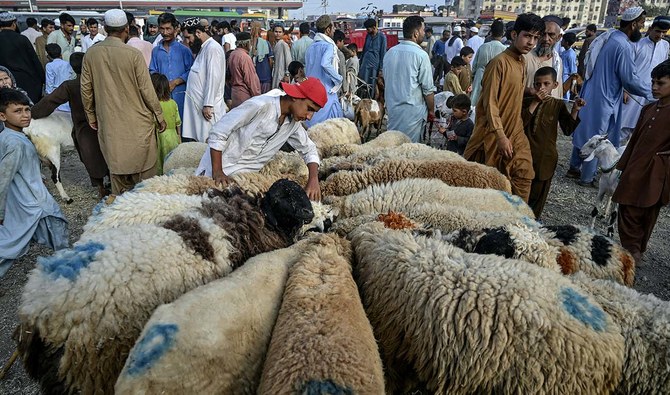
KARACHI: Pakistanis thronging markets to buy sacrificial cows, camels and goats for the upcoming Eid Al-Adha complained about rising prices of the livestock this week.
Pakistan has been beset by inflation above 20 percent since May 2022. Last year in May, inflation jumped as high as 38 percent as the country navigated reforms as part of an International Monetary Fund (IMF) bailout program.
While inflation has since tapered, at the main cattle market in Karachi, Pakistan’s biggest city, customers said they were still facing higher prices than last year.
“There is no impact of it (inflation slowing down). The prices are higher as compared to last year. The price of an animal that was up to 100,000 rupees ($358) last year is reaching 150,000 rupees ($537) this year,” said a customer, Mohammad Asif.
“It is the government’s claim that they have brought down the inflation whereas it is totally contrary to that here at the market. The prices are like three folds up as compared to last year,” said another buyer, Abdur-Rehman.
Trader Mohammad Chhuttal, who traveled some 540 km (336 miles) from the city of Ghotki to sell his cows and bulls in Karachi, said the impact of last year’s high inflation continued to be felt this year.
Traders said the inflation was hurting the purchasing power of ordinary consumers and noted that there were not only fewer customers in the market compared to last year, but that people would choose smaller animals.
Pakistan is in talks with IMF for a loan estimated to be anything between $6 billion to $8 billion to avert a default for an economy that is growing at the slowest pace in the region.
Pakistan narrowly averted a default last summer thanks to a short-term IMF bailout of $3 billion over nine months.
Muslims around the world celebrate the Eid holiday by slaughtering animals such as cattle and goats as they mark the willingness of Prophet Ibrahim to sacrifice his son on God’s command. The meat is shared among family and friends and donated to the poor.
The three-day festival of Eid Al-Adha, one of the two most important festivals on the Islamic calendar, will be celebrated from Monday (June 17) in Pakistan this year.


![]()

Pakistanis complain about high prices of sacrificial animals before Eid Al-Adha
Short Url
https://arab.news/8cqmw
Pakistanis complain about high prices of sacrificial animals before Eid Al-Adha
- Muslims celebrate Eid by slaughtering cattle, goats and cow to mark the willingness of Prophet Ibrahim to sacrifice his son on God’s command
- The three-day festival, one of the two most important festivals on the Islamic calendar, will be celebrated in Pakistan from June 17 this year
Latest updates


© 2026 SAUDI RESEARCH & PUBLISHING COMPANY, All Rights Reserved And subject to Terms of Use Agreement.