Moody’s highlights Pakistan’s persistent debt issues, says budget to aid IMF negotiations

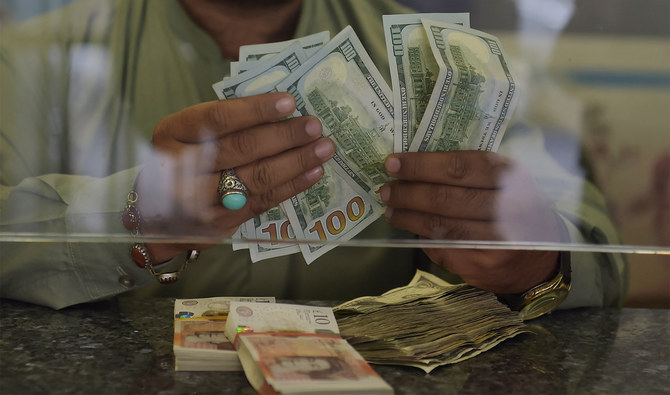
A Pakistani dealer counts US dollars at a currency exchange shop in Islamabad on October 9, 2018. (AFP/File)
Short Url
Updated 14 June 2024
Follow

Moody’s highlights Pakistan’s persistent debt issues, says budget to aid IMF negotiations

  • The global credit rating agency points toward additional taxes without significant cost-containment measures
  • It says sustaining economic reforms may become difficult amid risk of social disruption, coalition challenges

KARACHI: A leading global credit rating agency said on Friday Pakistan’s newly announced federal budget was likely to help the country with its ongoing negotiation with the International Monetary Fund (IMF), though it highlighted the country’s weak debt affordability and challenge of keeping economic reforms on track.

Moody’s Investors Service issued a brief assessment of Pakistan’s economy two days after Finance Minister Muhammad Aurangzeb presented the $67.76 billion federal budget in which he kept some high ambitious revenue generation targets.

The global agency noted the government sought to achieve quicker fiscal consolidation through increase in revenue, adding their were little spending containment measures.

“The announced budget will likely support Pakistan’s ongoing negotiations with the IMF for a new Extended Fund Facility (EFF) program that will be crucial for the government to unlock financing from IMF and other bilateral and multilateral partners to meet its external financing needs,” it said. “However, it will be the government’s ability to sustain reform implementation that will be key to allowing Pakistan to meet its budget targets and continually unlock external financing to meet its needs, leading to a durable easing of liquidity risks.”

“A resurgence of social tensions on the back of high cost of living (which may increase because of higher taxes and future adjustments to energy tariffs) could weigh on reform implementation,” it added. “Moreover, risks that the coalition government may not have a sufficiently strong electoral mandate to continually implement difficult reforms remain.”

Moody’s noted the government had set a challenging target to increase federal government revenue to PKR17.8 trillion, about 46 percent higher from a year ago.

It noted that this increase was led by a 40 percent increase in tax revenue that the government wanted to achieve through a combination of new taxes and stronger nominal growth.

“At the same time, the budget is targeting an overall federal government expenditure of PKR18.9 trillion, about 25 percent higher than a year ago,” it said. “The increase in expenditure reflects lack of significant cost-containment measures and Pakistan’s very high interest payments.”

It maintained the government had been spending more than half its revenue on interest payments, “indicating very weak debt affordability which drives high debt sustainability risks.”

“Having a significant share of its budget allocated toward debt payments will constrain the government’s capacity to service its debt while meeting essential social spending and infrastructure needs,” it added.


Pakistan’s JF-17 fighter jet draws ‘strong interest’ at Riyadh defense exhibition

Updated 13 sec ago
Follow

Pakistan’s JF-17 fighter jet draws ‘strong interest’ at Riyadh defense exhibition

  • Jets showcased as Pakistan seeks to expand defense exports
  • Interest in JF-17 has heightened after May 2025 conflict with India 

ISLAMABAD: Pakistan’s JF-17 Thunder fighter jet has drawn “strong interest” at the World Defense Exhibition in Riyadh, Pakistan’s state broadcaster said on Sunday, as Islamabad promotes the aircraft to international buyers at one of the region’s largest defense industry events.

The exhibition brings together defense officials, manufacturers and military delegations from dozens of countries, offering a platform for arms exporters to showcase equipment and pursue new contracts amid heightened global and regional security concerns.

Saudi Arabia has sought to position Riyadh as a regional hub for defense and aerospace exhibitions, using such events to foster partnerships and attract international manufacturers as part of broader diversification efforts. 

Last year Islamabad signed a mutual defense pact with Riyadh and is reportedly discussing another defense agreement involving Saudi Arabia and Turkiye, although details have not been made public.

“At the World Defense Exhibition in Riyadh, the Pakistan Air Force’s JF-17 Thunder has attracted strong interest from visitors and defense experts, standing out among fighter jets displayed by the US, Saudi Arabia and other countries,” state broadcaster Pakistan Television reported.

Islamabad is attending the exhibition in the backdrop of talks with at least 13 countries, six to eight of which are in an advanced stage, for deals involving JF-17 jets made jointly with China as well as training aircraft, drones, and weapons systems, according to recent media reports. 

Interest in the JF-17 jets has been bolstered by its operational visibility following the Pakistan-India military confrontation in May 2025, which Pakistani officials and defense analysts have cited as reinforcing the aircraft’s combat credibility.

Islamabad has increasingly positioned the JF-17 as a cost-effective multirole combat aircraft for countries seeking alternatives to high-end Western fighter jets. The aircraft is already in service with several foreign air forces and remains central to Islamabad’s defense export strategy.

Countries engaged in talks include Sudan, Saudi Arabia, Indonesia, Morocco, Ethiopia, and Nigeria as well as the government in eastern Libya led by Khalifa Haftar. Discussions on JF-17s and other weapons with Bangladesh and Iraq have been publicly acknowledged by Pakistan’s military, although more details have not been made public.

Almost all the potential buyers are Muslim-majority nations, like Pakistan. Many are from the predominantly Muslim Middle East, where Pakistan has historically been a security provider.