JERUSALEM: Israeli jets and artillery hit targets in southern Lebanon on Friday after dozens of missiles were launched toward northern Israel, the military said as an escalation in cross-border strikes continued for a third day.
Warning sirens sounded in border areas in northern Israel in the late morning as about 35 missiles were fired from southern Lebanon into the area around the border town of Kiryat Shmona.
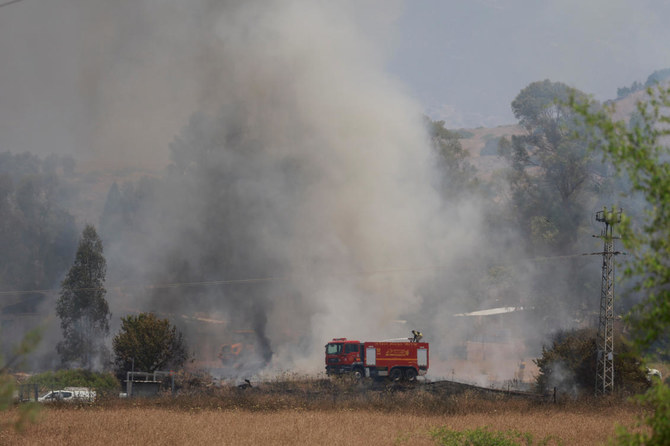
Television footage showed damaged buildings and cars as well as brush fires in several locations caused by strikes or falling debris amid heatwave conditions.
Warning sirens sounded and emergency services said teams were active in several areas but there were no reports of any casualties.
In response, the Israeli military said its artillery attacked launch sites operated by the Iranian-backed Hezbollah militia in southern Lebanon and Israeli jets also hit Hezbollah infrastructure in the areas of Odaisseh and Kfarkela.
The Israeli military has exchanged regular fire with Hezbollah forces across the border in southern Lebanon ever since the start of the war in Gaza in October.
Israeli strikes have killed more than 300 Hezbollah fighters in Lebanon — more than in 2006, when the sides last fought a major war, according to a Reuters tally. Around 80 civilians have also been killed, the tally says. Attacks from Lebanon have killed 18 Israeli soldiers and 10 civilians, Israel says.
Neither side has appeared to wish a wider conflict, but there has been growing worry that the steady intensification of strikes could push the situation out of control with the risk of a wider conflict in a region that has already seen direct exchanges between Israel and Iran.
The latest salvo came after an Israeli strike killed a senior commander from the Iranian-backed Hezbollah militia in southern Lebanon on Tuesday, drawing the heaviest bombardment of northern Israel since the start of the war in October last year.
Tens of thousands of residents have been evacuated from their homes on both sides of the border, creating growing pressure to resolve the stand-off, but diplomatic efforts have so far proved fruitless.
On Friday, the Israeli military said fighter jets and anti-aircraft systems had intercepted 11 of the 16 drones launched by Hezbollah against Israel in the past 72 hours.
“The Israeli Air Force is continuing to operate at all times to thwart terrorist activities and protect Israel’s skies from any threat,” it said in a statement.


![]()


Israeli jets strike targets in Lebanon after missile barrage hits northern areas
Short Url
https://arab.news/8gsdd
Israeli jets strike targets in Lebanon after missile barrage hits northern areas
- Warning sirens sounded in border areas in northern Israel in the late morning as about 35 missiles were fired from southern Lebanon
- In response, the Israeli military said its artillery attacked launch sites operated by the Iranian-backed Hezbollah militia


Iran urges US to drop ‘excessive demands’ to reach deal
- Longtime adversaries Iran and the United States held their third round of Omani-mediated nuclear talks on Thursday in Geneva
- Both Iran and Oman cited progress after the talks, with technical discussions scheduled for Monday in Vienna
TEHRAN: Iran’s Foreign Minister Abbas Araghchi said on Friday that in order to reach a deal, the United States will have to drop its “excessive demands,” after the two sides held talks in Geneva.
In a phone call with Egypt’s top diplomat Badr Abdelatty, Araghchi said “success in this path requires seriousness and realism from the other side and avoidance of any miscalculation and excessive demands.”
Araghchi did not clarify what demands he was referring to, but Washington has pointed to Iran’s ballistic missile program and has repeatedly described Tehran’s uranium enrichment capability as a red line.
US President Donald Trump said on Wednesday that Tehran had “already developed missiles that can threaten Europe and our bases overseas, and they’re working to build missiles that will soon reach the United States of America.”
Also on Wednesday, US Secretary of State Marco Rubio said Iran is “not enriching right now, but they’re trying to get to the point where they ultimately can,” adding that Tehran “refuses” to discuss its ballistic missile program and “that’s a big problem.”
Iran has repeatedly said its missile program is part of its defensive capabilities and has ruled out abandoning uranium enrichment, insisting its nuclear program is solely for peaceful purposes.
Longtime adversaries Iran and the United States held their third round of Omani-mediated nuclear talks on Thursday in Geneva, seeking to avert military escalation as Washington expands its military build-up in the region.
Both Iran and Oman cited progress after the talks, with technical discussions scheduled for Monday in Vienna ahead of a fourth round expected next week.
In a phone call with Egypt’s top diplomat Badr Abdelatty, Araghchi said “success in this path requires seriousness and realism from the other side and avoidance of any miscalculation and excessive demands.”
Araghchi did not clarify what demands he was referring to, but Washington has pointed to Iran’s ballistic missile program and has repeatedly described Tehran’s uranium enrichment capability as a red line.
US President Donald Trump said on Wednesday that Tehran had “already developed missiles that can threaten Europe and our bases overseas, and they’re working to build missiles that will soon reach the United States of America.”
Also on Wednesday, US Secretary of State Marco Rubio said Iran is “not enriching right now, but they’re trying to get to the point where they ultimately can,” adding that Tehran “refuses” to discuss its ballistic missile program and “that’s a big problem.”
Iran has repeatedly said its missile program is part of its defensive capabilities and has ruled out abandoning uranium enrichment, insisting its nuclear program is solely for peaceful purposes.
Longtime adversaries Iran and the United States held their third round of Omani-mediated nuclear talks on Thursday in Geneva, seeking to avert military escalation as Washington expands its military build-up in the region.
Both Iran and Oman cited progress after the talks, with technical discussions scheduled for Monday in Vienna ahead of a fourth round expected next week.
Latest updates


© 2026 SAUDI RESEARCH & PUBLISHING COMPANY, All Rights Reserved And subject to Terms of Use Agreement.