ATHENS: Demonstrators were due to rally in Athens on Friday to mark the anniversary of a shipwreck that killed hundreds of migrants off Greece and demand answers about the causes of the disaster and the fate of relatives.
Up to 700 migrants from Pakistan, Syria and Egypt were crammed in Libya into a fishing trawler bound for Italy. It capsized off southwestern Greece on June 14, 2023, even though the Greek coast guard had been monitoring it for hours.
Some 104 survivors were rescued but only 82 bodies were recovered. The catastrophe, one of the worst Mediterranean boat disasters on record, raised searching questions about how the European Union is trying to stem flows of migrants.
“I wake up to nightmares. Even now, I swear by God, my body still hurts,” said one Egyptian survivor called Mohamed. “We, thanks to God, are alive ... Where are the rest of the bodies?“
Survivors and activists were planning rallies in Athens, London, Paris and Berlin. In the Pakistani city of Lalamousa, victims’ relatives prepared a memorial ceremony.
Survivors say the coast guard caused the ship to capsize when it tried to tow the vessel in the early hours of the morning. Authorities say the movement of migrants on board tipped the overcrowded boat over.
A year on, a probe by a naval court into the coast guard’s role is still at a preliminary stage, frustrating survivors, relatives and rights groups. Greece’s shipping minister has called for patience.
Pantelis Themelis, commander of Greece’s Disaster Victim Identification unit, said 74 of the 82 dead had been identified. But many more families from Africa, the Middle East and Asia have sent DNA samples to Greece for checks to no avail.
Hasan Ali, an Athens resident from Pakistan, said his brother Fahad was among the missing, and their parents back in Pakistan would not accept that he could be dead.
“My mother and father are waiting for him,” Ali said. “They say he’s alive, that he’s in Greece.”

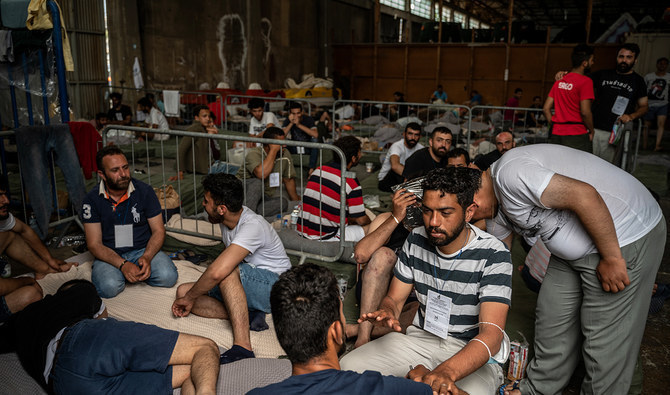
Relatives of Pakistani, other victims of Greece boat disaster demand answers, one year on
https://arab.news/vfvbr
Relatives of Pakistani, other victims of Greece boat disaster demand answers, one year on
- Up to 700 migrants from Pakistan, Syria and Egypt were crammed in Libya into a fishing trawler bound for Italy
- It capsized off southwestern Greece in June 2023, even though Greek coast guard had been monitoring it for hours
Chinese, Pakistani firms join Barrick in mining push as Reko Diq exports near
- Port operator says more than $5 billion in copper and gold exports planned from Reko Diq in phases
- PIBT readies capacity upgrades as security and regional connectivity remain key logistical risks
KARACHI: After Canada’s Barrick Mining Corporation, Chinese firms and major Pakistani business groups have also secured mining leases for copper, gold and other minerals in Pakistan’s southwest, signaling a broader expansion of the sector, according to a senior port executive involved in export planning.
Sharique Azim Siddiqui, chief executive officer of Pakistan International Bulk Terminal Limited (PIBT), said the facility had been contracted to export more than $5 billion worth of minerals from the Reko Diq project in phases, with additional mining ventures emerging in the same mineral-rich belt in Balochistan.
“There are some Chinese involved in that, but otherwise there are Pakistani big business houses that have taken the mining leases,” he said in an interview with Arab News this week.
Last week, Reko Diq Mining Company (RDMC), a Barrick subsidiary, signed a port access agreement with PIBT to use Pakistan’s first dirty bulk cargo handling terminal at Port Qasim for large-scale exports of copper and gold concentrate starting from 2028.
Located in the remote Chagai district of Balochistan, Reko Diq is among the world’s largest undeveloped copper-gold deposits. Barrick holds a 50 percent stake in the project, while Pakistan’s federal and Balochistan governments each own 25 percent.
“They are working on their mine in Balochistan, and we hope that by 2028 or latest by 2029 they should be in operation,” Siddiqui said. “They should be sending about 800,000 to a million tons of copper and gold concentrate for which PIBT will be the export terminal at Port Qasim.”
He said exports from the first phase were estimated at $2.7 billion annually, rising to around $5 billion after expansion.
“$2.7 billion is just from Reko Diq,” Siddiqui said. “They would double in two phases. It could be around $5 billion in exports, which would be a significant chunk of Pakistan’s exports.”
Pakistan has struggled to lift exports, which rose 4.5 percent last fiscal year to $32 billion. In the current fiscal year through January, exports fell 7 percent to $18.2 billion, while imports rose 9 percent to $40.2 billion, official data show.
“One single project adding $5 billion to our bottom line would be very helpful,” Siddiqui said.
He added that other copper and gold projects in Balochistan remained at early stages.
“Reko Diq will come online before them, but I don’t have an agreement with them so I can’t comment on those projects,” he said.
CAPACITY EXPANSION
Under its agreement with PIBT, RDMC will invest $150 million to build dedicated storage and handling facilities at the terminal as part of the project’s broader $7.7 billion investment.
“Reko Diq is upgrading PIBT’s infrastructure and Reko Diq is building their own storage and handling facility inside PIBT,” Siddiqui said. “Our export line can handle their product. We have got an export handling crane, we have got a conveyor, several kilometers of conveyor belt built for that purpose, but they will upgrade it.”
Construction of the port-side facilities is expected to begin within two months.
PIBT, which began operations in 2017, was developed with $305 million in investment, including financing from the International Finance Corporation, and is listed on the Pakistan Stock Exchange with about 20,000 shareholders.
PIBT has an annual handling capacity of 12 million tons of imports and four million tons of exports. Reko Diq is expected to initially use about one million tons of export capacity, rising to two million tons in the second phase.
“We will still have ample capacity to fill up our 4 million tons of export capacity,” Siddiqui said.
Historically focused on coal imports, PIBT currently handles six to seven million tons annually. Reko Diq will make it a major export terminal for the first time.
Siddiqui said PIBT was also in discussions with exporters of barite, rock phosphate, iron ore and sand, adding that Reko Diq’s shipments would set the benchmark for future mineral exports.
He said the terminal was also open to partnerships with Gulf investors, particularly from the United Arab Emirates.
SECURITY RISKS
Siddiqui said Pakistan’s long-term ambition to serve as a transit hub for landlocked Central Asian states remained constrained by security and regional connectivity challenges.
Afghanistan, he said, remained a bottleneck, though he described it as temporary.
“We are well positioned to encash that opportunity and become a transit port for exporting or importing cargo for Central Asian states,” he said.
Security concerns persist, particularly in Balochistan, which has seen a resurgence of militant attacks. However, the PIBT official downplayed the situation.
“The government at the highest level is going to ensure that there is security for their cargo movement, because if there is no security for the cargo movement, then that’s going to hurt that project and hurt everyone,” Siddiqui said.
“I’m pretty confident that we would be able to provide that security for their cargo movement,” he added.