Unusually heavy monsoon rains in Pakistan will affect 200,000 people, top UN official warns

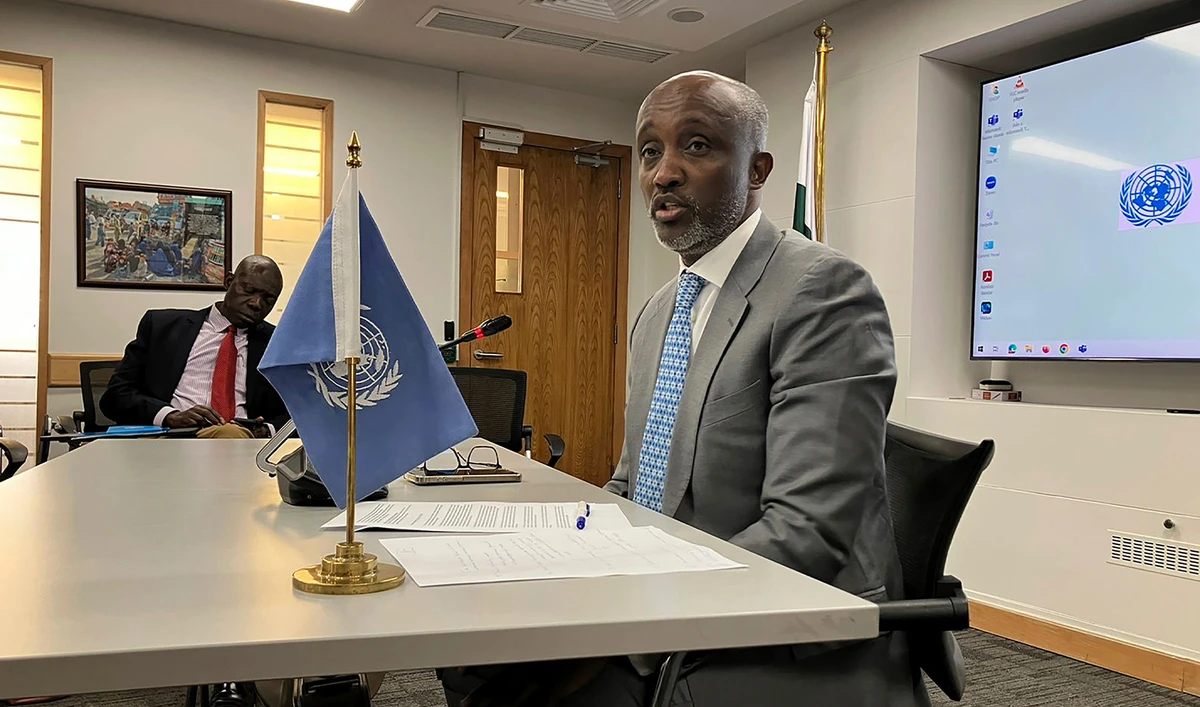
Mohamed Yahya, the newly appointed Resident Coordinator and Humanitarian Coordinator, speaks during a press conference in Islamabad, Pakistan, on June 13, 2024. (AP)
Short Url
Updated 13 June 2024
Follow

Unusually heavy monsoon rains in Pakistan will affect 200,000 people, top UN official warns

  • UN, with help from local authorities, has prepared contingency plan, with $40 million set aside to respond to any emergencies
  • Devastating floods in 2022 killed 1,739 people, destroyed 2 million homes, and covered as much as one-third of the country 

ISLAMABAD: An estimated 200,000 people in Pakistan could be affected by the upcoming monsoon season, which is expected to bring heavier rains than usual, a top UN official warned on Thursday.

The United Nations, with help from local authorities, has prepared a contingency plan, with $40 million set aside to respond to any emergencies, said Mohamed Yahya, the newly appointed Resident Coordinator and Humanitarian Coordinator in Pakistan.

Yahya told journalists in Islamabad that the weather forecasters in Pakistan are projecting above-normal rainfall in the coming weeks. However, the rains would not be as heavy as in 2022 when devastating floods killed 1,739 people, destroyed 2 million homes, and covered as much as one-third of the country at one point.

Pakistan is one of the countries in the world most vulnerable to climate change, in part because of its immense northern glaciers, which are now melting as air temperatures rise. Warmer air can also hold more moisture, intensifying the rains of the monsoon.

Until recently, public opinion and even some government officials took little account of the possible negative impact from climate change on daily life. Pakistan’s weather patterns have changed in recent years, forcing cities to strengthen their infrastructure and farmers to adapt their practices.

The 2022 floods caused more than $30 billion in damage to Pakistan’s already cash-strapped economy.

Analysts and government officials say Pakistan in recent years failed to achieve goals for economic growth because of man-made disasters, which have repeatedly hit the country in the form of droughts, heatwaves and heavy rains, which badly damaged the road network, bridges, power system and other infrastructure.

Pakistan says despite contributing less than 1 percent to carbon emissions worldwide, it is bearing the brunt of global climate disasters. This year, Pakistan recorded its wettest April since 1961, with more than double the usual monthly rainfall.

Yahya said he was in contact with officials at Pakistan’s ministry of climate change, who were preparing their contingency own plans for monsoon season, which in Pakistan runs from July to October.

Earlier this week, weather forecasters in Pakistan urged people to stay indoors as the third heatwave in a month began. A recent study by the United Nations children’s agency said that Pakistan could avert 175,000 deaths by 2030 by developing resilient energy systems to power its health facilities.

On Thursday, temperatures in various parts of Pakistan soared as high as 48 degrees Celsius (118 degrees Fahrenheit), forcing many people to stay indoors. Authorities are asking people to hydrate and avoid unnecessary travel.


Pakistan condemns Sudan attack that killed Bangladeshi UN peacekeepers, calls it war crime

Updated 14 December 2025
Follow

Pakistan condemns Sudan attack that killed Bangladeshi UN peacekeepers, calls it war crime

  • Six peacekeepers were killed in a drone strike in Kadugli as fighting between Sudan’s army and the RSF grinds on
  • Pakistan, a major troop contributor to the UN, says perpetrators of the attack must be identified, brought to justice

ISLAMABAD: Pakistan on Sunday extended condolences to the government and people of Bangladesh after six United Nations peacekeepers from the country were killed in a drone strike in southern Sudan, condemning the attack and describing it as a war crime.

The attack took place amid a full-scale internal conflict that erupted in April 2023 between the Sudanese Armed Forces (SAF) and the Rapid Support Forces (RSF), a powerful paramilitary group, following a power struggle after the collapse of Sudan’s post-Bashir political transition.

Omar Al-Bashir, who ruled Sudan for nearly three decades, was ousted by the military in 2019 after months of mass protests, but efforts to transition to civilian rule later faltered, plunging the country back into violence that has since spread nationwide.

The drone strike hit a logistics base of the United Nations Interim Security Force for Abyei (UNISFA) in Kadugli, the capital of South Kordofan state, on Saturday, killing the Bangladeshi peacekeepers. Sudan’s army blamed the RSF for the attack, though there was no immediate public claim of responsibility.

“Pakistan strongly condemns the attack on @UNISFA in Kadugli, resulting in the tragic loss of 6 Bangladeshi peacekeepers & injuries to several others,” the country’s permanent mission to the UN said in a social media message. “We honor their supreme sacrifice in the service of peace, and express our deepest condolences to the government and people of #Bangladesh.”

“Such heinous attacks on UN peacekeepers amount to war crimes,” it added. “Perpetrators of this horrific attack must be identified and brought to justice. As a major troop-contributing country, we stand in complete solidarity with all Blue Helmets serving the cause of peace in the perilous conditions worldwide.”

According to Pakistan’s UN mission in July, the country has deployed more than 235,000 peacekeepers to 48 UN missions across four continents over the past eight decades.

Pakistan also hosts one of the UN’s oldest peacekeeping operations, the United Nations Military Observer Group in India and Pakistan (UNMOGIP), and is a founding member of the UN Peacebuilding Commission.

More than 180 Pakistani peacekeepers have lost their lives while serving under the UN flag.

Pakistan and Bangladesh have also been working in recent months to ease decades of strained ties rooted in the events of 1971, when Bangladesh — formerly part of Pakistan — became independent following a bloody war.

Relations have begun to shift following the ouster of former Bangladeshi prime minister Sheikh Hasina last year amid mass protests.

Hasina later fled to India, Pakistan’s neighbor and arch-rival, creating space for Islamabad and Dhaka to rebuild their relationship.