GAZA: It is not only the ever-present danger from Israeli bombardment or ground fighting that makes life a trial for Gaza’s Palestinian civilians. It is also the sheer daily slog to find bare necessities such as water, to drink or cook or wash with.
For the Shenbary family, that can be a walk of 90 minutes, jerry cans at the ready, in the hope of finding a makeshift distribution point among the mounds of grey, dusty rubble of the Jabalia urban refugee camp in northern Gaza.
“Now that Jabalia has all been bulldozed, all the wells are bulldozed with it. There’s not a single water well left,” family father Ahmed Al-Shenbary said last Saturday. “Water is a big tragedy in Jabalia.”
The war started on Oct. 7 when Hamas, the group ruling Gaza, killed 1,200 people in Israel, according to Israeli tallies, and took another 250 or so to hold as hostages in Gaza, one of the most crowded places on earth.
Israel’s retaliatory offensive has not only killed more than 37,000 people but created a humanitarian crisis with shortages of food, fuel and medicine as well as water in a territory whose housing and infrastructure is now little more than rubble.
“Children and their families are having to use water from unsafe sources that are highly salinated or polluted,” said Catherine Russell, executive director of the UN children’s fund UNICEF.
“Without safe water, many more children will die from deprivation and disease in the coming days.”
People have dug wells in bleak areas near the sea where the bombing has pushed them, or rely on salty tap water from Gaza’s only aquifer, now contaminated with seawater and sewage.
Children walk long distances to line up at makeshift water collection points. Often not strong enough to carry the filled containers, they drag them home on wooden boards.
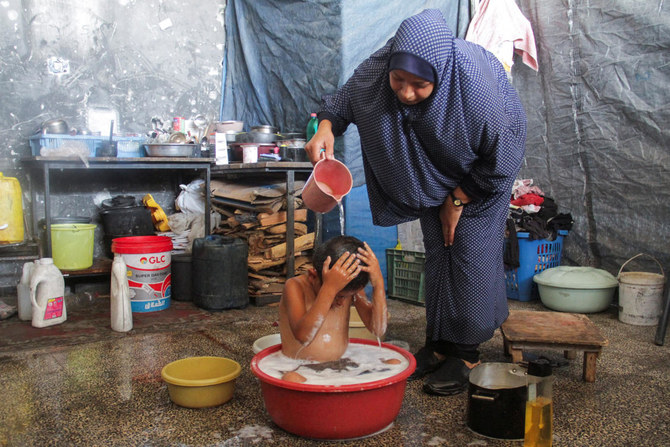
“As you see, we bathe our children in a small basin. It’s water from washing dishes, not clean water, because of the water shortages,” said Ahmed’s wife Fatima.
She bathes her son on the floor in the concrete shell of a wrecked school that now passes for their latest home after several forced relocations.
“We have hepatitis, which causes yellowing of the eyes,” she said. “We also have intestinal infections — not just me but the whole school ... Even ‘filtered water’ isn’t really filtered. We fool ourselves and pretend.”


![]()

Gaza families desperate for water with no relief in sight
Short Url
https://arab.news/6xbnq
Gaza families desperate for water with no relief in sight
- Israel’s retaliatory offensive has not only killed more than 37,000 people but created a humanitarian crisis with shortages of food, fuel and medicine as well as water


Latest updates


© 2026 SAUDI RESEARCH & PUBLISHING COMPANY, All Rights Reserved And subject to Terms of Use Agreement.