Greece, Jordan assist in tackling Cyprus wildfire

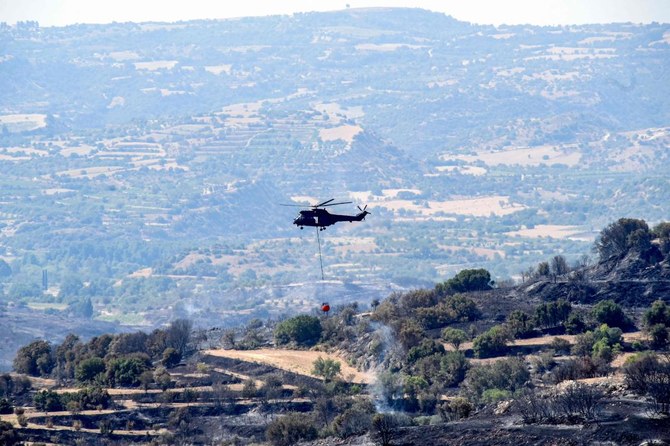
A firefighting helicopter carries a bucket while putting out a fire that broke out in Psathi in western Cyprus on June 12, 2024. (AFP)
Short Url
Updated 12 June 2024
Follow

Greece, Jordan assist in tackling Cyprus wildfire

NICOSIA: Aircraft from Greece and Jordan were helping Cypriot authorities battle a large wildfire in the southwestern Paphos region believed to have been started by an illegal landfill, officials said Wednesday.
The fire broke out Tuesday east of the village of Giolou, triggering a national emergency plan that saw civil defense evacuate five mountain villages at risk.
Officials said two air tractors from the Royal Jordanian Air Force and two planes from Greece were deployed Wednesday to tackle the blaze in the rugged terrain.
Nicosia activated the European Union fire assistance protocol to seek help in containing the fire.
Fire service chief Nicos Logginos told state radio Wednesday that seven aircraft, including two Canadair planes from Greece, are operating over the active fronts.
He said that due to harsh terrain, ground forces are unable to reach the area.
Over 300 people, including fire crews, supported by bulldozers, are working to secure the perimeter of the fire.
Logginos said police have evidence the fire started from an illegal landfill site.
Around 48 people evacuated from the fire zone were taken to hotels, said local daily Kathimerini Cyprus.
The scale of the fire prompted President Nikos Christodoulides to return early from a Gaza aid summit in Jordan on Tuesday to visit the crisis control center.
During a meeting with King Abdullah II of Jordan, he requested additional aerial support to combat the fire in Paphos.
Fire service spokesman Andreas Kettis said a number of homes suffered extensive damage or were destroyed, but the scale of the destruction has yet to be determined.
Residents have complained that homes were destroyed because of the slow response to the fire’s outbreak.
The community leader in the village of Lemona, Kyriakos Charalambous, told the Cyprus News Agency it took “too long” for aerial firefighting units to arrive.
Wildfires often erupt in Cyprus during the sweltering summer months on the island which suffers from a severe lack of rainfall.
The Department of Meteorology issued a yellow alert for Wednesday for extreme heat, with maximum temperatures expected to reach 41 degrees Celsius.
Cyprus recorded its hottest-ever June day last Friday as temperatures soared to an unprecedented 44 degrees Celsius, the department said.


In show of support, Canada, France open consulates in Greenland

Updated 06 February 2026
Follow

In show of support, Canada, France open consulates in Greenland

  • Decisions taken in a strong show of support for Greenland government amid threats by US President Trump to seize the island

COPENHAGEN, Denmark: Canada and France, which both adamantly oppose Donald Trump’s wish to control Greenland, will open consulates in the Danish autonomous territory’s capital on Friday, in a strong show of support for the local government.
Since returning to the White House last year, Trump has repeatedly insisted that Washington needs to control the strategic, mineral-rich Arctic island for security reasons.
The US president last month backed off his threats to seize Greenland after saying he had struck a “framework” deal with NATO chief Mark Rutte to ensure greater American influence.
A US-Denmark-Greenland working group has been established to discuss ways to meet Washington’s security concerns in the Arctic, but the details of the talks have not been made public.
While Denmark and Greenland have said they share Trump’s security concerns, they have insisted that sovereignty and territorial integrity are a “red line” in the discussions.
“In a sense, it’s a victory for Greenlanders to see two allies opening diplomatic representations in Nuuk,” said Jeppe Strandsbjerg, a political scientist at the University of Greenland.
“There is great appreciation for the support against what Trump has said.”
French President Emmanuel Macron announced Paris’s plans to open a consulate during a visit to Nuuk in June, where he expressed Europe’s “solidarity” with Greenland and criticized Trump’s ambitions.
The newly-appointed French consul, Jean-Noel Poirier, has previously served as ambassador to Vietnam.
Canada meanwhile announced in late 2024 that it would open a consulate in Greenland to boost cooperation.
The opening of the consulates is “a way of telling Donald Trump that his aggression against Greenland and Denmark is not a question for Greenland and Denmark alone, it’s also a question for European allies and also for Canada as an ally, as a friend of Greenland and the European allies also,” Ulrik Pram Gad, Arctic expert at the Danish Institute of International Studies, told AFP.
“It’s a small step, part of a strategy where we are making this problem European,” said Christine Nissen, security and defense analyst at the Europa think tank.
“The consequences are obviously not just Danish. It’s European and global.”

Recognition

According to Strandsbjerg, the two consulates — which will be attached to the French and Canadian embassies in Copenhagen — will give Greenland an opportunity to “practice” at being independent, as the island has long dreamt of cutting its ties to Denmark one day.
The decision to open diplomatic missions is also a recognition of Greenland’s growing autonomy, laid out in its 2009 Self-Government Act, Nissen said.
“In terms of their own quest for sovereignty, the Greenlandic people will think to have more direct contact with other European countries,” she said.
That would make it possible to reduce Denmark’s role “by diversifying Greenland’s dependence on the outside world, so that it is not solely dependent on Denmark and can have more ties for its economy, trade, investments, politics and so on,” echoed Pram Gad.
Greenland has had diplomatic ties with the European Union since 1992, with Washington since 2014 and with Iceland since 2017.
Iceland opened its consulate in Nuuk in 2013, while the United States, which had a consulate in the Greenlandic capital from 1940 to 1953, reopened its mission in 2020.
The European Commission opened its office in 2024.