BRUSSELS: Hungary has agreed not to block NATO from giving support to Ukraine but it will not provide any personnel or funds to help the war-ravaged country, NATO Secretary-General Jens Stoltenberg said Wednesday.
At a summit in Washington next month, US President Joe Biden and his NATO counterparts are expected to agree on a new system for providing more predictable and long-term security assistance and military training to Ukraine’s beleaguered armed forces.
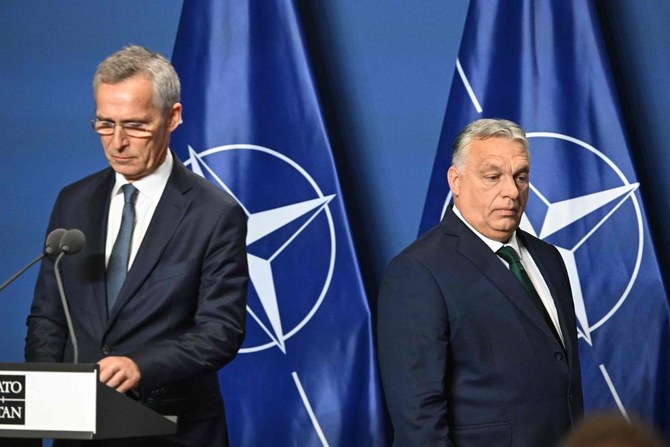
“Hungary will not participate in these NATO efforts and I accept this position,” Stoltenberg told reporters in Budapest, after talks with Hungarian Prime Minister Viktor Orban.
Stoltenberg said that he and Orban had “agreed modalities for Hungary’s non-participation in NATO’s support for Ukraine.” NATO’s top civilian official did not elaborate on how that would work.
“No Hungarian personnel will take part in these activities and no Hungarian funds will be used to support them,” Stoltenberg said.
“At the same time, the prime minister has assured me that Hungary will not oppose these efforts, enabling other allies to move forward, and he has confirmed that Hungary will continue to meet its NATO commitments in full,” Stoltenberg added.
NATO takes all its decisions by consensus, effectively giving any one of the 32 allies a veto.
Hungary’s stridently nationalist government has increasingly become a thorn in the side of NATO — and the European Union — by undermining their efforts to help Ukraine. All other allies agree that Russia’s war on Ukraine poses an existential threat to European security.
Orban, seen as one of the friendliest European leaders toward Russian President Vladimir Putin, styles himself as a peacemaker, and has labelled his EU and NATO partners assisting Ukraine as being “pro-war.” He has also advocated for former US President Donald Trump’s victory in the November election.
Since Russia’s full-fledged invasion in February 2022, Ukraine’s Western backers have routinely met as part of the Ukraine Defense Contact Group, run by the Pentagon, to drum up weapons and ammunition for Kyiv.
Stoltenberg has spearheaded an effort to have NATO coordinate that process. As an organization, the military alliance does not send weapons to Ukraine and has no plans to do so but many of its members give help on a bilateral basis.
NATO allies provide more than 90 percent of the military support that Ukraine receives.
Plans are afoot for NATO’s leaders to commit on July 9-11 to maintain the level of military support they have provided Ukraine since the invasion began. The world’s biggest security organization estimates the amounts to around $40 billion worth of equipment each year.
At their summit in Lithuania last year, Biden and his counterparts promised that they would “be in a position to extend an invitation to Ukraine to join the alliance when allies agree and conditions are met.” The consensus among members now is that it should not happen while war rages on.


![]()

NATO chief says Hungary has agreed not to veto alliance’s assistance to Ukraine
Short Url
https://arab.news/c939g
NATO chief says Hungary has agreed not to veto alliance’s assistance to Ukraine
- Prime Minister Viktor Orban had ‘agreed modalities for Hungary’s non-participation in NATO’s support for Ukraine’
- NATO takes all its decisions by consensus, effectively giving any one of the 32 allies a veto


Latest updates



© 2026 SAUDI RESEARCH & PUBLISHING COMPANY, All Rights Reserved And subject to Terms of Use Agreement.