More acts pull out of UK festival Latitude in protest against sponsor Barclays’ links to Israel

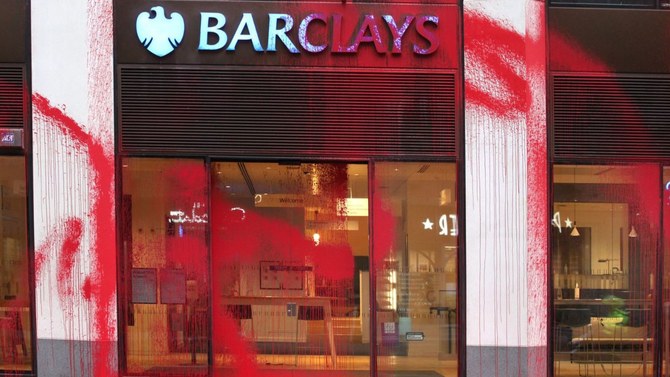
Barclays has been accused by the Palestine Action group, whose members this week doused 20 branches of the bank across England and Scotland with red paint, of having financial interests in Israel’s weapons trade and fossil fuel industry. (X/@Pal_action)
Short Url
Updated 12 June 2024
Follow

More acts pull out of UK festival Latitude in protest against sponsor Barclays’ links to Israel

  • Comedians Sophie Duker, Grace Campbell and Alexandra Haddow are the latest performers to withdraw from the event in Essex next month
  • Barclays has been accused by the protest group Palestine Action of having financial interests in Israel’s weapons trade and fossil fuel industry

LONDON: Three comedians said on Tuesday they were pulling out of the UK’s Latitude Festival in protest against ties between the event’s main sponsor, Barclays, and Israel.

The withdrawals by Sophie Duker, Grace Campbell and Alexandra Haddow follow a similar decision last week by Irish singer-songwriter CMAT. Other musicians that have pulled out include Pillow Queens, Mui Zyu and Georgia Ruth, Sky News reported.

Acts such as Keane, Kasabian and London Grammar are still scheduled to perform at the event in the English county of Suffolk from July 25 to 28.

Barclays has been accused by the protest group Palestine Action of having financial interests in Israel’s weapons trade and fossil fuel industry. Members of the group this week splashed red paint on 20 of the bank’s branches across England and Scotland.

Comedian Duker posted a short video on social media in which she confirmed she would no longer be performing at the festival, despite her experience there being “magical in the past,” because she said Barclays was “profiting from the production of weaponry” used by Israeli forces in Gaza.


A post shared by DUKER (@sophiedukebox)

“I am committed to minimizing my complicity in what I consider to be a pattern of abhorrent, unlawful violence,” she said, adding that her stance had attracted “violent abuse, targeted pile-ons and death threats.”

Haddow shared a similar message on Instagram in which she said she could not “in good conscience take the fee” for performing at the event and that boycotting it was “one of the only things I can actively do.”

Barclays said it recognizes “the profound human suffering” caused by the war in Gaza but added: “We provide vital financial services to US, UK and European public companies that supply defense products to NATO and its allies.

“Barclays does not directly invest in these companies. The defense sector is fundamental to our national security, and the UK government has been clear that supporting defense companies is compatible with ESG (environmental, social and governance) considerations.

“Decisions on the implementation of arms embargoes to other nations are the job of respective elected governments.”


Saudi opera star Sawsan Albahiti: ‘I’m a playful person, I love to have fun’ 

Updated 13 December 2025
Follow

Saudi opera star Sawsan Albahiti: ‘I’m a playful person, I love to have fun’ 

  • The Kingdom’s first professional opera singer talks teaching, travel, and time off 

RIYADH: Sawsan Albahiti is one of the most recognizable voices in Saudi Arabia’s cultural renaissance. Recognized as the Kingdom’s first professional opera singer, Albahiti has performed in London and Berlin, as well as Riyadh and AlUla, among other cities, carving a path once unimaginable for Saudi artists, especially women. 

Albahiti began her operatic journey in 2008 and has since mastered singing in Italian, French, German, and English, giving her access to a rich repertoire of classical works. Her mix of perseverance and talent continues to inspire young Saudi women, and Albahiti is eager to ensure that she uses her standing to help the next generation of Saudi singers realize their potential. 

Sawsan Albahiti performing in Riyadh in May this year, accompanied by Najd Choir. (Getty Images)

“I love to train singers, whether they’re opera singers, pop singers or singers (in) different Arabic genres,” she tells Arab News. “I love to see those singers shaping their voices and polishing their skills. It’s a passion of mine to be a part of that.”  

And she has found that working with students enriches her own development. “I learn from every singer that I train by reflecting on my own capabilities,” she says. “Understanding how to inspire other singers and (aid) their artistic development helps me grow as an artist and as a leader.”  

She reveals that she will soon publish an Arabic-language book about vocal training, having noted that “content in Arabic — with books about singing — is not sufficient yet. I saw that it’s my place, as a vocal coach and an opera singer, to write a book about such an important topic.” 

Albahiti performing the national anthem at the Tareq Abdulhakim Center for this year's National Day celebrations. (Instagram)

Travel has also shaped her artistic evolution, with certain cities leaving lasting impressions, particularly Rome, where she lived for almost a year.  

“That city is so rich in history and arts, specifically music, and specifically opera,” she says. “Walking where (legends of opera) walked, learning in the same institutes where they learned, understanding their stories, and seeing their belongings changed my connection with the opera world forever.”  

Closer to home, AlUla has been a huge inspiration for Albahiti. “AlUla is such a strong representation of Saudi culture, it’s very artistic,” she says. “Its blend of culture and art, heritage and modernity, has really impacted my view of art in general.”  

Her serene stage presence, she says, gives people the impression that she is “very serious, like, calm and composed.” However, that persona is somewhat misleading, according to Albahiti.  

Albahiti performing the national anthem at the Tareq Abdulhakim Center for this year's National Day celebrations. (Instagram)

“I want people to know that I’m just (like) any other young Saudi woman,” she says. “I’m a playful person. I love to have fun. I love to dance. 

“A perfect day for me, outside of performing or rehearsing, is enjoying quality time with people I love — spending time with my family, going out with friends, walking my dog… my dog’s a sweet Maltese Shih Tzu called Lucky.” 

And she has a lot of family to spend time with, she adds. “I come from a big family. I’m the youngest of seven siblings.” Some of those siblings were early musical inspirations too. “I can say I’m the most artistic in my family, but one of my sisters and one of my brothers also have musical skills. And I learned from them. They pursued other fields in life, but I continued in music.” 

That decision is certainly paying off now, as Saudi Arabia’s leaders continue to place great emphasis on the development of a homegrown cultural scene, in which Albahiti is increasingly being acknowledged as a major player. The most recent recognition of this was her collaboration with the Tareq Abdulhakim Center for Saudi National Day, in which she performed the national anthem in the center’s courtyard in her hometown of Jeddah’s historic Al-Balad district.  

AlUla has been a huge inspiration for Albahiti. (Supplied)

“That was special because Tariq Abdulhakim was one of the pioneers of Saudi music,” she says. “To be able to have a collaboration with such a name was a big deal for me.” 

One of the most exciting of the Kingdom’s upcoming cultural projects, for Albahiti, is the Royal Opera House in King Salman Park. “I haven’t been involved yet, because the project is still under construction,” she says, adding that she is eagerly anticipating the opening “as (are) so many people around the world.”  

She continues: “I heard the great news about the collaboration with the Metropolitan Opera in New York, where (the Met) will perform their programs in the opera house once it opens.”  

The significance of the Royal Opera House will be far-reaching, Albahiti believes. “It will be a very important center for arts and culture,” she says. “It will not only bring a new form of arts — opera — (to the Kingdom), it will also be the hub for so many artists and so many art forms, introduce new arts to society, and give a platform for upcoming artists to showcase their art regardless (of what) new kind of genres they want to bring forward.”