Air pollution linked to 135 million premature deaths: study

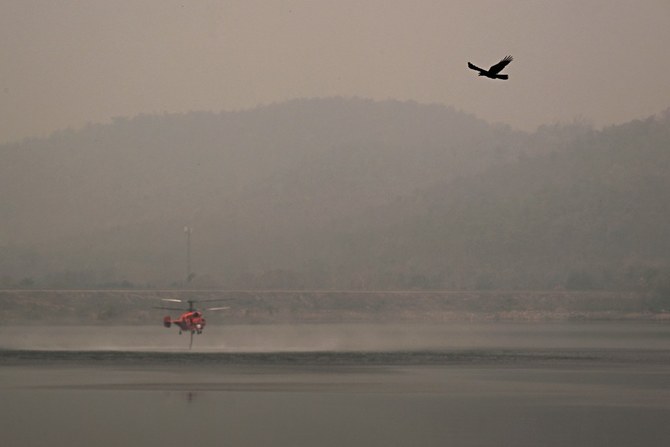
Heavy air pollution at Mae Ngat Somboon Chon Dam in the northern Thai province of Chiang Mai (AFP)
Short Url
Updated 10 June 2024
Follow

Air pollution linked to 135 million premature deaths: study

Singapore: Pollution from man-made emissions and other sources like wildfires have been linked to around 135 million premature deaths worldwide between 1980 and 2020, a Singapore university said Monday.
Weather phenomena like El Nino and the Indian Ocean Dipole worsened the effects of these pollutants by intensifying their concentration in the air, Singapore’s Nanyang Technological University (NTU) said, unveiling the results of a study led by its researchers.
The tiny particles called particulate matter 2.5, or “PM 2.5,” are harmful to human health when inhaled because they are small enough to enter the bloodstream. They come from vehicle and industrial emissions as well as natural sources like fires and dust storms.
The fine particulate matter “was associated with approximately 135 million premature deaths globally” from 1980 to 2020, the university said in a statement on the study, published in the journal Environment International.
It found that people were dying younger than the average life expectancy from diseases or conditions that could have been treated or prevented, including stroke, heart and lung disease, and cancer.
Weather patterns increased the deaths by 14 percent, the study found.
Asia had the “highest number of premature deaths attributable to PM 2.5 pollution” at more than 98 million people, mostly in China and India, the university said.
Pakistan, Bangladesh, Indonesia and Japan also had significant numbers of premature deaths, ranging from 2 to 5 million people, it added.
The study is one of the most expansive to date on air quality and climate, using 40 years of data to give a big-picture view of the effects of particulate matter on health.
“Our findings show that changes in climate patterns can make air pollution worse,” said Steve Yim, an associate professor at NTU’s Asian School of the Environment, who led the study.
“When certain climate events happen, like El Nino, pollution levels can go up, which means more people might die prematurely because of PM 2.5 pollution,” Yim added.
“This highlights the need to understand and account for these climate patterns when tackling air pollution to protect the health of the global population.”
The Singapore researchers studied satellite data from the US National Aeronautics and Space Administration (NASA) on the levels of particulate matter in the Earth’s atmosphere.
They analyzed statistics on deaths from diseases linked to pollution from the US-based Institute for Health Metrics and Evaluation, an independent research center.
Information on weather patterns during the period was taken from the National Oceanic and Atmospheric Administration in the United States.
The study focused only on the effects of ordinary weather patterns on air pollution, Yim said, adding that the impact of climate change will be the subject of future studies.
Researchers from universities in Hong Kong, Britain and China were also involved in the study.
The World Health Organization has said the “combined effects of ambient air pollution and household air pollution” are associated with 6.7 million premature deaths worldwide every year.


Filipinos master disaster readiness, one roll of the dice at a time

Updated 29 December 2025
Follow

Filipinos master disaster readiness, one roll of the dice at a time

  • In a library in the Philippines, a dice rattles on the surface of a board before coming to a stop, putting one of its players straight into the path of a powerful typhoon

MANILA: In a library in the Philippines, a dice rattles on the surface of a board before coming to a stop, putting one of its players straight into the path of a powerful typhoon.
The teenagers huddled around the table leap into action, shouting instructions and acting out the correct strategies for just one of the potential catastrophes laid out in the board game called Master of Disaster.
With fewer than half of Filipinos estimated to have undertaken disaster drills or to own a first-aid kit, the game aims to boost lagging preparedness in a country ranked the most disaster-prone on earth for four years running.
“(It) features disasters we’ve been experiencing in real life for the past few months and years,” 17-year-old Ansherina Agasen told AFP, noting that flooding routinely upends life in her hometown of Valenzuela, north of Manila.
Sitting in the arc of intense seismic activity called the “Pacific Ring of Fire,” the Philippines endures daily earthquakes and is hit by an average of 20 typhoons each year.
In November, back-to-back typhoons drove flooding that killed nearly 300 people in the archipelago nation, while a 6.9-magnitude quake in late September toppled buildings and killed 79 people around the city of Cebu.
“We realized that a lot of loss of lives and destruction of property could have been avoided if people knew about basic concepts related to disaster preparedness,” Francis Macatulad, one of the game’s developers, told AFP of its inception.
The Asia Society for Social Improvement and Sustainable Transformation (ASSIST), where Macatulad heads business development, first dreamt up the game in 2013, after Super Typhoon Haiyan ravaged the central Philippines and left thousands dead.
Launched six years later, Master of Disaster has been updated this year to address more events exacerbated by human-driven climate change, such as landslides, drought and heatwaves.
More than 10,000 editions of the game, aimed at players as young as nine years old, have been distributed across the archipelago nation.
“The youth are very essential in creating this disaster resiliency mindset,” Macatulad said.
‘Keeps on getting worse’ 
While the Philippines has introduced disaster readiness training into its K-12 curriculum, Master of Disaster is providing a jolt of innovation, Bianca Canlas of the Department of Science and Technology (DOST) told AFP.
“It’s important that it’s tactile, something that can be touched and can be seen by the eyes of the youth so they can have engagement with each other,” she said of the game.
Players roll a dice to move their pawns across the board, with each landing spot corresponding to cards containing questions or instructions to act out disaster-specific responses.
When a player is unable to fulfil a task, another can “save” them and receive a “hero token” — tallied at the end to determine a winner.
At least 27,500 deaths and economic losses of $35 billion have been attributed to extreme weather events in the past two decades, according to the 2026 Climate Risk Index.
“It just keeps on getting worse,” Canlas said, noting the lives lost in recent months.
The government is now determining if it will throw its weight behind the distribution of the game, with the sessions in Valenzuela City serving as a pilot to assess whether players find it engaging and informative.
While conceding the evidence was so far anecdotal, ASSIST’s Macatulad said he believed the game was bringing a “significant” improvement in its players’ disaster preparedness knowledge.
“Disaster is not picky. It affects from north to south. So we would like to expand this further,” Macatulad said, adding that poor communities “most vulnerable to the effects of climate change” were the priority.
“Disasters can happen to anyone,” Agasen, the teen, told AFP as the game broke up.
“As a young person, I can share the knowledge I’ve gained... with my classmates at school, with people at home, and those I’ll meet in the future.”