

Suspected Islamists in eastern Congo kill more than 80 in a week

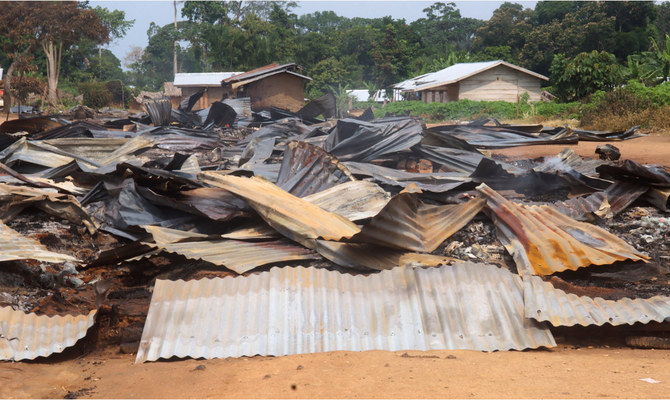
The ruins of market stalls smoulder following an attack by suspected Islamist rebels from the Allied Democratic Forces (ADF), within Masala village in Beni territory of eastern Democratic Republic of Congo June 9, 2024. (Reuters)
Short Url
Updated 10 June 2024
Follow

Suspected Islamists in eastern Congo kill more than 80 in a week

  • “Several dozen civilians have been victims of the ADF in eastern DRC in recent days,” said EU foreign affairs spokeswoman Nabila Massrali

BENI, Democratic Republic of Congo: The death toll has risen to 41 following an attack on Friday by suspected Islamist rebels on villages in eastern Democratic Republic of Congo, a Congolese army spokesman said, bringing the total toll in the region to more than 80 since Tuesday.
Friday night’s attack, on the villages of Masala, Mapasana and Mahini, had been carried out by members of the Allied Democratic Forces (ADF), said lieutenant-colonel Mak Hazukay, an army spokesman in Congo’s North Kivu province.
The ADF, which is now based in eastern Congo, has pledged allegiance to Islamic State and mounts frequent attacks, further destabilising a region where many militant groups are active.
It originates from neighboring Uganda and is alleged to be behind multiple assaults in the area over the past week, including one in the village of Masawu that killed 17 people, two civil society leaders said.
On Thursday, five bodies were found in the villages of Kabweli and Mamulese, according to Justin Kavalami, a civil society member who helped search for bodies. The same day, six bodies were recovered from a river in the village of Mununze, that village’s chief said.
On Friday, 13 bodies were found in the village of Makobu, a civil society leader and the village chief said, bringing the total number of people killed by suspected ADF militants since Tuesday to 82.
It was not possible to reach the ADF for comment.

‘CHAOS’
During the attacks on Friday evening, armed men used guns and machetes to attack residents of the villages in Beni territory, local official Fabien Kakule told Reuters.
Vusindi Nick Junior, a local civil society leader, said a local health center had been set ablaze and nine people were injured in addition to the 41 killed.
“Several dozen civilians have been victims of the ADF in eastern DRC in recent days,” said EU foreign affairs spokeswoman Nabila Massrali, adding there was an urgent need to accelerate efforts to find a political solution.
“Terrorist groups are taking advantage of the chaos to expand their hold on an already very unstable region,” she said.
Julien Paluku, a former governor of North Kivu, said on X that Congo’s national government needed to do more to address insecurity in the east. The government has not yet made any statement on Friday’s attacks, and a government spokesman did not respond to requests for comment.
“People have the impression, rightly or wrongly, of being abandoned to their sad fate,” he said.


ASEAN should adhere to rule of law in face of ‘unilateral actions,’ Philippines’ top diplomat says

Updated 3 sec ago
Follow

ASEAN should adhere to rule of law in face of ‘unilateral actions,’ Philippines’ top diplomat says

  • Several ASEAN members have expressed deep concern over the US strike that resulted in the arrest of Venezuelan leader Nicolas Maduro
  • Philippines’ top envoy: ‘Across our region, we continue to see tensions at sea, protracted internal conflicts and unresolved border and humanitarian concerns’
CEBU, Philippines: Southeast Asian countries should steadfastly maintain restraint and adhere to international law as acts of aggression across Asia and “unilateral actions” elsewhere in the world threaten the rules-based global order, Manila’s top diplomat said Thursday.
Philippine Foreign Secretary Theresa Lazaro did not provide details of the geopolitical alarm she raised before her counterparts in the 11-nation Association of Southeast Asian Nations who were holding their first major closed-door meetings this year in the Philippines’ central seaside city of Cebu.
Several ASEAN members, however, have expressed deep concern over the secretive US strike that resulted in the arrest of Venezuelan leader Nicolas Maduro on orders from US President Donald Trump. China’s intensifying aggressive stance on Taiwan and in the disputed South China Sea have also troubled the region for years.
Calling out the US and China, among the largest trading and defense partners of ASEAN countries, have been a dilemma and diplomatic tightrope.
“Across our region, we continue to see tensions at sea, protracted internal conflicts and unresolved border and humanitarian concerns,” Lazaro said in her opening speech before ASEAN counterparts.
“At the same time, developments beyond Southeast Asia, including unilateral actions that carry cross-regional implications, continue to affect regional stability and erode multilateral institutions and the rules- based international order,” she said.
“These realities underscore the interim importance of ASEAN’s time-honored principles of restraint, dialogue and adherence to international law in seeking to preserve peace and stability to our peoples.”
The Philippines holds ASEAN’s rotating chair this year, taking what would have been Myanmar’s turn after the country was suspended from chairing the meeting after its army forcibly ousted Aung San Suu Kyi’s democratically elected government in 2021.
Founded in 1967 in the Cold War era, ASEAN has an unwieldy membership of diverse countries that range from vibrant democracies like the Philippines, a longtime treaty ally of Washington, to authoritarian states like Laos and Cambodia, which are close to Beijing.
The regional bloc adopted the theme “Navigating our future, Together” this year but that effort to project unity faced its latest setback last year when deadly fighting erupted between two members, Thailand and Cambodia, over a longtime border conflict.
Aside from discussing the deadly fighting that embroiled Thailand and Cambodia before both forged a US-backed ceasefire last year, the ASEAN foreign ministers will deliberate how to push a five-point peace plan for the war in Myanmar, issued by the regional bloc’s leaders in 2021. The plan demanded, among others, an immediate end to fighting and hostilities, but it has failed to end the violence or foster dialogue among contending parties.
ASEAN foreign ministers are also under pressure to conclude negotiations with China ahead of a self-imposed deadline this year on a so-called “code of conduct” to manage disputes over long-unresolved territorial rifts in the South China Sea. China has expansive claims in the waterway, a key global trade route, that overlap with those of four ASEAN members, the Philippines, Malaysia, Vietnam and Brunei.