

Mashaer metro ready to transport thousands of pilgrims

1 / 3
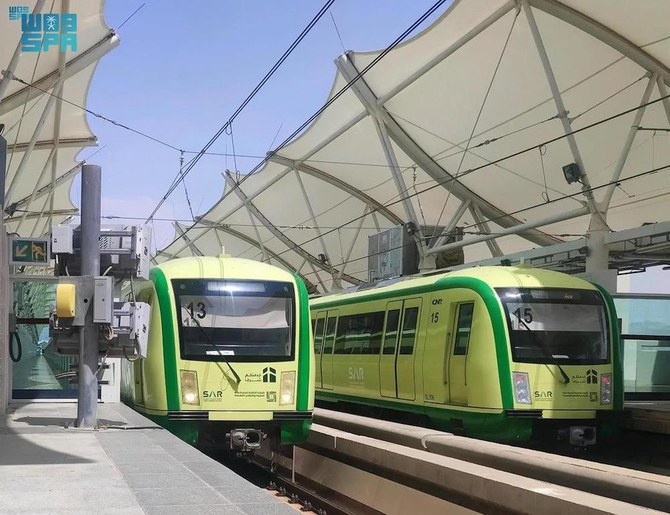
With a capacity of 72,000 passengers per hour in one direction across more than 200 trips, the train facilitates the movement of pilgrims to and from their destinations. (SPA)
2 / 3
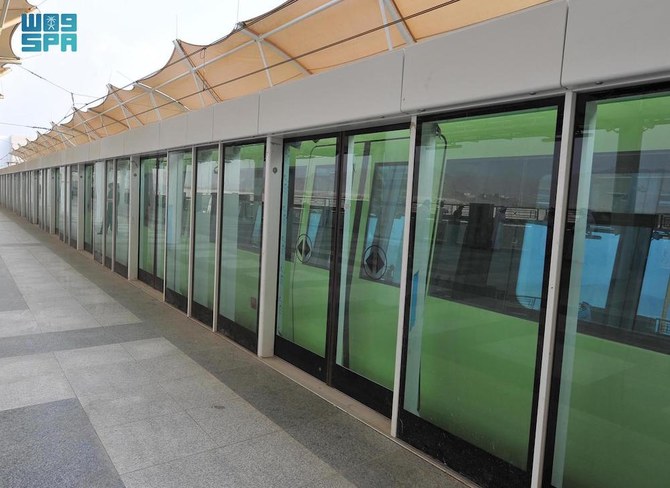
With a capacity of 72,000 passengers per hour in one direction across more than 200 trips, the train facilitates the movement of pilgrims to and from their destinations. (SPA)
3 / 3
With a capacity of 72,000 passengers per hour in one direction across more than 200 trips, the train facilitates the movement of pilgrims to and from their destinations. (SPA)
Short Url
Updated 09 June 2024
Follow

Mashaer metro ready to transport thousands of pilgrims

  • The Mashaer metro system comprises nine stations located across the holy sites, connected by an 18-km double-track railway,

JEDDAH: As the Hajj season approaches, the Mashaer metro is ready to play a crucial role in transporting thousands of pilgrims between the holy sites in Makkah.

The train, with its efficient operations and unique features, is set to enrich the pilgrimage experience and ensure the smooth movement of pilgrims during their rituals.

The Mashaer metro system comprises nine stations located across the holy sites, connected by an 18-km double-track railway, the Saudi Press Agency reported.

With a capacity of 72,000 passengers per hour in one direction across more than 200 trips, the train facilitates the movement of pilgrims to and from their destinations.

Operating at a speed of 80 km per hour, the train can swiftly transport pilgrims between Mina and Arafat in just 20 minutes, the SPA said.

The fleet has 17 trains, each capable of carrying 3,000 passengers.

The Mashaer metro is also built on an environmentally sustainable model using electric power, helping to preserve holy sites and safeguard the health of pilgrims.

The eco-friendly approach reduces traffic congestion and carbon emissions by eliminating about 50,000 passenger buses from the roads during the Hajj season.


Saudi Arabia led green building performance regionally in 2025: Report

Updated 40 min 45 sec ago
Follow

Saudi Arabia led green building performance regionally in 2025: Report

  • Saudi Arabia achieved the highest regional score of 76.31 points and certified more than 1.03 million sq. meters of sustainable building space
  • Results reflect measurable efficiency gains across 6,662 projects completed since 2010, marking a new regional benchmark for measurable sustainability progress

RIYADH: Saudi Arabia led the region in sustainable building performance and environmental impact in 2025, according to the Saaf index developed by the Saudi Green Building Forum.

Saudi Arabia achieved the highest regional score of 76.31 points and certified more than 1.03 million sq. meters of sustainable building space, the Saudi Press Agency reported on Wednesday.

These results reflect measurable efficiency gains across 6,662 projects completed since 2010, marking a new regional benchmark for measurable sustainability progress and institutional excellence.

The achievement underscores Saudi Arabia’s growing influence in advancing sustainable construction across the Middle East and supports the Kingdom’s Vision 2030 objectives for cleaner growth, resource efficiency and climate resilience through data‑driven environmental performance.

Faisal Al‑Fadl, secretary‑general of SGBF, said that 2025 represented a major turning point toward a measurable, institutional sustainability strategy that united policy, technology and practice.

He added that the approach extended beyond renewable energy, clean water and eco‑friendly materials to embed sustainability in economic planning and public development programs, made possible through integrated efforts with regional governments and public institutions.

The Saaf index provides a specialized regional framework for measuring efficiency and resilience through the Sufficiency and Resilience Composite Index, or SCI, enabling precise performance assessments.

Findings show that the sector has evolved into a cohesive strategy integrating project delivery, professional capacity building, market innovation and climate action.

According to the SGBF review, Saudi  Arabia’s achievements reflect its ability to combine quality implementation, institutional maturity and scale.

Environmentally, green building projects achieved an estimated 62,800 tonnes  of  carbon‑equivalent annual reduction and earned 29 professional recognitions, reinforcing growing international acknowledgment of Saudi leadership in sustainability.

The data also underscore SGBF’s role as a professional partner in advancing methodologies, applications and impact measurement within non‑governmental frameworks that link policy and practical execution.

More than 7,300 professionals across 22 Arab countries engaged with the Saaf platform in 2025, alongside numerous business‑driven initiatives expanding the region’s sustainable‑development footprint.

Al‑Fadl said that the period from 2025 to 2026 would act as a bridge toward Vision 2030, strengthening a model in which sustainable buildings were managed by impact, measured through indicators and implemented via lasting partnerships.

SGBF serves as the Kingdom’s leading platform for advancing sustainable construction and green design. It unites experts, innovators and practitioners dedicated to building environmentally responsible and high‑performance structures.

Through continuous education, certification and collaboration, SGBF drives the transformation of Saudi Arabia’s building sector — minimizing environmental impact, promoting resource efficiency and improving overall quality of life for communities nationwide.
