

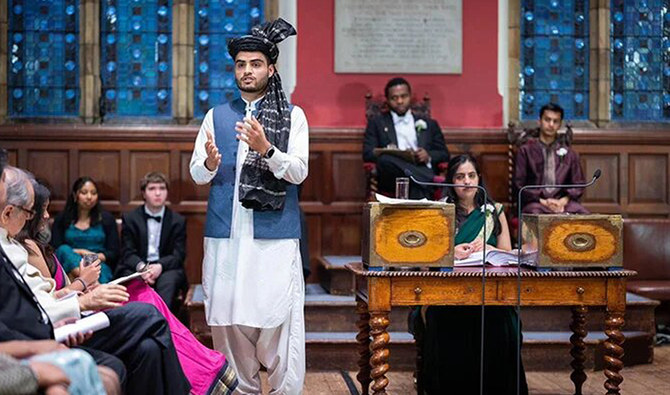
In a first, student from Pakistan’s Balochistan elected Oxford Union president

An undated file photo of Israr Khan at the Oxford University. (Photo courtesy: Murtaza Ali Shah/X)
Short Url
Updated 09 June 2024
Follow

In a first, student from Pakistan’s Balochistan elected Oxford Union president

  • Israr Khan, who hails from Pakistan’s southwestern Killa Abdullah city in Balochistan, was elected on Saturday as Oxford Union’s president 
  • Before Khan, ex-PM Benazir Bhutto and student Ahmad Nawaz were elected to head one of the world’s most prestigious debating societies

ISLAMABAD: In a historic development this week, a student from Pakistan’s Balochistan was elected as the head of the Oxford Union, considered one of the most prestigious debating societies around the world. 

The Oxford Union, founded in 1823, has a tradition of hosting internationally prominent individuals across politics, academia, and popular culture. 

The union remains an independent, student-led society with a membership primarily drawn from The University of Oxford. Members have the opportunity to meet their heroes and challenge those with whom they disagree in a forum that promotes debate and critical thinking.

Israr Khan, who hails from Pakistan’s restive southwestern Balochistan province, got elected on Saturday as the president of the Union after bagging 617 first preferences, winning by a significant margin over contender Izzy Horrocks-Taylor’s 393 first preferences. He hails from Balochistan’s Killa Abdullah city. 

“Coming from a remote village on Pak- Afghan border in Balochistan, this is beyond what I ever imagined,” Khan wrote on social media platform X. 

“I am incredibly grateful to the members of the Oxford Union for their trust in electing me as President, and to my team for believing in me.”

Khan is pursuing a DPhil in Law at Regent’s Park College and has served as the Union’s Chief of Staff. According to the Oxford University’s student newspaper, Khan emphasized fighting the Union’s “institutional racism” while Horrocks-Taylor centered her campaign on increasing “female representation on committees and in our term card.”

Khan is the third Pakistani student who has been elected to head the prestigious debating union. Before him, former prime minister Benazir Bhutto and Oxford University student Ahmad Nawaz were also elected to head the Oxford Union. 

Balochistan Chief Minister Sarfraz Bugti took to X to congratulate Khan on his achievement. 

“A proud moment for Balochistan & Pakistan,” Bugti wrote. “Following in the footsteps of Shaheed Benazir Bhutto, @IkIsrar has won the @OxfordUnion Presidency. More power to you, Israr!“

Pakistani journalist Hamid Mir posted a picture with Khan on X. 

“Israr Khan is the first student from Balochistan and 3rd from Pakistan who has been elected as the President of Oxford Union,” Mir wrote. 


At ECO meeting, Pakistan proposes ‘Regional Innovation Hub’ to curb natural disasters

Updated 21 January 2026
Follow

At ECO meeting, Pakistan proposes ‘Regional Innovation Hub’ to curb natural disasters

  • Pakistan hosts high-level 10th ECO Ministerial Meeting on Disaster Risk Reduction in Islamabad
  • Innovation hub to focus on early warning technologies, risk informed infrastructure planning

ISLAMABAD: Pakistan has proposed to set up a “Regional Innovation Hub on Disaster Risk Reduction” that focuses on early warning technologies and risk informed infrastructure planning, the Press Information Department (PID) said on Wednesday, as Islamabad hosts a high-level meeting of the Economic Cooperation Organization (ECO).

The ECO’s 10th Ministerial Meeting on Disaster Risk Reduction (DRR) is being held from Jan. 21-22 at the headquarters of the National Disaster Management Authority (NDMA) in Pakistan’s capital. 

The high-level regional forum brings together ministers, and senior officials from ECO member states, representatives of the ECO Secretariat and regional and international partner organizations. The event is aimed to strengthen collective efforts toward enhancing disaster resilience across the ECO region, the PID said. 

“Key agenda items include regional cooperation on early warning systems, disaster risk information management, landslide hazard zoning, inclusive disaster preparedness initiatives, and Pakistan’s proposal to establish a Regional Innovation Hub on Disaster Risk Reduction, focusing on early warning technologies, satellite data utilization, and risk-informed infrastructure planning,” the statement said. 

The meeting was attended by delegations from ECO member states including Pakistan, Türkiye, Azerbaijan, Iran, Kyrgyzstan, Tajikistan, Turkmenistan and Uzbekistan. Representatives of regional and international organizations and development partners were also in attendance.

Discussions focused on enhancing regional coordination, harmonizing disaster risk reduction frameworks, and strengthening collective preparedness against transboundary and climate-induced hazards impacting the ECO region, the PID said. 

ECO members states such as Pakistan, Türkiye, Afghanistan and others have faced natural calamities such as floods and earthquakes in recent years that have killed tens of thousands of people. 

Heavy rains triggered catastrophic floods in Pakistan in 2022 and 2025 that killed thousands of people and caused damages to critical infrastructure, inflicting losses worth billions of dollars. 

Islamabad has since then called on regional countries to join hands to cooperate to avert future climate disasters and promote early warning systems to avoid calamities in future.