ISLAMABAD: Prime Minister Shehbaz Sharif has arrived in the Chinese city of Xi’an in the third leg of his five-day visit to China, Sharif’s office said on Friday, with the premier saying he was looking forward to exploring new avenues to benefit from China’s agricultural prowess and “modernization.”
Since the 1980s, Xi’an has matured into an agricultural, industrial and educational hub as part of the economic growth of inland China. It ranks among top cities across the world known for scientific research output and is home to multiple prestigious educational institutions.
The Pakistani prime minister arrived on a five-day visit to China this week in an effort to upgrade the China-Pakistan Economic Corridor (CPEC), a flagship of the Belt and Road Initiative (BRI), through which Beijing has pledged over $60 billion in the South Asian country.
Upon his arrival in Xi’an, the prime minister was warmly welcomed by Chen Chunjiang, vice-governor of the Shaanxi province, and senior diplomatic staff of both countries, according to Sharif’s office.
“Looking forward to learning about China’s agricultural modernization and innovation from the world class facilities of this great city,” the prime minister said on X, after landing in Xi’an.
“Keen to explore new avenues of cooperation and further deepen our linkages in agriculture to enhance Pakistan’s food productivity and quality.”
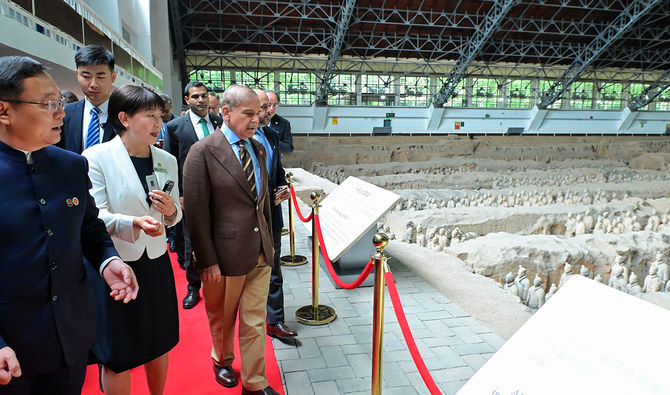
PM Sharif visited the Terracotta Warriors Museum in Xi’an along with the Pakistani delegation, where they were briefed on the preservation and restoration of China’s historical heritage and the promotion of tourism, according to his office. He visited various parts of the museum and appreciated the beauty of the ancient Chinese heritage and craftsmanship.
“Great nations like China protect their historical heritage,” Sharif said. “The skill of Chinese craftsmen from 200BC is admirable.”
During his visit to Xi’an, Sharif will meet top leadership of the province and tour the Yangling Institute of Modern Agriculture, his office said.
On Friday, Sharif held a meeting with President Xi Jinping and discussed with him tapping Pakistan’s potential as a regional hub of trade and connectivity.
“Had the honor of meeting President Xi Jinping at the iconic Great Hall of People in Beijing,” the prime minister said on X. “We discussed various dimensions of the multi-faceted Pakistan-China relationship and reaffirmed our longstanding and steadfast friendship, All-Weather Strategic cooperation, economic and trade ties, and CPEC.”
Earlier in the day, Sharif held delegation-level talks with China’s Premier Li Qiang to discuss CPEC’s development and timely completion of all ongoing projects.
“The two leaders expressed continued commitment and support for the high-quality development of China-Pakistan Economic Corridor (CPEC) and timely completion of all ongoing projects,” the Pakistani foreign office said in a statement.
“The two sides also expressed their firm commitment to protect CPEC from its detractors and adversaries.”
Since its initiation in 2013, CPEC has seen tens of billions of dollars funneled into massive transport, energy and infrastructure projects in Pakistan. But the undertaking has been hit by Islamabad struggling to keep up its financial obligations as well as attacks on Chinese targets by militants.
Most recently, five Chinese engineers, who were working on a dam in northwest Pakistan, were killed in a suicide bombing on March 26.
In the meeting with his Chinese counterpart, Sharif reaffirmed Pakistan’s unflinching resolve to ensure the safety and security of Chinese personnel and projects in Pakistan.
The delegation-level talks were followed by a ceremony, where 23 memorandums of understanding (MoUs) and agreements were signed on deepening cooperation between the two countries in transport, infrastructure, industry, energy, agriculture, media, health, water, socio-economic development and other areas of mutual interest.
Since his arrival in China, the prime minister has held several meetings with Chinese investors and businesspersons to discuss and explore investment opportunities in Pakistan.
In these meetings and events, including the Business Conference in Shenzhen, the prime minister encouraged Chinese companies to invest in Pakistan and develop joint ventures, according to the Pakistani foreign office.
Officials of around 79 Pakistani companies were also present in the southeastern Chinese city of Shenzhen to attend the business forum. Both sides signed a number of agreements in economy, green energy, textiles and manufacturing.


![]()
![]()

Pakistan hopes to learn from China’s ‘modernization’ as PM arrives in city known for advanced agriculture

Short Url
https://arab.news/cr59z
Pakistan hopes to learn from China’s ‘modernization’ as PM arrives in city known for advanced agriculture
- Shehbaz Sharif says he is keen to explore new avenues of cooperation and further deepen linkages with China in agriculture, food productivity
- On Friday, he held a meeting with President Xi Jinping and discussed with him tapping Pakistan’s potential as hub of trade and connectivity
Latest updates





Recommended


© 2026 SAUDI RESEARCH & PUBLISHING COMPANY, All Rights Reserved And subject to Terms of Use Agreement.