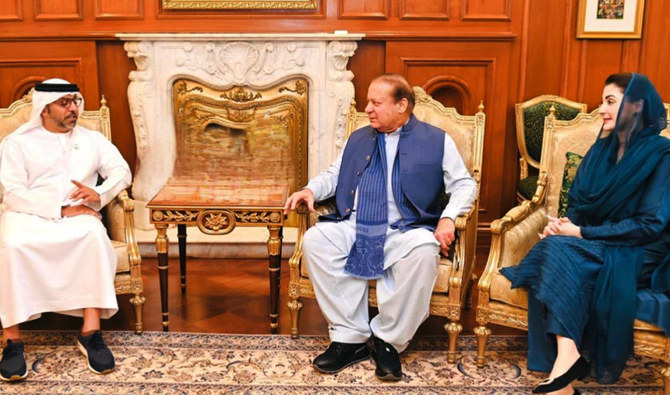
ISLAMABAD: Nawaz Sharif, head of the ruling Pakistan Muslim League-Nawaz (PML-N) party, and Punjab Chief Minister Maryam Nawaz Sharif on Thursday met with United Arab Emirates (UAE) Ambassador Hamad Obaid Al-Zaabi in the Pakistani hill station of Murree and discussed with him cooperation in trade and several other sectors, the Punjab CM office said.
The UAE is Pakistan’s third-largest trading partner, after China and the United States as well as home to more than a million Pakistani expatriates and the second-largest source of remittances to Pakistan, after Saudi Arabia.
Policymakers in the South Asian country consider the Gulf state an optimal export destination due to its geographical proximity, which minimizes transportation and freight costs while facilitating commercial transactions.
During the meeting, the two sides shared their views on the promotion of bilateral relations between the two brotherly countries, according to the Punjab CM office.
“Discussions were held on increasing cooperation in various fields, including agricultural research, technology and trade,” the CM office said in a statement, adding the two sides agreed to cooperate in increasing agricultural productivity and promoting food security.
“They reviewed possibilities in livestock development and dairy farming, besides considering investment promotion in pharmaceutical and other industrial sectors.”
Sharif and the Punjab CM also appreciated the UAE’s announcement of $10 billion investment in the South Asian country and thanked the Gulf nation for the assistance.
UAE President Sheikh Mohamed bin Zayed Al Nahyan made the announcement during a meeting with Pakistan Prime Minister Shehbaz Sharif last month, according to the Pakistani PM’s Office.
Sharif met the UAE president in Abu Dhabi on May 23 during a day-long trip to the Gulf country where he arrived with a high-level delegation, amid a concerted push by Pakistan to seek foreign investment as it navigates a challenging path to economic recovery.
The UAE is one of Pakistan’s closest allies and has frequently bailed out the South Asian country, joining Saudi Arabia and China in rolling over billions of dollars of loans to Pakistan last year to help it clinch a last-gasp deal with the International Monetary Fund (IMF) and avoid a sovereign debt default.


![]()

Pakistan ruling party chief, UAE envoy discuss cooperation in trade and other sectors
Short Url
https://arab.news/5h7k3
Pakistan ruling party chief, UAE envoy discuss cooperation in trade and other sectors
- The UAE is Pakistan’s third-largest trading partner, after China and the US as well as home to more than a million Pakistani expats
- Policymakers in the South Asian country consider the Gulf state an optimal export destination due to its geographical proximity
Latest updates


Recommended


© 2026 SAUDI RESEARCH & PUBLISHING COMPANY, All Rights Reserved And subject to Terms of Use Agreement.