

Sindh press clubs demand action as report says 10 journalists killed across province

Pakistani journalists hold a protest demonstration in solidarity with Palestinian counterparts in Karachi, Pakistan on May 3, 2024. (AFP/File)
Short Url
Updated 06 June 2024
Follow

Sindh press clubs demand action as report says 10 journalists killed across province

  • Pakistan-based media watchdog launches report which says from 2018-2023, 10 journalists killed in Sindh
  • Journalists say Sindh continues to remain one of Pakistan’s most concerning regions for their safety 

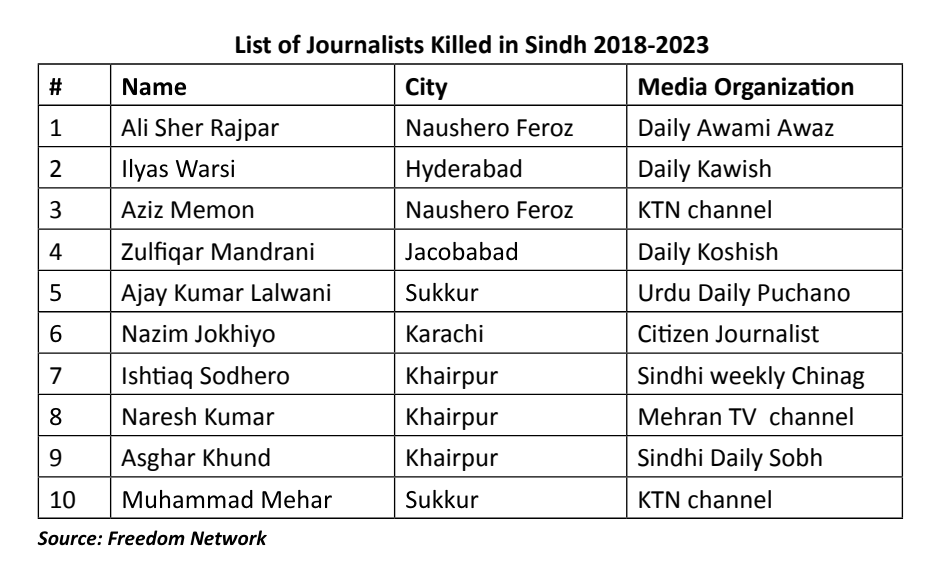
KARACHI: Journalist unions and press clubs across Pakistan’s Sindh on Thursday urged the government to take urgent action to ensure freedom of expression and that journalists remained safe in the province, citing a report that said 10 media workers have been killed in the past five years there. 

Representatives of press clubs and journalist unions from Sindh’s Sukkur, Khairpur, Hyderabad and Karachi cities attended the launch of a special report, titled: “Journalism in the Shadow of Violence” at the Karachi Press Club. The report was launched by Pakistan-based media and development sector watchdog, Freedom Network. The event was organized by the Sindh chapter of the Pakistan Journalists Safety Coalition (PJSC). 

As per the report, 184 incidents of violence against journalists took place in Sindh between 2018 and 2023, whichincluded the killings of 10 journalists in the province. Freedom Network Executive Director Iqbal Khattak said the report described the current situation of media freedoms and journalists’ safety in Sindh.

“Sindh continues to remain one of the most concerning regions for the safety of journalists in Pakistan, even though the province has a special legislation to combat impunity in crimes against journalists,” Khattak said, according to a press release by the PJSC. 
President of the PJSC’s Sindh chapter, Amir Lateef, said the targeting of journalists in the province has increased alarmingly, especially in northern Sindh, which has witnessed a disturbing rise in physical attacks against journalists.

“The issue is that the state is not supporting journalists,” Lateef said. “We will use the report’s findings to lobby with government officials and policymakers to ensure that they support the journalist community against safety risks.”

Senior journalist Mazhar Abbas demanded media owners also be held accountable or the safety of their workers while Khan Muhammad, president of the Khairpur Press Club, said journalists in rural Sindh require support against legal and physical threats.

Imdad Buzdar, president of the Sukkur Press Club, called on journalists to unite for a constant struggle for their rights while Sajjad Khanzada, the Hyderabad Press Club’s president, said brazen attacks on journalists will continue until their perpetrators are brought to justice.

Khattak had earlier shared details of the report, the PJSC said, adding that it shows low-income backgrounds of critical journalists, the lack of enforcement of labor laws in the news industry and the lack of digital safety skills create pressures for local journalists. This, the PJSC said, makes them vulnerable to threats and forces them to take undue risks.


Pakistan, ADB sign $730 loan agreements to boost SOE reforms, energy infrastructure

Updated 25 December 2025
Follow

Pakistan, ADB sign $730 loan agreements to boost SOE reforms, energy infrastructure

  • Both sign $330 million Power Transmission Strengthening Project and $400 million SOE Transformation Program loan agreements
  • Economic Affairs Division official says Transmission Project will secure Pakistan’s energy future by strengthening national grid’s backbone

KARACHI: Pakistan and the Asian Development Bank (ADB) on Thursday signed two loan agreements totaling $730 million to boost reforms in state-owned enterprises (SOEs) and energy infrastructure in the country, the bank said.

The first of the two agreements pertains to the SOE Transformation Program worth $400 million while the second loan, worth $330 million, is for a Power Transmission Strengthening Project, the lender said. 

The agreements were signed by ADB Country Director for Pakistan Emma Fan and Pakistan’s Secretary of Economic Affairs Division Humair Karim. 

“The agreements demonstrate ADB’s enduring commitment to supporting sustainable and inclusive economic growth in Pakistan,” the ADB said. 

Pakistan’s SOEs have incurred losses worth billions of dollars over the years due to financial mismanagement and corruption. These entities, including the country’s national airline Pakistan International Airlines, which was sold to a private group this week, have relied on subsequent government bailouts over the years to operate.

The ADB approved the $400 million loan for SOE reforms on Dec. 12. It said the program seeks to improve governance and optimize the performance of Pakistan’s commercial SOEs. 

Karim highlighted that the Power Transmission Strengthening Project will enable reliable evacuation of 2,300 MW from Pakistan’s upcoming hydropower projects, relieve overloading of existing transmission lines and enhance resilience under contingency conditions, the Press Information Department (PID) said. 

“The Secretary emphasized that both initiatives are transformative in nature as the Transmission Project will secure Pakistan’s energy future by strengthening the backbone of the national grid whereas the SOE Program will enhance transparency, efficiency and sustainability of state-owned enterprises nationwide,” the PID said. 

The ADB has supported reforms by Pakistan to strengthen its public finance and social protection systems. It has also undertaken programs in the country to help with post-flood reconstruction, improve food security and social and human capital. 

To date, ADB says it has committed 764 public sector loans, grants and technical assistance totaling $43.4 billion to Pakistan.