Pakistan, China sign multiple agreements in agriculture, logistics and digital economy sectors

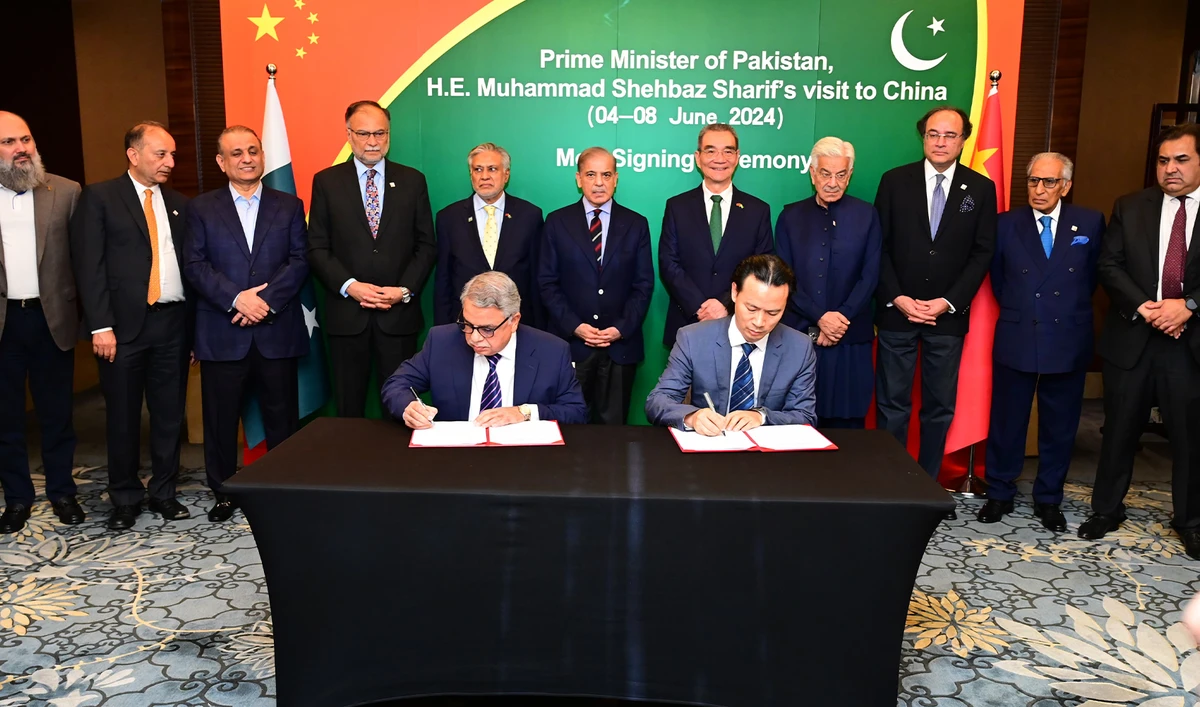
Pakistan Prime Minister Muhammad Shehbaz Sharif (sixth from left in the second row) witnesses signing multiple Memorandums of Understanding (MoUs) between China and Pakistan in Beijing, China, on June 6, 2024. (Government of Pakistan)
Short Url
Updated 06 June 2024
Follow

Pakistan, China sign multiple agreements in agriculture, logistics and digital economy sectors

  • Agreements signed during third day of Prime Minister Shehbaz Sharif’s visit to China from June 4-8
  • Sharif, Deputy PM Dar praise China’s outward-looking global economic policies during signing ceremony

ISLAMABAD: Prime Minister Shehbaz Sharif on Thursday oversaw the signing of multiple agreements between Pakistan and China in the fields of agriculture, logistics, digital and green economy, the state-run Associated Press of Pakistan (APP) said in a statement. 

The memorandums of agreement were signed during the third day of PM Shehbaz Sharif’s visit to China from June 4-8 as the South Asian nation pushes to bring in much needed foreign direct investment. 

The focus of Sharif’s visit is business-to-business meetings and efforts to seek an upgrade for the China-Pakistan Economic Corridor (CPEC), a flagship of President Xi Jinping’s Belt and Road Initiative, through which Beijing has pledged over $60 billion in Pakistan since 2015.

“Pakistan and China on Thursday signed multiple Memorandums of Understanding (MoUs) to enhance bilateral cooperation in agriculture, labor-intensive manufacturing industry, digital economy, green economy and logistic ecosystem,” the state-run Associated Press of Pakistan (APP) said. 

PM Sharif and Deputy Prime Minister and Foreign Minister Ishaq Dar attended the ceremony, where the agreements were signed between Pakistan’s Board of Investment (BoI) and several Chinese entities.

Sharif and Dar both spoke about the importance of China’s outward-looking global economic policies, the capacity of Chinese enterprises to invest in the global market and the matching potential of Pakistan’s domestic market.

“He highlighted the supportive environment in Pakistan for Chinese businesses interested in relocating industries from China,” APP said. 

The development takes place a day after Pakistan and China signed 32 memorandums of agreement in the fields of IT, textiles, leather and footwear, minerals, pharmaceuticals and agriculture and food processing. It was termed as a “historic” moment by the Prime Minister’s Office (PMO).

Sharif’s visit to China takes place amid Pakistan’s push to attract foreign investment in key economic sectors to stabilize its fragile $350 billion economy. The Pakistani prime minister has repeatedly said Islamabad seeks regional cooperation for “mutual benefits” with its allies and not just loans. 

The South Asian country narrowly avoided a sovereign default last year when it clinched a last-gasp $3 billion deal with the International Monetary Fund (IMF). Islamabad views Beijing as one of its most reliable foreign partners in recent years, which has invested over $60 billion in energy and infrastructure projects in Pakistan as part of the China-Pakistan Economic Corridor (CPEC). 

‘Super Flu’: Pakistan confirms presence of fast-spreading H3N2 influenza strain

Updated 58 min 21 sec ago
Follow

‘Super Flu’: Pakistan confirms presence of fast-spreading H3N2 influenza strain

  • Health authorities say virus is not new but shows higher transmission rate
  • WHO reports global rise in seasonal influenza cases, especially in Europe

ISLAMABAD: Pakistani health authorities on Monday confirmed the presence of the H3N2 influenza strain, often referred to as a fast-spreading “super flu,” in the country, but stressed there was no cause for panic, saying the virus is not new and remains manageable with standard treatment and vaccination.

Officials said the strain is part of seasonal influenza viruses that circulate globally each year and has undergone genetic changes that make it spread more quickly, a pattern health experts say is common for influenza.

The confirmation comes as the World Health Organization (WHO) reports a global increase in seasonal influenza activity in recent months, with a growing proportion of influenza A(H3N2) cases detected, particularly across several European countries, including the United Kingdom.

“Yes, we have witnessed confirmed cases of H3N2 influenza (super Flu) in Pakistan since November this year. Out of total around 1,691 cases reported throughout Pakistan since last month, 12 percent are of the so called super flu,” Dr. Shafiq-Ur-Rahman, Senior Scientific Officer at Pakistan’s Center for Disease Control (CDC), told Arab News.

He said the virus had undergone a genetic drift, a gradual mutation that is typical of influenza viruses. 

“The symptoms are similar to other influenza strains, but speed of transmission is high for H3N2,” Rahman said, adding that treatment remains the same as for other flu types and vaccination is critical to limiting spread.

Seasonal influenza is an acute respiratory infection caused by influenza viruses that circulate year-round worldwide. The WHO has stressed that influenza continues to evolve through gradual genetic changes, making ongoing surveillance and regular vaccine updates essential.

Influenza spreads easily through droplets when infected people cough or sneeze. While most individuals recover within a week without medical treatment, the illness can range from mild to severe and may result in hospitalization or death, particularly among high-risk groups such as young children, older adults, pregnant women and people with underlying health conditions.

Doctors say early symptoms of the flu can resemble those of the common cold, but the progression often differs. Colds typically develop gradually, beginning with a runny or blocked nose, sneezing and sore throat, followed by mild coughing and fatigue.

Flu symptoms, however, tend to appear suddenly and more intensely, with patients often experiencing high fever, extreme tiredness, body aches, headaches and a dry cough.

Health experts say this abrupt and severe onset is usually the clearest indication that an illness is influenza rather than a common cold, which is generally milder and slower to develop.