

Saudi Arabia launches ‘National Semiconductor Hub’ to drive industry localization

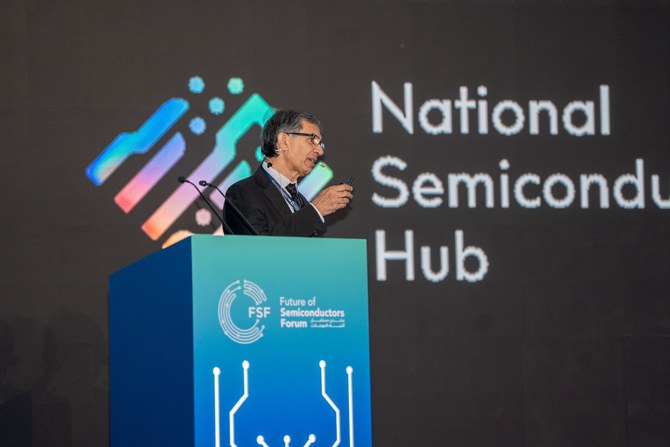
Naveed Sherwani, CEO of Rapid Silicon, speaking at the launch of the National Semiconductor Hub in Riyadh. AN
Short Url
Updated 05 June 2024
Follow

Saudi Arabia launches ‘National Semiconductor Hub’ to drive industry localization

RIYADH: At least 50 semiconductor design companies will be established in Saudi Arabia by 2030 after a new initiative was launched to develop the sector in the Kingdom. 

This undertaking will be supported by a deep tech venture capital fund that exceeds SR1 billion ($266 million) as part of a new National Semiconductor Hub.

The intiative will also provide access to SR150 million in support products from Saudi Arabia’s National Technology Development Program, which is integral to Vision 2030. 

Unveiled during the third edition of the Future of Semiconductors Forum in Riyadh, the hub is a strategic effort to establish a semiconductor design industry ecosystem in the Kingdom, potentially worth upward of SR50 billion. 

This initiative is part of Saudi Arabia’s broader effort to incentivize and attract talent to the sector. It emphasizes innovation over fundraising by launching a deep tech venture capital fund exceeding SR1 billion and investing in the industry. 

Moreover, the hub seeks to attract 25 world-class experts in the field through the premium residency program and aims to train 5,000 engineers in semiconductor design by 2030. 

Following the global shortages of semiconductors in the wake of the 2019 epidemic, the sector’s importance was underscored, prompting the Kingdom to embark on a strategy to address it. 

Speaking during the forum, Ross Jatou, president of the Public Investment Fund subsidiary Alat Semiconductors, underscored the importance of the intersectional nature of this venture, saying: “I argue that future is where you integrate many technologies together that in the past were considered very different. Now this is pretty sophisticated, and sometimes we take it for granted, it’s in everybody’s phone and everybody’s car, and we have it everywhere. Alat will not be able to do this alone.”

He added: “As the saying goes, it takes a village to raise a child, and luckily, with the National Semiconductor hub, with the help of KACST (King Abdulaziz City for Science and Technology) and KAUST (King Abdullah University of Science and Technology) we’re going to make that happen. The Silicon Valley took decades to build, with the national semiconductor hub, we will be able to accelerate this by working together.”

The two-day forum at KACST brought together experts and stakeholders from academia, industry, and government to discuss critical topics that will shape the future of the semiconductor industry. 


Saudi POS spending jumps 28% in final week of Jan: SAMA

Updated 06 February 2026
Follow

Saudi POS spending jumps 28% in final week of Jan: SAMA

RIYADH: Saudi Arabia’s point-of-sale spending climbed sharply in the final week of January, rising nearly 28 percent from the previous week as consumer outlays increased across almost all sectors. 

POS transactions reached SR16 billion ($4.27 billion) in the week ending Jan. 31, up 27.8 percent week on week, according to the Saudi Central Bank. Transaction volumes rose 16.5 percent to 248.8 million, reflecting stronger retail and service activity. 

Spending on jewelry saw the biggest uptick at 55.5 percent to SR613.69 million, followed by laundry services which saw a 44.4 percent increase to SR62.83 million. 

Expenditure on personal care rose 29.1 percent, while outlays on books and stationery increased 5.1 percent. Hotel spending climbed 7.4 percent to SR377.1 million. 

Further gains were recorded across other categories. Spending in pharmacies and medical supplies rose 33.4 percent to SR259.19 million, while medical services increased 13.7 percent to SR515.44 million. 

Food and beverage spending surged 38.6 percent to SR2.6 billion, accounting for the largest share of total POS value. Restaurants and cafes followed with a 20.4 percent increase to SR1.81 billion. Apparel and clothing spending rose 35.4 percent to SR1.33 billion, representing the third-largest share during the week. 

The Kingdom’s key urban centers mirrored the national surge. Riyadh, which accounted for the largest share of total POS spending, saw a 22 percent rise to SR5.44 billion from SR4.46 billion the previous week. The number of transactions in the capital reached 78.6 million, up 13.8 percent week on week. 

In Jeddah, transaction values increased 23.7 percent to SR2.16 billion, while Dammam reported a 22.2 percent rise to SR783.06 million. 

POS data, tracked weekly by SAMA, provides an indicator of consumer spending trends and the ongoing growth of digital payments in Saudi Arabia.  

The data also highlights the expanding reach of POS infrastructure, extending beyond major retail hubs to smaller cities and service sectors, supporting broader digital inclusion initiatives.  

The growth of digital payment technologies aligns with Saudi Arabia’s Vision 2030 objectives, promoting electronic transactions and contributing to the Kingdom’s broader digital economy.