

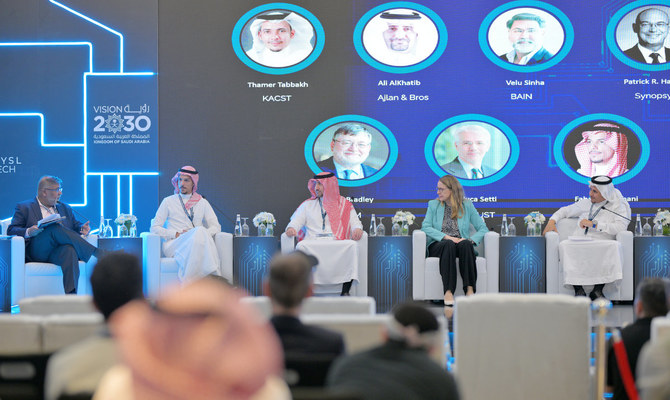
3rd ‘Future of Semiconductors Forum’ to boost digital economy

This year’s forum follows successful first and second editions, which have led to collaborative research and semiconductor manufacturing efforts.
Short Url
Updated 04 June 2024
Follow

3rd ‘Future of Semiconductors Forum’ to boost digital economy

The third edition of the Future of Semiconductors Forum will be held in 2024 in Riyadh, hosted by King Abdulaziz City for Science and Technology in partnership with King Abdullah University of Science and Technology. The event, scheduled for June 5-6, at the Garage Innovation District in Riyadh, will promote the domestic production of electronic chips and boost the digital economy within Saudi Arabia.

This forum will gather esteemed policymakers, industrial pioneers, experts, and scholars in semiconductor technology. Notable participants include Shuji Nakamura, a Nobel laureate in physics known for his development of blue/green LEDs and violet laser diodes, alongside Kang Wang, who holds a professorship in electrical engineering and computer science and serves as co-director of the Center for Quantum Science and Engineering at UCLA and a professor of electrical engineering at Raytheon Company. Also in attendance will be Steven P. DenBaars from the University of California — Santa Barbara, renowned for holding more than 190 US patents and co-founding the Institute of Engineering Electricity and Electronics alongside four photonics and electronics companies.

Umesh Mishra, dean of the College of Engineering at UCSB, joins the list of participants, as do Ross Jatou, president of semiconductor at Alat Company; Dr. Naveed Sherwani, chairman of the board of directors and CEO of Rapid Silicon Company, co-designer of Intel microprocessor algorithms and Intel Award winner; and Professor Goutam Chattopadhyay, a research scientist at NASA’s Jet Propulsion Laboratory and the California Institute of Technology.

Dr. Munir Eldesouki, president of KACST, said the forum reflects the goals and priorities set by Crown Prince Mohammed bin Salman, the prime minister of Saudi Arabia, in the field of research, development, and innovation. It also plays a significant role in advancing the digital economy in the Kingdom. He added that the event is organized by KACST, which serves as a national laboratory and hub for innovation. Its purpose is to enhance the research, development, and innovation system, expedite technological advancements, and promote the localization of technologies.

Dr. Tony Chan, president of KAUST, praised the forum for its accomplishments in the first and second editions. He noted that the new edition offers promising opportunities to enhance the digital economy, advance research cooperation between various entities, and exchange knowledge about best practices in the electronic chip industry by bringing together the most prominent local and international entities under one roof.

The forum’s purpose is to raise awareness about the significance of localizing the electronic chip industry and its contribution to the growth of the digital economy in the Kingdom. It will also explore potential opportunities for localizing this crucial industry to make the Kingdom a key player in the electronic chip sector. Additionally, the forum seeks to promote research collaboration and sharing best practices in semiconductor development and manufacturing.

Over two days, the forum will delve into various subjects to outline the semiconductor industry’s future trajectory in the Kingdom by exploring the semiconductor value chain, from raw materials to finished microchips. 

Additionally, it will examine the application of this cutting-edge technology in areas like space exploration, quantum technologies, 6G communications, electric vehicles, and integrated sensors to enable smart cities.

The third edition of the forum will announce significant initiatives that bolster Saudi Arabia’s standing in the global semiconductor arena, drive transformation in the Middle East, cultivate talent in this vital sector, and address industry challenges to spur economic growth.

This year’s forum follows successful first and second editions, which have led to collaborative research, advancements, and semiconductor manufacturing efforts. This includes the launch of the Saudi Semiconductors Program, a pioneering regional initiative supporting research and development and qualifying cadres in the field of designing and localizing electronic chips. This program collaborates with 16 Saudi universities and has trained more than 400 researchers and students in microchip design and manufacturing.


BYD launches 2nd-gen Blade Battery and FLASH charging technology

Updated 11 March 2026
Follow

BYD launches 2nd-gen Blade Battery and FLASH charging technology

BYD, a global tech leader and pioneer in new energy vehicles, has unveiled the second generation of its Blade Battery alongside its new ultra-fast FLASH charging technology. The announcement marks a significant leap in electric vehicle innovation, further enhancing the appeal of EVs in markets witnessing rapid growth in adoption. Among these markets is Saudi Arabia, which is increasingly emerging as one of the most promising markets in the Middle East for electric mobility, driven by the Kingdom’s vision for a more sustainable future and its commitment to adopting advanced transportation technologies.

Combining a driving range exceeding 1,000 km on a single charge with ultra-fast charging capabilities, the new technology offers a practical and reliable driving experience for EV users in the Kingdom. The second-generation Blade Battery opens new possibilities for long-distance electric travel while significantly reducing the need for frequent charging. The new battery supports ultra-fast charging, enabling vehicles to charge from 10 percent to 70 percent in just five minutes, and reach 97 percent within nine minutes.

The technology also maintains strong performance under extreme weather conditions. Charging from 20 percent to 97 percent at –30°C requires only three additional minutes compared to charging at room temperature.

In a statement, BYD said: “The combination of long driving range and ultra-fast charging represents one of the most important advantages of BYD’s new generation of batteries. With this technology, electric vehicles can travel longer distances with ease. Some models equipped with the second-generation Blade Battery can exceed 1,000 km of range, making this battery particularly suited to the long-distance travel patterns and road networks in Saudi Arabia.”

The second-generation Blade Battery relies on an innovative ion-transfer system known as FlashPass, which combines three advanced technologies designed to enhance charging speed and battery performance. The Flash-Release Cathode enables rapid lithium-ion release, while the Flash-Flow Electrolyte, developed using artificial intelligence, improves ionic conductivity. The Flash-Intercalate Anode enables faster and more efficient lithium-ion insertion, further improving overall battery performance.

The battery also features an advanced restructuring of its electrode design. Graphite particles within the anode are arranged vertically in a structured formation, reducing resistance to lithium-ion transfer and enabling faster, more efficient charging while increasing energy density by more than 5 percent compared with the first-generation Blade Battery.

In addition, the battery incorporates an ultra-thin and highly durable solid electrolyte interface layer, which supports high ionic conductivity while maintaining chemical stability. A dynamic self-repair mechanism further helps preserve battery performance over time.

In terms of safety, the second-generation Blade Battery exceeds the requirements of China’s new national EV battery safety standard GB 38031-2025 and has passed a range of rigorous tests. These include the world’s first combined ultra-fast charging and nail penetration safety test, completed without thermal runaway, smoke, or fire. The battery also successfully passed thermal runaway testing following simultaneous short-circuiting in four battery cells without fire or explosion, as well as undercarriage impact testing at energy levels 10 times higher than those required by the new national safety standard.

Technical innovations in the new battery have also helped reduce capacity degradation by 2.5 percent, improving long-term operational life and efficiency.

Alongside the battery technology, BYD introduced its FLASH ultra-fast charging system, which includes one of the most powerful mass-produced charging units in the world, delivering up to 1,500 kW per charging port.

The company has also developed an integrated energy storage and charging system that operates both as an energy storage unit that helps reduce pressure on the power grid and as a power booster capable of delivering high-capacity charging to vehicles. This approach enables ultra-fast charging while maintaining grid stability and improving overall energy efficiency.

BYD has also introduced an innovative FLASH charger design focused on user convenience. The charger features the world’s first T-shaped cable reel system, which allows the charging cable to remain suspended and prevents contact with the ground. It also includes a “gravity-free” charging connector that can be easily operated with one hand.

In addition, the system supports Plug and Charge functionality with automatic payment, allowing users to simply connect their vehicle and begin charging immediately after initial registration through the application.

As part of its broader strategy to support the growth of electric mobility, BYD is actively building a large network of FLASH charging stations. As of March 5, the company had established 4,239 charging stations across China, with plans to expand the network to 20,000 stations by the end of 2026.

The launch of these new technologies builds on BYD’s long-term vision first introduced in 2006 under the concept of “Three Green Dreams.” This vision focuses on developing an integrated ecosystem that includes solar energy, energy storage, and charging infrastructure, helping accelerate the global transition to electric mobility and support a more sustainable future.