

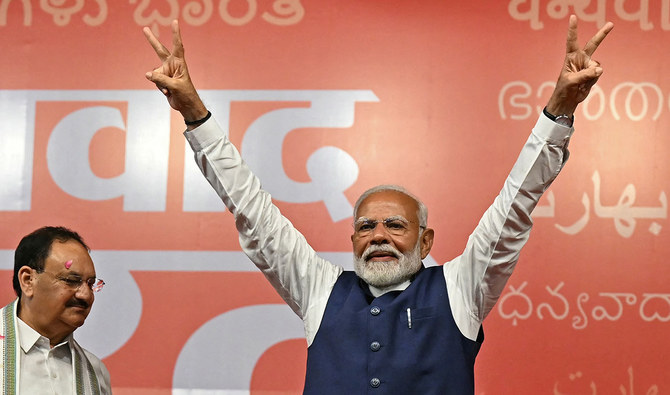
Modi set to take oath for the third time on June 8 as allies pledge support

India’s Prime Minister Narendra Modi (R) flashes victory sign as Bharatiya Janata Party (BJP) President Jagat Prakash Nadda (L) looks on during the celebrations after their victory in India's general election, in New Delhi on June 4, 2024. (AFP)
Short Url
Updated 05 June 2024
Follow

Modi set to take oath for the third time on June 8 as allies pledge support

  • Modi’s BJP loses majority, allies’ support crucial to rule
  • Election results may impact reform agenda, analysts say

HYDERABAD, India: Indian Prime Minister Narendra Modi is expected to be sworn-in for a record-equalling third term on June 8, after key allies pledged their continued support a day after a humbling election verdict that saw his party lose its majority in parliament.
Modi, a populist who has dominated Indian politics since coming to power in 2014, will for the first time need the support of regional allies whose loyalties have wavered over the years, which could complicate the government’s reform agenda.
On Wednesday, two allies in his National Democratic Alliance coalition, the Telugu Desam Party, a key regional player in the southern state of Andhra Pradesh, and the Janata Dal (United) which rules the northern state of Bihar, pledged their support.
“We are with the NDA, I will be attending the meeting in Delhi today,” Chandrababu Naidu, the leader of the TDP, told reporters, referring to a meeting of the BJP-led alliance scheduled to take place later in the day.
Modi tendered his resignation on Wednesday to President Droupadi Murmu after the federal cabinet met and recommended the dissolution of parliament, the first of many constitutional formalities before Modi can form a new government.
Modi and his new cabinet were scheduled to be sworn-in on Saturday, local media reported.
The NDA won 293 seats in the 543-member lower house of parliament, more than the 272 needed to form a government.

Modi’s BJP won 240 seats on its own, a weakened verdict which could slow India’s fiscal tightening, ratings agency Moody’s said.
Both regional allies, the TDP and JD-(U), are considered pragmatists on economic policy, but Modi’s new government is likely to need to find money to fund more spending on welfare projects in their states.
The weakened majority for Modi’s alliance could pose challenges for the more ambitious elements of the government’s reform agenda, ratings agency Fitch said.
However, it added: “Despite the slimmer majority, we do expect broad policy continuity to persist, with the government retaining its focus on its capex push, ease of doing business measures, and gradual fiscal consolidation.”
The closer-than-expected election should increase the prospect of productive reforms, the country’s chief economic adviser the country’s chief economic adviser said on Wednesday.

RURAL SETBACKS
With the party losing most ground in rural areas, investors say land and labor reforms, that had been expected to unlock value and growth, will probably fall by the wayside.
Newspapers said Modi’s aura had dimmed, with the Indian Express’s banner headline reading: “India gives NDA a third term, Modi a message.”
In the latter stages of the campaign Modi had sought to renew his appeal to India’s Hindu-majority, accusing the opposition of favoring minority Muslims.
But without a majority of its own, some policies of his Hindu-nationalist BJP, such as a uniform civil code for all religions that was opposed by some Muslims, will likely be put on the back burner, with Modi’s regional allies seen as more accommodating toward minorities.
The BJP lost heavily in the two states that send the most lawmakers to parliament, its northern stronghold of Uttar Pradesh, which has 80 seats, and the western state of Maharashtra, which sends 48 members to the decision-making lower house.
In Uttar Pradesh, the party lost nearly half its seats, down to 33 from its 2019 tally of 62, while in Maharashtra, India’s richest state that includes financial powerhouse Mumbai, it slumped to a dismal nine seats from its previous tally of 23.
Modi’s own victory in his seat of Varanasi, located in Uttar Pradesh and considered one of the holiest cities for Hindus, was subdued, with his margin of victory down from nearly 500,000 votes at the last general election in 2019 to a little more than 150,000.
But this reduced victory may not necessarily mean reform paralysis, the chairman of a government finance panel, Arvind Panagariya, said in an editorial in the Economic Times newspaper.
“Despite the reduced majority in parliament, the necessary reforms are entirely feasible. Delivering sustained growth at a accelerated pace can only strengthen the government’s hand in the coming years,” he said.
The opposition INDIA alliance led by Rahul Gandhi’s centrist Congress party won 230 seats, more than forecast. Congress alone won 99, almost double the 52 it won in 2019 — a surprise jump that is expected to boost Gandhi’s standing.
The INDIA alliance was also expected to meet on Wednesday in New Delhi, and discuss a future course of action.


Rohingya refugees hope new leaders can pave a path home

Updated 6 sec ago
Follow

Rohingya refugees hope new leaders can pave a path home

  • Some 1.7 million Rohingya Muslims displaced in Myanmar's military crackdown live in squalid camps in Cox’s Bazar, Bangladesh

COX’S BAZAR, Bangladesh: Rohingya refugees living in squalid camps in Bangladesh have elected a leadership council, hoping it can improve conditions and revive efforts to secure their return home to Myanmar.
Spread over 8,000 acres in Cox’s Bazar in Bangladesh, the camps are home to 1.7 million members of the stateless group, many of whom fled a 2017 military crackdown that is now subject to a genocide probe at the UN court.
In July, the refugees held their first elections since their influx began eight years ago, resulting in the formation of the United Council of Rohang (UCR).
“They are working to take us home,” said Khairul Islam, 37, who back home had a thriving timber business.
The new council has brought him a glimmer of hope amid an uncertain future.
“We can hardly breathe in these cramped camp rooms... all our family members live in a single room,” he said.
“It’s unbearably hot inside. Back in Myanmar, we didn’t even need a ceiling fan. In summer, we used to sit under tall trees,” Islam said, his eyes welling up.
More than 3,000 voters from across 33 refugee camps cast their ballots to elect an executive committee and five rotating presidents to focus on human rights, education and health.
Addressing a gathering at one of the camps, UCR president Mohammad Sayed Ullah urged refugees not to forget the violence that forced the mostly Muslim group to flee Myanmar’s Rakhine state.
“Never forget that we left our parents’ graves behind. Our women died on the way here. They were tortured and killed... and some drowned at sea,” said Sayed Ullah, dressed in a white full-sleeved shirt and lungi.
“We must prepare ourselves to return home,” he said, prompting members of the audience to nod in agreement.

A seat at the table 

“UCR wants to emerge as the voice of the Rohingyas on the negotiation table,” Sayed Ullah later told AFP.
“It’s about us, yet we were nowhere as stakeholders.”
The council is not the first attempt to organize Rohingya refugees.
Several groups emerged after 2017, including the Arakan Rohingya Society for Peace and Human Rights, once led by prominent activist Mohib Ullah.
But he was murdered in 2021.
And even before that, many organizations were shut down after a major 2019 rally, when the Rohingya said they would go home only with full rights and safety guarantees.
“Some newspapers misrepresented us, claiming we wanted to stay permanently in Bangladesh,” Sayed Ullah said.
“Many organizers were detained. The hardest blow was the assassination of Mohib Ullah.”
But trust is slowly building up again among the Rohingya crammed in the camps in Cox’s Bazar.
“Of course we will return home,” said 18-year-old Mosharraf, who fled the town of Buthidaung with his family.
“UCR will negotiate for better education. If we are better educated, we can build global consensus for our return,” he told AFP.

Security threats 

Many refugees have started approaching the body with complaints against local Rohingya leaders, reflecting a slow but noticeable shift in attitudes.
On a recent sunny morning, an AFP reporter saw more than a dozen Rohingya waiting outside the UCR office with complaints.
Some said they were tortured while others reported losing small amounts of gold they had carried while fleeing their homes.
Analysts say it remains unclear whether the new council can genuinely represent the Rohingya or if it ultimately serves the interests of Bangladeshi authorities.
“The UCR ‘elections’ appear to have been closely controlled by the authorities,” said Thomas Kean, senior consultant at the International Crisis Group.
Security threats also loom large, undermining efforts to forge political dialogue.
Armed groups like the Arakan Rohingya Salvation Army and Rohingya Solidarity Organization continue to operate in the camps.
A report by campaign group Fortify Rights said at least 65 Rohingyas were killed in 2024.
“Violence and killings in the Rohingya camps need to stop, and those responsible must be held to account,” the report quoted activist John Quinley as saying.