US flies B-1B bomber over Korean peninsula as tension simmers with Pyongyang

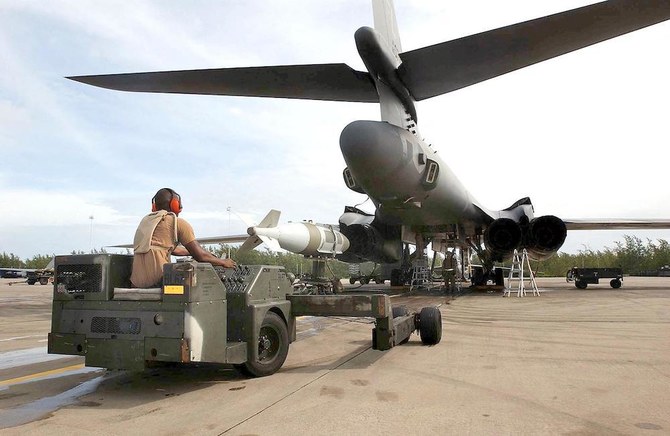
A long-range B-1B is capable of carrying a large conventional weapons payload. (AFP file photo)
Short Url
Updated 05 June 2024
Follow

US flies B-1B bomber over Korean peninsula as tension simmers with Pyongyang

  • B-1B bomber dropped JDAMs during the training while being escorted by South Korean jets
  • North Korean has previously called the bomber’s deployment proof of US hostility

SEOUL: The United States flew a long-range B-1B bomber over the Korean Peninsula on Wednesday for its first precision-guided bombing drill with South Korea in seven years, the South said Wednesday.
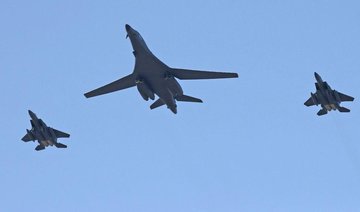
The US B-1B bomber conducted joint aerial drills with other US and South Korean fighter jets, South Korea’s Defense Ministry said in a statement.
It said the B-1B bomber dropped Joint Direct Attack Munitions during the training while being escorted by South Korean jets, the first such bombing drill since 2017.
The JDAM bombs include “bunker-busters.” JDAM is a guidance system that converts unguided, conventional bombs into more precise, GPS-guided weapons. All US fighter jets, bombers and drones can use JDAMs, and the munitions are among the weapons systems the United States has been providing to Ukraine to help it fight Russia’s invasion.
The drill is seen as a show of force against North Korea amid rising tensions over its recent launches of trash-carrying balloons toward South Korea. North Korea is sensitive to drills of bunker-buster bombs, which could threaten its leadership.
A B-1B is capable of carrying a large conventional weapons payload. North Korean has previously called the bomber’s deployment proof of US hostility and responded with missile tests.
In the past week, North Korea floated hundreds of huge balloons containing manure, cigarette butts, scraps of cloth, dead batteries and reportedly dirty diapers across the border into South Korea. In response, South Korea vowed “unbearable” retaliatory steps and suspended a fragile military deal meant to ease tensions with its northern neighbor.


M23 police still present as armed group withdraws from DR Congo city

Updated 4 sec ago
Follow

M23 police still present as armed group withdraws from DR Congo city

  • Local and security sources reported that troops had moved toward the north of the city.
  • Early Thursday, M23 police and plain-clothed agents were still seen in the streets and at strategic points

KINSHASA: M23 police and plain-clothed intelligence agents were still deployed Thursday in Uvira, local and security sources said, after the armed group announced it had begun withdrawing from the eastern DR Congo city.
After seizing the major cities of Goma and Bukavu early this year, fighters from the Rwanda-backed M23 group captured Uvira near the border with Burundi on December 10.
Its fall came days after the Congolese and Rwandan leaders signed a peace deal in Washington and the offensive drew sharp condemnation from the United States, which vowed “action” over the “clear violation” of the US-brokered accord.
The seizure of Uvira — a city of several hundred thousand people — allowed the anti-government M23 to control the land border with Burundi and cut the DRC off from military support from its neighbor.
On Wednesday, the M23 said it had begun pulling out from the city and called on “mediators and other partners to ensure Uvira is protected from violence, reprisals and remilitarization.”
Local and security sources reported that troops had moved toward the north of the city.
Early Thursday, M23 police and plain-clothed agents were still seen in the streets and at strategic points, according to local sources.
“At city hall, at the headquarters, at the police, in front of banks, where there were a large number of M23 elements, we woke up this morning and it’s police officers who are there,” a civil society representative told AFP on condition of anonymity.
An M23 official confirmed to AFP Thursday that “police and soldiers in plain clothes” were still in Uvira as well as “our intelligence services.”
Provincial authorities in South Kivu, where Uvira is located, said in a statement Thursday that M23 forces were nine kilometers (nearly six miles) from Uvira, with their artillery and “no intention whatsoever of returning.”
Contacted by AFP Thursday, the M23 declined to say how far its troops had withdrawn or their location.
“This withdrawal will only be valid if our services can fully verify by regaining control of the city,” Congolese government spokesman Patrick Muyaya told AFP.