PHNOM PENH: US Defense Secretary Lloyd Austin traveled to Cambodia on Tuesday to push for stronger military ties with China’s closest ally in Southeast Asia.
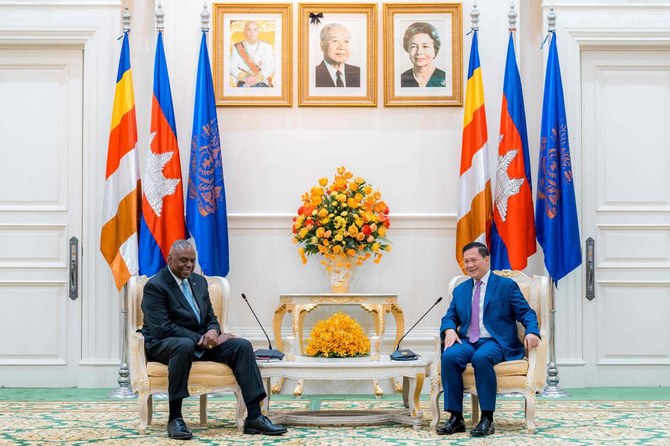
Austin met his Cambodian counterpart, Tea Seiha, and Prime Minister Hun Manet during a one-day visit to Phnom Penh, Cambodia’s Defense Ministry said in a statement. It said Austin’s visit would strengthen the ongoing good cooperation between the countries that has lasted more than 70 years.
Austin arrived from Singapore, where he attended the Shangri-La defense forum and held talks with his Chinese counterpart, Adm. Dong Jun, as the the US and China gradually work to repair lines of communications between their militaries that could be critical as tensions continue to rise between the two in the Indo-Pacific region.
US relations with Cambodia have been frosty for years, in large part because of Phnom Penh’s close ties with China, and particularly China’s military presence at a navy base in the Gulf of Thailand that has been upgraded with Beijing’s assistance. Washington has also been vocal about what it sees as Cambodia’s poor human rights record, which has seen continuing clampdowns on political dissidents and critics.
Cambodian officials deny China will have any special basing privileges and say their country maintains a neutral defense posture.
The visit was Austin’s first visit to Cambodia since Hun Manet became prime minister last year, succeeding his father Hun Sen, who held office for 38 years. The handover has led to speculation of a reset in US-Cambodia relations, though so far Hun Manet has maintained his father’s policies.
Hun Manet was Cambodia’s army commander before becoming prime minister last August. Both Austin and he graduated from the US Military Academy at West Point — Austin in 1975 and Hun Manet in 1999, as Cambodia’s first cadet there.
Austin also held separate talks Tuesday with Hun Sen, who is now the president of the Senate.
From Cambodia, Austin will go to France to attend events commemorating the 80th anniversary of the World War II D-Day landing, the US Defense Department said.

US defense secretary travels to Cambodia to push for stronger ties with China’s ally
Short Url
https://arab.news/4h2tz
US defense secretary travels to Cambodia to push for stronger ties with China’s ally
- US relations with Cambodia have been frosty for years, in large part because of Phnom Penh’s close ties with China
- The visit was Lloyd Austin’s first visit to Cambodia since Hun Manet became prime minister last year
Cuba says attacking speedboat had nearly 13,000 rounds of ammunition
- Firefight took place at a range of 20 meters, Cuba says
- Incoming crew originally set out on two vessels but ditched one
HAVANA: A commando of Cuban exiles who intended to infiltrate Cuba on a speedboat was armed with nearly 13,000 rounds of ammunition, 13 rifles and 11 pistols, Cuban officials said on Friday, providing new details about Wednesday’s deadly exchange of gunfire at sea. The government in Havana has said 10 Cuban nationals coming from the United States entered Cuban waters and opened fire on a border guard vessel, leading Cuban forces to return fire killing four and wounding six others, who were taken into custody.
In an attempt to dispel doubts about its account to date, senior Cuban Interior Ministry officers displayed the captured armaments from the studio on a special television program, including bins full of at least some of the 12,846 recovered rounds. They also showed pictures of the vessels, each peppered with bullet holes from the firefight they said took place at a range of 20 meters (66 feet).
The confrontation took place at a fraught moment in US-Cuban relations, with US President Donald Trump pressuring the island by imposing a virtual oil blockade after capturing and ousting Venezuelan President Nicolas Maduro, a crucial Cuban ally, on January 3.
Cuba has identified the assailants as Cuban exiles, some of whom had been previously placed on a list of accused terrorists, who came from the United States with the intent to sow chaos and attack military units on the Communist-ruled island.
“The intent of this group is to infiltrate, to promote public disorder. To incite the people to unite. To carry out something violent. Attack military units in order to incite social unrest and to unite the people in order to steal the revolution. That has been duly proven,” said Col. Victor Alvarez of the Interior Ministry.
Cuba says response ‘proportional’
US politicians have expressed skepticism over Cuba’s version of events. Secretary of State Marco Rubio on Wednesday said his government would independently investigate, adding that it was not a US operation and that no US government personnel were involved.
Cuban officers said the infiltrators set out from Marathon in the Florida Keys on two vessels but ditched one at some point due to technical difficulties. They united on one speedboat, which a US official said was reported stolen in Florida. Cuba said it recovered a drone, radios, knives, a portable power plant, bolt cutters and other materiel. They also found emblems of the November 30th Movement and People’s Self-Defense, anti-communist groups that oppose the Cuban government.
Cuba says a patrol of five border guard members on a 9-meter boat spotted the incoming vessel shortly after 7 a.m., with some members of the incoming crew in the water, about one nautical mile off a cay on the Caribbean island’s northern coast, about 100 miles (160 km) from Marathon.
The infiltrators opened fire at a distance of 185 meters, striking the captain of the Cuban vessel in the abdomen, Cuba said. Bleeding heavily, the wounded captain remained at the helm and steered toward the enemy vessel, leading to a firefight at a distance of about 20 meters, the officers said.
Cuba called its response “proportional.”
“It is a defensive model that practically never uses firearms, and the use of firearms is proportional to the type of action being carried out against our force,” said Interior Ministry Col. Ybey Carballo.
The captured Cuban nationals were receiving medical care and face charges including armed aggression, illegal entry into national territory, crimes associated with terrorist acts, and arms trafficking, prosecutor Edward Robert Campbell told the program. He said they face prison terms of up to 10 to 15 years for the lesser offenses and 20 to 30 years — or even the death penalty — for the more serious charges.
In an attempt to dispel doubts about its account to date, senior Cuban Interior Ministry officers displayed the captured armaments from the studio on a special television program, including bins full of at least some of the 12,846 recovered rounds. They also showed pictures of the vessels, each peppered with bullet holes from the firefight they said took place at a range of 20 meters (66 feet).
The confrontation took place at a fraught moment in US-Cuban relations, with US President Donald Trump pressuring the island by imposing a virtual oil blockade after capturing and ousting Venezuelan President Nicolas Maduro, a crucial Cuban ally, on January 3.
Cuba has identified the assailants as Cuban exiles, some of whom had been previously placed on a list of accused terrorists, who came from the United States with the intent to sow chaos and attack military units on the Communist-ruled island.
“The intent of this group is to infiltrate, to promote public disorder. To incite the people to unite. To carry out something violent. Attack military units in order to incite social unrest and to unite the people in order to steal the revolution. That has been duly proven,” said Col. Victor Alvarez of the Interior Ministry.
Cuba says response ‘proportional’
US politicians have expressed skepticism over Cuba’s version of events. Secretary of State Marco Rubio on Wednesday said his government would independently investigate, adding that it was not a US operation and that no US government personnel were involved.
Cuban officers said the infiltrators set out from Marathon in the Florida Keys on two vessels but ditched one at some point due to technical difficulties. They united on one speedboat, which a US official said was reported stolen in Florida. Cuba said it recovered a drone, radios, knives, a portable power plant, bolt cutters and other materiel. They also found emblems of the November 30th Movement and People’s Self-Defense, anti-communist groups that oppose the Cuban government.
Cuba says a patrol of five border guard members on a 9-meter boat spotted the incoming vessel shortly after 7 a.m., with some members of the incoming crew in the water, about one nautical mile off a cay on the Caribbean island’s northern coast, about 100 miles (160 km) from Marathon.
The infiltrators opened fire at a distance of 185 meters, striking the captain of the Cuban vessel in the abdomen, Cuba said. Bleeding heavily, the wounded captain remained at the helm and steered toward the enemy vessel, leading to a firefight at a distance of about 20 meters, the officers said.
Cuba called its response “proportional.”
“It is a defensive model that practically never uses firearms, and the use of firearms is proportional to the type of action being carried out against our force,” said Interior Ministry Col. Ybey Carballo.
The captured Cuban nationals were receiving medical care and face charges including armed aggression, illegal entry into national territory, crimes associated with terrorist acts, and arms trafficking, prosecutor Edward Robert Campbell told the program. He said they face prison terms of up to 10 to 15 years for the lesser offenses and 20 to 30 years — or even the death penalty — for the more serious charges.
© 2026 SAUDI RESEARCH & PUBLISHING COMPANY, All Rights Reserved And subject to Terms of Use Agreement.


