

Yemeni riyal hits a new low of 1,500 against dollar

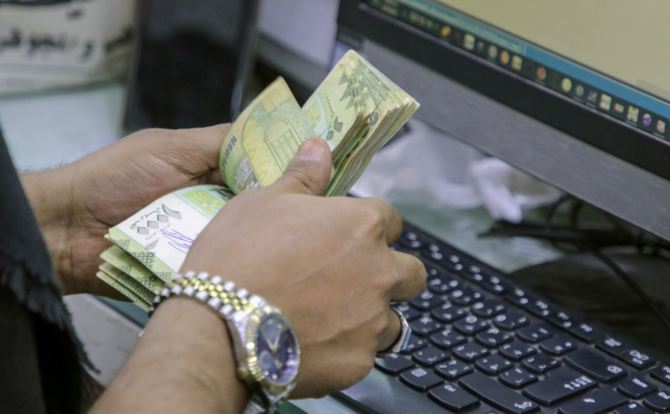
A cashier counts Yemeni riyal banknotes at a local currency exchange in Aden, Yemen. (Reuters/File Photo)
Short Url
Updated 04 November 2023
Follow

Yemeni riyal hits a new low of 1,500 against dollar

  • The Yemeni riyal began depreciating in early 2013 in response to the Yemeni government’s repeated request for a financial bail-out

AL-MUKALLA: The Yemeni riyal fell to a new low of 1,540 against the dollar in Yemeni government-controlled territories on Saturday, bringing it closer to its all-time low of 1,700 per dollar.

Money traders and media reports said that the Yemeni riyal breached a record low of 1,500 against the dollar for the first time in years, compared to a prior low of 1,400 in July. 

Since early 2022, the Yemeni riyal has stabilized at about 1,200 per dollar in government-controlled areas, boosted by the formation of the internationally recognized Presidential Leadership Council, the return of the Yemeni government to Yemen’s interim capital of Aden, and Saudi Arabia’s injection of cash into Yemen’s Aden-based central bank.

The Yemeni riyal began depreciating in early 2013 in response to the Yemeni government’s repeated request for a financial bail-out after Houthi drone and missile attacks on oil installations depleted its financial reserves, as well as the impasse in peace talks to end the war in Yemen.

Saudi Arabia’s $1.2 billion funding aid helped the Yemeni riyal to recover to 1,300 per dollar in early August, up from 1,400 in July.

The Yemeni riyal hit an all-time low of 1,700 per dollar in late 2021.

People and local traders in government-controlled areas have reported an increase in the cost of fuel, transportation and vital products as a result of the riyal’s fast devaluation during the past few months.

The riyal’s new record low occurred just days after the central bank pledged to take all necessary measures to stabilize the economy and limit the depreciation of the national currency. 

In a statement issued following a board meeting in Aden on Wednesday, the bank stated that it would not use “under any circumstances” inflationary financing to cover government expenses, urging the Yemeni government to effectively collect revenues and deposit them into the bank, address imbalances that drain resources and work on improving Yemenis’ standard of living and services.

To combat the riyal’s depreciation, the central bank closed unlicensed money firms, ordered local banks to send their financial statements to the bank, ordered the replacement of the unofficial remittance system between exchange companies, and organized public auctions for selling the dollar to local traders.

The official riyal exchange rate is 1,174. In early 2015, the riyal was trading at 215 per dollar.

In a recent report, the Yemeni government blamed the riyal’s depreciation and current economic meltdown on the Houthi military takeover of power in late 2014, their looting of central bank reserves, drone and missile attacks on oil facilities in Hadramout and, most recently, their ban on imports through government-controlled ports.

The government said in a report released last week that Yemen loses $5 billion in revenue annually as a result of the Houthi military coup and the subsequent war, and the country’s exports have decreased from $6.4 billion in 2014 to $1.7 billion last year.

The “deep” financial crisis in Yemen, according to the government report, caused a decrease in government investment programs, a reduction in private investment, a contraction of the GDP, the departure of foreign investors, the flight of local capital abroad in search of better opportunities, and the suspension of grant and loan programs.


Syrian army pushes into Aleppo district after Kurdish groups reject withdrawal

Updated 10 January 2026
Follow

Syrian army pushes into Aleppo district after Kurdish groups reject withdrawal

  • Two Syrian security officials told Reuters the ceasefire efforts had failed and that the army would seize the neighborhood by force

ALEPPO, Syria: The Syrian army said it would push into the last Kurdish-held district of Aleppo ​city on Friday after Kurdish groups there rejected a government demand for their fighters to withdraw under a ceasefire deal.
The violence in Aleppo has brought into focus one of the main faultlines in Syria as the country tries to rebuild after a devastating war, with Kurdish forces resisting efforts by President Ahmed Al-Sharaa’s Islamist-led government to bring their fighters under centralized authority.
At least nine civilians have been killed and more than 140,000 have fled their homes in Aleppo, where Kurdish forces are trying to cling on to several neighborhoods they have run since the early days of the war, which began in 2011.

HIGHLIGHTS

• Standoff pits government against Kurdish forces

• Sharaa says Kurds are ‘fundamental’ part of Syria

• More than 140,000 have fled homes due to unrest

• Turkish, Syrian foreign ministers discuss Aleppo by phone

ِA ceasefire was announced by the defense ministry overnight, demanding the withdrawal of Kurdish forces to the Kurdish-held northeast. That would effectively end Kurdish control over the pockets of Aleppo that Kurdish forces have held.

CEASEFIRE ‘FAILED,’ SECURITY OFFICIALS SAY
But in a statement, Kurdish councils that run Aleppo’s Sheikh Maksoud and Ashrafiyah districts ‌said calls to leave ‌were “a call to surrender” and that Kurdish forces would instead “defend their neighborhoods,” accusing government forces ‌of intensive ⁠shelling.
Hours ​later, the ‌Syrian army said that the deadline for Kurdish fighters to withdraw had expired, and that it would begin a military operation to clear the last Kurdish-held neighborhood of Sheikh Maksoud.
Two Syrian security officials told Reuters the ceasefire efforts had failed and that the army would seize the neighborhood by force.
The Syrian defense ministry had earlier carried out strikes on parts of Sheikh Maksoud that it said were being used by the Kurdish-led Syrian Democratic Forces (SDF) to launch attacks on the “people of Aleppo.” It said on Friday that SDF strikes had killed three army soldiers.
Kurdish security forces in Aleppo said some of the strikes hit a hospital, calling it a war crime. The defense ministry disputed that, saying the structure was a large arms depot and that it had been destroyed in the resumption of strikes on Friday.
It ⁠posted an aerial video that it said showed the location after the strikes, and said secondary explosions were visible, proving it was a weapons cache.
Reuters could not immediately verify the claim.
The SDF is ‌a powerful Kurdish-led security force that controls northeastern Syria. It says it withdrew its fighters from ‍Aleppo last year, leaving Kurdish neighborhoods in the hands of the Kurdish ‍Asayish police.
Under an agreement with Damascus last March the SDF was due to integrate with the defense ministry by the end of 2025, ‍but there has been little progress.

FRANCE, US SEEK DE-ESCALATION
France’s foreign ministry said it was working with the United States to de-escalate.
A ministry statement said President Emmanuel Macron had urged Sharaa on Thursday “to exercise restraint and reiterated France’s commitment to a united Syria where all segments of Syrian society are represented and protected.”
A Western diplomat told Reuters that mediation efforts were focused on calming the situation and producing a deal that would see Kurdish forces leave Aleppo and provide security guarantees for Kurds who remained.
The diplomat ​said US envoy Tom Barrack was en route to Damascus. A spokesperson for Barrack declined to comment. Washington has been closely involved in efforts to promote integration between the SDF — which has long enjoyed US military support — and Damascus, with which the ⁠United States has developed close ties under President Donald Trump.
The ceasefire declared by the government overnight said Kurdish forces should withdraw by 9 a.m. (0600 GMT) on Friday, but no one withdrew overnight, Syrian security sources said.
Barrack had welcomed what he called a “temporary ceasefire” and said Washington was working intensively to extend it beyond the 9 a.m. deadline. “We are hopeful this weekend will bring a more enduring calm and deeper dialogue,” he wrote on X.

TURKISH WARNING
Turkiye views the SDF as a terrorist organization linked to the outlawed Kurdistan Workers’ Party and has warned of military action if it does not honor the integration agreement.
Turkish Foreign Minister Hakan Fidan, speaking on Thursday, expressed hope that the situation in Aleppo would be normalized “through the withdrawal of SDF elements.”
Though Sharaa, a former Al-Qaeda commander who belongs to the Sunni Muslim majority, has repeatedly vowed to protect minorities, bouts of violence in which government-aligned fighters have killed hundreds of Alawites and Druze have spread alarm in minority communities over the last year.
The Kurdish councils in Aleppo said Damascus could not be trusted “with our security and our neighborhoods,” and that attacks on the areas aimed to bring about displacement.
Sharaa, in a phone call with Iraqi Kurdish leader Masoud Barzani on Friday, affirmed that the Kurds were “a fundamental part ‌of the Syrian national fabric,” the Syrian presidency said.
Neither the government nor the Kurdish forces have announced a toll of casualties among their fighters from the recent clashes.