Russia warns US against ‘fatal’ miscalculation in Ukraine

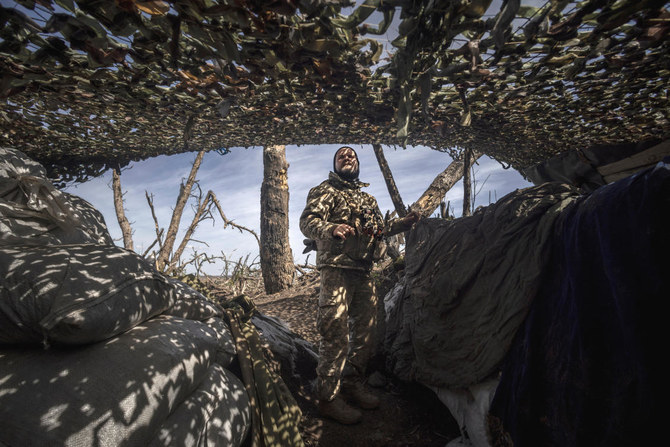
Infantry soldier Viktor of Ukraine's 58th Motorized Brigade scans the sky for enemy drones as he stands in a frontline trench in the Donetsk region. (REUTERS)
Short Url
Updated 03 June 2024
Follow

Russia warns US against ‘fatal’ miscalculation in Ukraine

  • Putin said the West would be directly involved in any use of its weapons by Ukraine to strike deep inside Russia

MOSCOW: Russian Deputy Foreign Minister Sergei Ryabkov said on Monday the United States could face “fatal consequences” if it ignored Moscow’s warnings not to let Ukraine use weapons provided by Washington to strike targets inside Russia.
Ryabkov was commenting on President Joe Biden’s decision last week to approve the use of US-supplied weapons to hit targets inside Russia that were involved in attacks on Ukraine’s Kharkiv region.
“I would like to warn American leaders against miscalculations that could have fatal consequences. For unknown reasons, they underestimate the seriousness of the rebuff they may receive,” state news agency RIA quoted Ryabkov as saying.
He referred to comments last week by President Vladimir Putin, who said NATO countries were playing with fire and risking a deeper global conflict — one of a series of warnings from Moscow about the risk of a serious escalation.
“I urge these figures (in the US) ... to spend some of their time, which they apparently spend on some kind of video games, judging by the lightness of their approach, on studying what was said in detail by Putin,” Ryabkov said.
Putin had delivered “a very significant warning and it must be taken with the utmost seriousness”, he added.
Putin said the West would be directly involved in any use of its weapons by Ukraine to strike deep inside Russia, because such attacks would require its satellite, intelligence and military help.
NATO Secretary General Jens Stoltenberg said last week that NATO had the right to help Ukraine uphold its own right to self-defense, and this did not make NATO a party to the conflict.
Ukrainian President Volodymyr Zelensky said at the weekend that Kyiv was grateful to Washington for allowing it to use US-supplied HIMARS rocket systems in the Kharkiv region, but this was not enough. Ukraine has long argued that restrictions on the way it can use Western-supplied weapons are seriously limiting its ability to defend itself.
Russian news agencies quoted Ryabkov as saying that attempts by Kyiv to attack Russian early-warning radar systems would be thwarted and Moscow may respond asymmetrically to such steps.
A Kyiv intelligence source said last week that a Ukrainian drone had targeted a long-range radar deep inside Russia that is part of Russia’s early-warning system to detect whether it is under nuclear attack.


Greenland crisis boosts Danish apps designed to identify and help boycott US goods

Updated 4 sec ago
Follow

Greenland crisis boosts Danish apps designed to identify and help boycott US goods

  • Boycott campaigns are usually short-lived and real change often requires an organized effort rather than individual consumers
COPENHAGEN: The makers of mobile apps designed to help shoppers identify and boycott American goods say they saw a surge of interest in Denmark and beyond after the recent flare-up in tensions over US President Donald Trump’s designs on Greenland.
The creator of the “Made O’Meter” app, Ian Rosenfeldt, said he saw around 30,000 downloads of the free app in just three days at the height of the trans-Atlantic diplomatic crisis in late January out of more than 100,000 since it was launched in March.
Apps offer practical help
Rosenfeldt, who lives in Copenhagen and works in digital marketing, decided to create the app a year ago after joining a Facebook group of like-minded Danes hoping to boycott US goods.
“Many people were frustrated and thinking, ‘How do we actually do this in practical terms,’” the 53-year-old recalled. “If you use a bar code scanner, it’s difficult to see if a product is actually American or not, if it’s Danish or not. And if you don’t know that, you can’t really make a conscious choice.”
The latest version of “Made O’Meter” uses artificial intelligence to identify and analyze several products at a time, then recommend similar European-made alternatives. Users can set preferences, like “No USA-owned brands” or “Only EU-based brands.” The app claims over 95 percent accuracy.
“By using artificial intelligence, you can take an image of a product … and it can make a deep dive to go out and find the correct information about the product in many levels,” Rosenfeldt told The Associated Press during a demonstration at a Copenhagen grocery store. “This way, you have information that you can use to take decisions on what you think is right.”
‘Losing an ally’
After an initial surge of downloads when the app was launched, usage tailed off. Until last month, when Trump stepped up his rhetoric about the need for the US to acquire Greenland, a strategically important and mineral-rich Arctic island that is a semiautonomous territory of Denmark.
Usage peaked Jan. 23, when there were almost 40,000 scans in one day, compared with 500 or so daily last summer. It has dropped back since but there were still around 5,000 a day this week, said Rosenfeldt, who noted “Made O’Meter” is used by over 20,000 people in Denmark but also by people in Germany, Spain, Italy, even Venezuela.
“It’s become much more personal,” said Rosenfeldt, who spoke of “losing an ally and a friend.”
Trump announced in January he would slap new tariffs on Denmark and seven other European countries that opposed his takeover calls, only to abruptly drop his threats after he said a “framework” for a deal over access to mineral-rich Greenland was reached with NATO Secretary-General Mark Rutte’s help. Few details of that agreement have emerged.
The US began technical talks in late January to put together an Arctic security deal with Denmark and Greenland, which say sovereignty is not negotiable.
Rosenfeldt knows such boycotts won’t damage the US economy, but hopes to send a message to supermarkets and encourage greater reliance on European producers.
“Maybe we can send a signal and people will listen and we can make a change,” he added.
The protest may be largely symbolic
Another Danish app, “NonUSA,” topped 100,000 downloads at the beginning of February. One of its creators, 21-year-old Jonas Pipper, said there were over 25,000 downloads Jan. 21, when 526 product scans were performed in a minute at one point. Of the users, some 46,000 are in Denmark and around 10,000 in Germany.
“We noticed some users saying they felt like a little bit of the pressure was lifted off them,” Pipper said. “They feel like they kind of gained the power back in this situation.”
It’s questionable whether such apps will have much practical effect.
Christina Gravert, an associate professor of economics at the University of Copenhagen, said there are actually few US products on Danish grocery store shelves, “around 1 to 3 percent”. Nuts, wines and candy, for example. But there is widespread use of American technology in Denmark, from Apple iPhones to Microsoft Office tools.
“If you really want to have an impact, that’s where you should start,” she said.
Even “Made O’Meter” and “NonUSA” are downloaded from Apple’s App Store and Google’s Play Store.
Gravert, who specializes in behavioral economics, said such boycott campaigns are usually short-lived and real change often requires an organized effort rather than individual consumers.
“It can be interesting for big supermarket brands to say, OK, we’re not going to carry these products anymore because consumers don’t want to buy them,” she said. “If you think about large companies, this might have some type of impact on the import (they) do.”
On a recent morning, shoppers leaving one Copenhagen grocery store were divided.
“We do boycott, but we don’t know all the American goods. So, it’s mostly the well-known trademarks,” said Morten Nielsen, 68, a retired navy officer. “It’s a personal feeling … we feel we do something, I know we are not doing very much.”
“I love America, I love traveling in America,” said 63-year-old retiree Charlotte Fuglsang. “I don’t think we should protest that way.”