

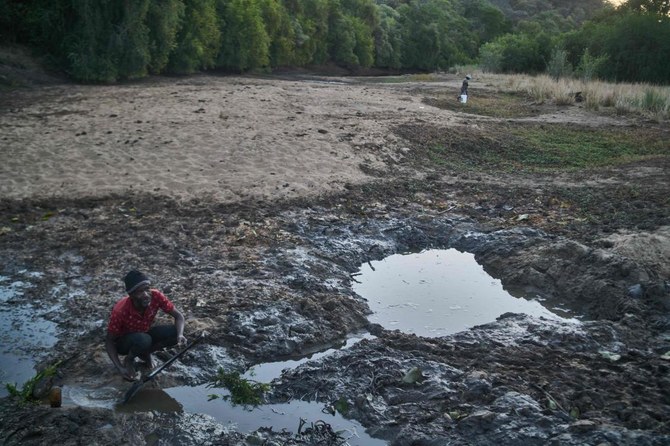
UN forecasts La Nina could help lower temperatures this year

The WMO warned that global temperatures would continue to rise in the long term due to human-induced climate change resulting in extreme weather worse and upend seasonal rainfall. (AFP)
Short Url
Updated 03 June 2024
Follow

UN forecasts La Nina could help lower temperatures this year

  • The WMO warned that global temperatures would continue to rise in the long term due to human-induced climate change resulting in extreme weather worse and upend seasonal rainfall

GENEVA: The return of the cooling La Nina weather phenomenon this year should help lower temperatures somewhat after months of global heat records, the United Nations’ weather agency said Monday.
The impact is likely to be felt in the next few months because the warming El Nino weather pattern — which has helped fuel a spike in global temperatures and extreme weather around the world since mid-2023 — “is showing signs of ending,” the UN’s World Meteorological Organization said in its latest update.
The WMO warned, however, that global temperatures would continue to rise in the long term due to human-induced climate change, which continues to make extreme weather worse and upend seasonal rainfall and temperature patterns.
La Nina refers to the cooling of the ocean surface temperatures in large swathes of the tropical Pacific Ocean, coupled with winds, rains and changes in atmospheric pressure.
In many locations, especially in the tropics, La Nina produces the opposite climate impacts to El Nino, which heats up the surface of the oceans, leading to drought in some parts of the world and triggering heavy downpours elsewhere.
The WMO said there was a “60 percent” chance of La Nina conditions in the period from July to September and a “70 percent” likelihood during August-November.
The chances of El Nino redeveloping are negligible, it added.
Every month since June 2023, when El Nino returned, has set a new high temperature record, and 2023 was by far the warmest year on record globally.
The WMO said the planet would continue to heat up overall from the use of fossil fuels that produce greenhouse gases.

“The end of El Nino does not mean a pause in long-term climate change, as our planet will continue to warm due to heat-trapping greenhouse gases,” WMO deputy secretary general Ko Barrett stressed.
“Exceptionally high sea surface temperatures will continue to play an important role during next months.”
Much of the planet’s excess heat from climate change is stored in the oceans.
In the United States, the National Oceanic and Atmospheric Administration has already factored the expected La Nina into its forecasts for this year’s Atlantic hurricane season.
The NOAA said it expected four to seven major hurricanes in the Atlantic between June and November.
“The upcoming Atlantic hurricane season is expected to have above-normal activity due to a confluence of factors, including near-record warm ocean temperatures in the Atlantic Ocean, development of La Nina conditions in the Pacific, reduced Atlantic trade winds and less wind shear,” the NOAA said on May 23.
The WMO noted that the past nine years had been the warmest on record, even with the cooling influence of a La Nina event that lasted from 2020 to early 2023.
The latest El Nino, which peaked in December, was one of the five strongest on record.
“Our weather will continue to be more extreme because of the extra heat and moisture in our atmosphere,” Barrett said.
The WMO has made it a priority to ensure that all regions of the world are covered by early warning systems by 2027, particularly the least well-equipped, such as Africa.
“Seasonal forecasts for El Nino and La Nina, and the anticipated impacts on the climate patterns globally, are an important tool to inform early warnings and early action,” Barrett said.


Only 4% women on ballot as Bangladesh prepares for post-Hasina vote

Updated 19 min 5 sec ago
Follow

Only 4% women on ballot as Bangladesh prepares for post-Hasina vote

  • Women PMs have ruled Bangladesh for over half of its independent history
  • For 2026 vote, only 20 out of 51 political parties nominated female candidates

DHAKA: As Bangladesh prepares for the first election since the ouster of its long-serving ex-prime minister Sheikh Hasina, only 4 percent of the registered candidates are women, as more than half of the political parties did not field female candidates.

The vote on Feb. 12 will bring in new leadership after an 18-month rule of the caretaker administration that took control following the student-led uprising that ended 15 years in power of Hasina’s Awami League party.

Nearly 128 million Bangladeshis will head to the polls, but while more than 62 million of them are women, the percentage of female candidates in the race is incomparably lower, despite last year’s consensus reached by political parties to have at least 5 percent women on their lists.

According to the Election Commission, among 1,981 candidates only 81 are women, in a country that in its 54 years of independence had for 32 years been led by women prime ministers — Hasina and her late rival Khaleda Zia.

According to Dr. Rasheda Rawnak Khan from the Department of Anthropology at Dhaka University, women’s political participation was neither reflected by the rule of Hasina nor Zia.

“Bangladesh has had women rulers, not women’s rule,” Khan told Arab News. “The structure of party politics in Bangladesh is deeply patriarchal.”

Only 20 out of 51 political parties nominated female candidates for the 2026 vote. Percentage-wise, the Bangladesh Socialist Party was leading with nine women, or 34 percent of its candidates.

The election’s main contender, the Bangladesh Nationalist Party, whose former leader Zia in 1991 became the second woman prime minister of a predominantly Muslim nation — after Pakistan’s Benazir Bhutto — was the party that last year put forward the 5 percent quota for women.

For the upcoming vote, however, it ended up nominating only 10 women, or 3.5 percent of its 288 candidates.

The second-largest party, Jamaat-e-Islami, has not nominated a single woman.

The 4 percent participation is lower than in the previous election in 2024, when it was slightly above 5 percent, but there was no decreasing trend. In 2019, the rate was 5.9 percent, and 4 percent in 2014.

“We have not seen any independent women’s political movement or institutional activities earlier, from where women could now participate in the election independently,” Khan said.

“Real political participation is different and difficult as well in this patriarchal society, where we need to establish internal party democracy, protection from political violence, ensure direct election, and cultural shifts around female leadership.”

While the 2024 student-led uprising featured a prominent presence of women activists, Election Commission data shows that this has not translated into their political participation, with very few women contesting the upcoming polls.

“In the student movement, women were recruited because they were useful, presentable for rallies and protests both on campus and in the field of political legitimacy. Women were kept at the forefront for exhibiting some sort of ‘inclusive’ images to the media and the people,” Khan said.

“To become a candidate in the general election, one needs to have a powerful mentor, money, muscle power, control over party people, activists, and locals. Within the male-dominated networks, it’s very difficult for women to get all these things.”