

UNRWA says forced displacement has pushed over 1 million away from Rafah

1 / 2
Palestinians look at the destruction after an Israeli strike on a school run by UNRWA, the U.N. agency helping Palestinian refugees, in Nuseirat, Gaza Strip, May 14, 2024. (AP)
2 / 2
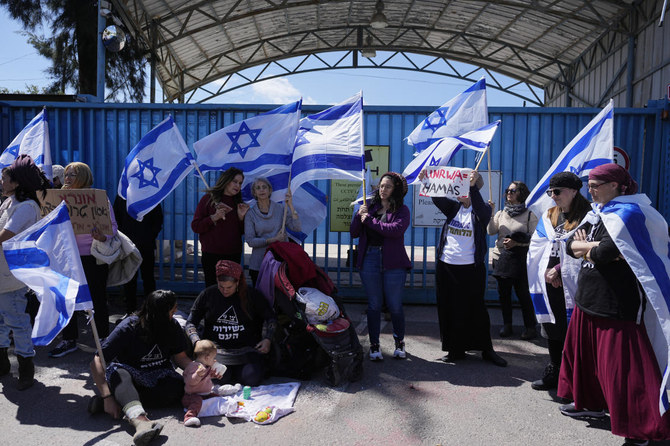
Israelis block the entrance to UNWRA, the main U.N. agency providing aid in the Gaza Strip, during a protest in Jerusalem, March 20, 2024. (AP)
Short Url
Updated 03 June 2024
Follow

UNRWA says forced displacement has pushed over 1 million away from Rafah

DUBAI: Forced displacement has pushed over a million people away from the Gazan city of Rafah, the United Nations Palestinian refugee agency (UNRWA) said on Monday.
The small city on the southern edge of the Gaza Strip had been sheltering around 1 million Palestinians who fled Israeli assaults on other parts of the enclave, aid groups said.
Since early May, Israel’s military has been carrying out what it says is a limited operation in Rafah to root out Hamas fighters and dismantle infrastructure used by the Palestinian Islamist militant group that runs Gaza.
The Israeli military has told civilians to go to an “expanded humanitarian zone” some 20 km (12 miles) away.
Many Palestinians have complained they are vulnerable to Israeli attacks wherever they go, and have been moving up and down the Gaza Strip in the past few months.
UNRWA said thousands of families now shelter in damaged and destroyed facilities in the city of Khan Younis, where the agency is providing essential services despite ‘increasing challenges’.
“Conditions are unspeakable,” the agency added.

MORE THAN HALF OF GAZA DESTORYED OR DAMAGED
Some 55 percent of all structures in the Gaza Strip have been destroyed, damaged or possibly damaged since war erupted in the Palestinian territory eight months ago, according to preliminary satellite analysis by the UN.

The analysis showed more than 137,000 buildings affected, UNOSAT, the United Nations satellite analysis agency, said on X, formerly Twitter.

The estimate is based on a satellite image taken on May 3, and compared with images taken in May a year earlier, last September, and on October 15 -- just over a week after Hamas's unprecedented October 7 attack on Israel that sparked the war.

The fresh satellite image was also compared to images taken during several dates in November, then again during the first months of this year, UNOSAT said.

“According to satellite imagery analysis, UNOSAT identified 36,591 destroyed structures,” the agency said in a statement.

In addition, it said it had seen "16,513 severely damaged structures, 47,368 moderately damaged structures, and 36,825 possibly damaged structures for a total of 137,297 structures".

“These correspond to around 55 percent of the total structures in the Gaza Strip and a total of 135,142 estimated damaged housing units,” it said.


Israel’s hostage forum releases AI-generated video of last Gaza captive

Updated 23 December 2025
Follow

Israel’s hostage forum releases AI-generated video of last Gaza captive

  • The Gaza ceasefire, which came into effect in October, remains fragile with both sides alleging violations, and mediators fearing that Israel and Hamas alike are stalling

JERUSALEM: An Israeli group representing the families of Gaza hostages released on Tuesday an AI-generated video of Ran Gvili, the last captive whose body is still being held in the Palestinian territory.
The one-minute clip, created whole cloth using artificial intelligence, purports to depict Gvili as he sits in a Gaza tunnel and appeals to US President Donald Trump to help bring his body back to Israel.
“Mr President, I’m asking you to see this through: Please bring me home. My family deserves this. I deserve the right to be buried with honor in the land I fought for,” says the AI-generated image of Gvili.
Gvili was 24 at the time of Hamas’s October 7, 2023 attack on Israel.
He was an officer in Israel’s Yasam elite police unit and was on medical leave when he learnt of the attack.
He decided to leave his home and brought his gun to counter the Hamas militants.
He was shot in the fighting at the Alumim kibbutz before he was taken to Gaza.
Israeli authorities told Gvili’s parents in January 2024 that he had not survived his injuries.
The AI clip was released by the Hostages and Missing Families Forum, the main group representing those taken captive to Gaza.
The Forum said it was published with the approval of Gvili’s family.
“Seeing and hearing Rani speak in his own voice is both moving and heartbreaking. I would give anything to hear, see and hold him again,” Gvili’s mother Talik said, quoted by the Forum.
“But all I can do now is plead that they don’t move to the next phase of the agreement before bringing Rani home — because we don’t leave heroes behind.”
The Gaza ceasefire, which came into effect in October, remains fragile with both sides alleging violations, and mediators fearing that Israel and Hamas alike are stalling.
In the first stage, Palestinian militants were expected to return all of the remaining 48 living and dead hostages held in Gaza.
Since the ceasefire came into effect on October 10, militants have released 47 hostages.
In the next stages of the truce, Israel is supposed to withdraw from its positions in Gaza, an interim authority is to govern the Palestinian territory instead of Hamas, and an international stabilization force is to be deployed.
Israeli Prime Minister Benjamin Netanyahu is expected to meet Trump in Florida later this month to discuss the second phase of the deal.