

Ivory Coast orchestra offers rural children an escape

1 / 3
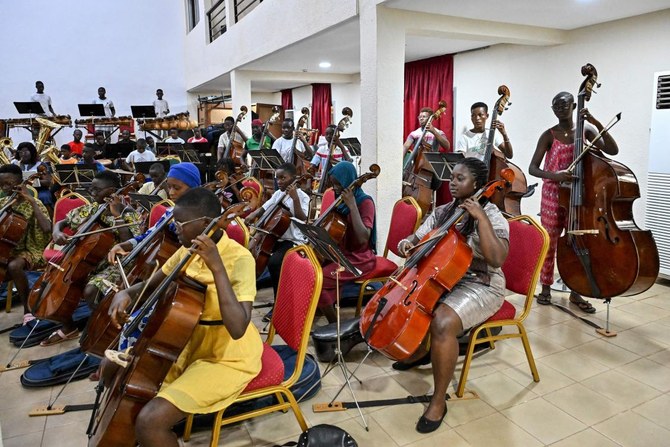
Members of the Odienne Philharmonic Orchestra perform during a rehearsal session at the Sara hotel in Odienne on May 21, 2024. (AFP)
2 / 3
Members of the Odienne Philharmonic Orchestra perform during a rehearsal session at the Sara hotel in Odienne on May 21, 2024. (AFP)
3 / 3
Members of the Odienne Philharmonic Orchestra perform during a rehearsal session at the Sara hotel in Odienne on May 21, 2024. (AFP)
Short Url
Updated 03 June 2024
Follow

Ivory Coast orchestra offers rural children an escape

ODIENNE: In the hubbub of children’s chatter, nine-year-old Leila Coulibaly deftly tunes her violin ahead of a rehearsal by Ivory Coast’s first philharmonic orchestra.
She is among almost 140 children who make up the ensemble based in the rural northern town of Odienne.
They gather as an orchestra once a week but every day some youngsters, aged six to 16, are picked up by minibus and brought to a hotel.
There, they practice for over two hours incorporating traditional instruments like the balafon, a type of xylophone, and djembe drums.
“I want to be a professional musician because the orchestra changed my life,” Leila told AFP.
Hundreds of kilometers (miles) away from the bustling metropolis of Abidjan, Odienne relies heavily on agriculture, sometimes involving child labor.
Poverty and high unemployment make the future uncertain for many young people in Ivory Coast.
The Odienne orchestra is somewhat of a “crazy project” in a region like this, conductor Fabrice Koffi said, laughing.
In temperatures of 35 degrees Celsius (95 degrees Fahrenheit), 15-year-old trombonist Siaka Sy Savane sits behind the shady stalls of a market.
From dawn “Monday to Friday, I come to help my mother at the market. Saturday and Sunday, I go with my big brother to the field,” he said.
“When I sing the music of the orchestra, I don’t feel tired anymore, it motivates me.
“Ever since I was young, I dreamed of being a musician,” he said, adding: “Today, my dream has come true.”
Last August, less than a year after the orchestra was created, the children played for Ivorian President Alassane Ouattara on the anniversary of independence from France in 1960.
Despite playing the odd wrong note, they play with ease Mozart’s “March of the Priests” from “The Magic Flute” or the “Coup du Marteau,” which became a hit during the 2024 Africa Cup of Nations.
The song by musician Tam Sir was performed by the orchestra at the closing ceremony of the football competition, which Ivory Coast won.
“I enjoyed playing in front of all of those people. I was really scared” but “I regained my self-confidence,” violinist Leila said.
The youth development program is inspired by Venezuelan initiative El Sistema, which teaches music to children from disadvantaged backgrounds.
In the West African nation, the orchestra was set up by Minister for Employment and Social Protection Adama Kamara, who is personally funding it.
Koffi has watched over every student since the very first rehearsal.
“We are doing the opposite of what a traditional orchestra does,” he said.
While an ensemble is usually a “gathering of the very best” musicians, the orchestra in Odienne has taught the children the basics, such as music theory and playing techniques.
Teaching is done collectively, “unlike an academy of music” which gives priority to private lessons, trumpet teacher Jean Caleb Kouadio said.

MUSIC AND SCHOOL
The lessons have also been designed with sometimes conservative parents in mind, in a predominantly Muslim region.
“At first, the parents were downright reluctant,” said Abdramane Doucoure, an intermediary between the families and the orchestra.
“Some people used to say that music doesn’t go with Islam,” he said.
Sarata Kante, a trumpeter in her early teens, had to convince her parents to let her play in the orchestra.
“She insisted for several weeks,” her mother Mawa Keita said.
“It wasn’t my ambition, my vision for her,” said her father Ousmane Kante, fearing she would be too distracted.
“School is serious business,” he added.
It is not a question of “taking children out of school” to become musicians, Koffi said.
He, too, had to stand up to his parents when he was younger in order to become a flautist.
“On the contrary, music” offers “the potential to excel at school,” he added.
Sarata’s grades in school have improved and she dreams of becoming a vet.
For viola teacher Deborah Bodo Israel, the orchestra and its achievements continue to amaze. “What’s happening is magic,” she said.


Arts festival’s decision to exclude Palestinian author spurs boycott

Randa Abdel Fattah. (Photo/Wikipedia)
Updated 12 January 2026
Follow

Arts festival’s decision to exclude Palestinian author spurs boycott

  • A Macquarie University academic who researches Islamophobia and Palestine, Abdel-Fattah responded saying it was “a blatant and shameless act of anti-Palestinian racism and censorship,” with her lawyers issuing a letter to the festival

SYDENY: A top Australian arts festival has seen ​the withdrawal of dozens of writers in a backlash against its decision to bar an Australian Palestinian author after the Bondi Beach mass shooting, as moves to curb antisemitism spur free speech concerns.
The shooting which killed 15 people at a Jewish Hanukkah celebration at Sydney’s Bondi Beach on Dec. 14 sparked nationwide calls to tackle antisemitism. Police say the alleged gunmen were inspired by Daesh.
The Adelaide Festival board said last Thursday it would disinvite Randa ‌Abdel-Fattah from February’s ‌Writers Week in the state of South Australia because “it ‌would not ​be ‌culturally sensitive to continue to program her at this unprecedented time so soon after Bondi.”

FASTFACTS

• Abdel-Fattah responded, saying it was ‘a blatant and shameless act of anti-Palestinian racism and censorship.’

• Around 50 authors have since withdrawn from the festival in protest, leaving it in doubt, local media reported.

A Macquarie University academic who researches Islamophobia and Palestine, Abdel-Fattah responded saying it was “a blatant and shameless act of anti-Palestinian racism and censorship,” with her lawyers issuing a letter to the festival.
Around 50 authors have since withdrawn from the festival in protest, leaving it in doubt, local media reported.
Among the boycotting authors, Kathy Lette wrote on social media the decision to bar Abdel-Fattah “sends a divisive and plainly discriminatory message that platforming Australian Palestinians is ‘culturally insensitive.'”
The Adelaide Festival ‌said in a statement on Monday that three board ‍members and the chairperson had resigned. The ‍festival’s executive director, Julian Hobba, said the arts body was “navigating a complex moment.”

 a complex and ‍unprecedented moment” after the “significant community response” to the board decision.
In the days after the Bondi Beach attack, Jewish community groups and the Israeli government criticized Prime Minister Anthony Albanese for failing to act on a rise in antisemitic attacks and criticized protest marches against Israel’s war in ​Gaza held since 2023.
Albanese said last week a Royal Commission will consider the events of the shooting as well as antisemitism and ⁠social cohesion in Australia. Albanese said on Monday he would recall parliament next week to pass tougher hate speech laws.
On Monday, New South Wales state premier Chris Minns announced new rules that would allow local councils to cut off power and water to illegally operating prayer halls.
Minns said the new rules were prompted by the difficulty in closing a prayer hall in Sydney linked to a cleric found by a court to have made statements intimidating Jewish Australians.
The mayor of the western Sydney suburb of Fairfield said the rules were ill-considered and councils should not be responsible for determining hate speech.
“Freedom ‌of speech is something that should always be allowed, as long as it is done in a peaceful way,” Mayor Frank Carbone told Reuters.