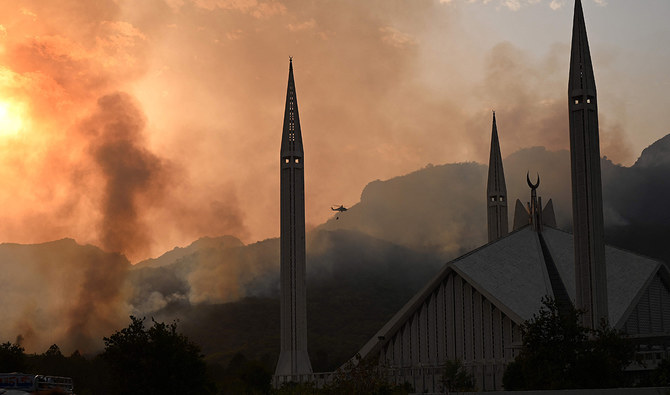
ISLAMABAD: The Islamabad administration on Sunday prevented the spread of another forest fire on Margalla Hills into its territory, but the blaze that erupted in part of the hills located in the northwestern Khyber Pakhtunkhwa (KP) province had yet to be fully extinguished, officials said, with experts warning of several environmental hazards of these annual fires.
The Margalla range, part of the Himalayan foothills, frequently experiences bush fires during the summer months. This month, several fires have occurred, largely due to the extreme heat wave affecting the South Asian region.
The latest fire incident occurred on the hills in KP on Saturday after authorities extinguished similar fires at three locations in Islamabad. Officials said the blaze in KP had a very “low intensity” and efforts were on to completely douse it.
“The latest situation is that the fire on the KP side is diminishing with each passing hour and getting less and less in intensity,” Shahzad Khalil, a Capital Development Authority (CDA) official who was supervising the firefighting operation, told Arab News.
He said CDA teams were working day and night to control fires, whenever they erupted on the hills, and the spread of the latest fire into Islamabad’s territory was prevented because of effective response by firefighters who remained on site through the night.
“It is a tough job because of the dense forest and they cannot take heavy equipment with them,” Khalil said. “They made fire lines to control the fire flow, and on the KP side, efforts are also underway to control the fire as we are helping them with all our resources.”
Fire lines, also known as firebreaks or fireguards, are gaps created to stop or slow the spread of a wildfire by removing the fuel that a fire needs to continue burning, thereby creating a barrier. Firefighters position fire lines around a wildfire’s perimeter to contain it and protect critical areas, or to redirect the fire to more manageable areas.
“All other institutions, including army and the National Disaster Management Authority, also take part in this effort as and when required,” he said.
More than 20 fires erupted on Margalla Hills from May 17 to May 31, but things were under control in the CDA’s territory, according to the official
These incidents could have resulted from accidental ignition due to dry conditions as well as “intentional arson by mischievous individuals.”
“We have filed around 15 police reports and have also apprehended three individuals on suspicion,” he said. “The law enforcement agencies are investigating all aspects.”
He said there were around 28 villages on Margalla Hills and the CDA had temporarily hired locals from these villages to assist in firefighting and safeguarding the area by increasing vigilance and providing additional security.
“We have hired 450 local people from the month of April for three months as a quick response force and our trained staff keep on guiding the locals in 37 pickets which we have established in this whole area,” Khalil said.
The future strategy will be to increase the number of pickets to enhance vigilance and promptly control fire in the event of an eruption, according to the CDA official.
Islamabad Deputy Commissioner Irfan Memon said the administration had sensitized the local community to report any “mischievous elements” involved in such incidents.
“We have conducted meetings with people in nearby villages, gaining their trust and confidence, and we are hopeful that locals will report any individuals involved in fire incidents,” Memon told Arab News. “Our personnel are stationed at the pickets around the clock, ready to dispatch teams immediately to control any fires in the affected area.”
INTER-DEPARTMENTAL GROUP ON FOREST FIRES
Meanwhile, Romina Khurshid Alam, the prime minister’s coordinator on climate change, has established an inter-departmental working group (IWG) on forest fires in the Margalla Hills National Park, headed by Inspector General of Forests Ghulam Qadir Shah. The body comprising Islamabad Deputy Inspector General (DIG) Mustafa Tanveer, the CDA director-general of environment and other officials will coordinate rapid response efforts across relevant departments and report directly to Alam.
“The idea was to ensure coordination among the most relevant agencies for an effective response to the fires, including CDA, NDMA, Rescue 1122, police, and the fire department,” Shah, the working group head, told Arab News.
During this dry season, he said, forest fires occur worldwide because the grass below is dry, and fires can start from anywhere at any time.
“Mainly, there is a human element involved, such as tourists making tea or warming food during picnics, discarding cigarette butts, and intentional acts by those involved in timber theft,” he said, adding the Ministry of Climate Change had developed standard operating procedures (SOPs) in 2022 for relevant departments to remain on alert during the season and prevent fires at the earliest.
“Due to this, our forestry departments have updated their mechanism, and created more fire lines, improving vigilance and so on, which has contributed to effective control of fires this year.”
The forest fires have occurred at a time when Pakistan has seen temperatures as high as 52.2 degrees Celsius (126°F) as South Asia swelters in a hot summer this year — a trend scientists say has been worsened by human-driven climate change.
‘TWO-FOLD IMPACT’
Experts say these annual fires are detrimental to the environment as they hinder biodiversity and disrupt the natural habitat of birds and animals.
“These fires have a two-fold impact on the environment. Firstly, they clear the vegetation of trees taking at least 10 years to regrow, and secondly, they generate smoke, leading to carbon dioxide emissions that degrade the environment,” Dr. Ghulam Rasul, head of the Climate Change Program’s International Union for Conservation of Nature, told Arab News.
He said this phenomenon was likely to exacerbate problems for the local population and lead to the suffering of biodiversity. To control these incidents, he said, the civic agencies should initiate an aggressive awareness campaign before the start of every summer season, targeting locals and tourists by involving academics, media and social media influencers.
“The campaign should highlight the damages caused by visitor negligence, emphasize the importance of environmental conservation, and stress the need for vigilance against criminals involved in starting fires and engaging in wood theft,” he added.
Maryam Shabbir, another environmental expert, said these fires adversely impacted the air quality, humans, wildlife residing in forests and birds along with disrupting hiking and other recreational activities on Margalla Hills.
“It is inevitable during summer to not have forest fires. However, proper and timely arrangements can save biodiversity,” she said, urging authorities to monitor the forest and use helicopters to control a fire as soon as it erupts.
Pakistan is seen by global organizations as one of the most vulnerable countries to extreme weather and climate change. In 2022, floods wreaked havoc in the country, killing over 1,700 people and displacing millions.


![]()

Efforts on to douse another fire on Margalla Hills as experts warn of environmental hazards
Short Url
https://arab.news/9ktp9
Efforts on to douse another fire on Margalla Hills as experts warn of environmental hazards
- Part of the Himalayan foothills, Margalla range in Pakistan experiences bush fires relatively often in summer months as temperatures soar
- Experts say these annual fires are detrimental to the environment as they hinder biodiversity and disrupt natural habitat of birds, animals
Latest updates





© 2026 SAUDI RESEARCH & PUBLISHING COMPANY, All Rights Reserved And subject to Terms of Use Agreement.