

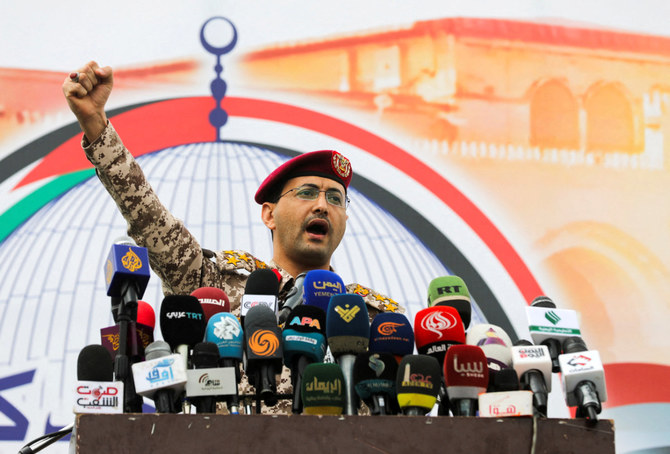

RIYADH: Houthi forces launched anti-ballistic missiles and armed drones targeting a US aircraft carrier, a US destroyer and three vessels in the Red Sea, the Iran-backed Yemeni militia’s military spokesman Yahya Saree said on Saturday.
The US military confirmed the attacks but said no injuries or damage were reported by US, coalition or commercial ships.
In a statement on X, the US Central Command said its forces destroyed one Iran-backed Houthi uncrewed aerial system in the southern Red Sea and saw two others crash into Red Sea.
US forces also destroyed two Houthi anti-ship ballistic missiles fired in direction of the US Navy ship Gravely, it said.
The attacks came a day after a Houthi official vowed to hit back after a joint British US airstrikes hit militia installations in Yemen on Thursday.
“We will meet escalation with escalation,” Mohammed Al-Bukhaiti, a Houthi official, wrote on X.
The Houthi militia, which controls the most populous parts of Yemen and is aligned with Iran, has attacked ships off its coast for months, saying it is acting in solidarity with Palestinians fighting Israel in Gaza.
Saree on Saturday said the group “targeted the American aircraft carrier, the Eisenhower, north of the Red Sea, with a number of missiles and drones,” adding that it was “the second targeting operation against the carrier during the past 24 hours.”
The spokesperson also added that the other operations have targeted a US destroyer and the ABLIANI ship in the Red Sea, along with “the MAINA ship that has been targeted twice in the Red Sea and in the Arabian Sea as well.”
Additionally, “the ship ALORAIQ has been targeted in the Indian Ocean,” he added.
On Friday, F/A-18 fighter jets from the USS Dwight D. Eisenhower aircraft hit a wide range of Houthi underground facilities, missile launchers, command and control sites, a vessel and other facilities, according to the US military.
The militia acknowledged that the joint British-US airstrikes killed at least 16 people and wounded 42 of its fighters. It was the highest publicly acknowledged death toll from the multiple rounds of strikes carried out over the Houthi attacks on shipping.
But the Houthis focused Friday morning on a strike they said struck a building housing Hodeida Radio and civilian homes in the port city on the Red Sea. Their Al Masirah satellite news channel aired images of one bloodied man being carried down stairs and others in the hospital, receiving aid. It said all the dead and nearly all the wounded from the strikes came from there.
The Houthis described all those killed and hurt in Hodeida as civilians. The rebel force that’s held Yemen’s capital, Sanaa, since 2014 includes fighters who often aren’t in uniform.
Other strikes hit outside of Sanaa near its airport, and communication equipment in Taiz, the broadcaster said. Little other information was released on those sites — likely signaling that Houthi military sites had been struck. One person was wounded in Sanaa.
“We confirm this brutal aggression against Yemen as punishment for its position in support of Gaza, in support of Israel to continue its crimes of genocide against the wounded, besieged and steadfast Gaza Strip,” Houthi spokesman Mohammed Abdulsalam posted on X.
The US and the UK have launched strikes against the Houthis since January, with the US regularly carrying out its own in the time since as well.
Abdul Malik Al-Houthi, the Houthis’ secretive supreme leader, offered an overall death toll for the strikes up to that point as 40 people killed and 35 others wounded. He didn’t offer a breakdown between civilian and combatant casualties at the time.
The Houthis have stepped up attacks on shipping in the Red Sea and the Gulf of Aden, demanding that Israel end the war in Gaza, which has killed more than 36,000 Palestinians there. The war began after Hamas-led militants attacked Israel on Oct. 7, killing about 1,200 people and taking around 250 hostage.
The Houthis have launched more than 50 attacks on shipping, killed three sailors, seized one vessel and sunk another since November, according to the US Maritime Administration. This week, they attacked a ship carrying grain to Iran, the rebels’ main benefactor.
On Wednesday, another US MQ-9 Reaper drone apparently crashed in Yemen, with the Houthis claiming they fired a surface-to-air missile at it. The US Air Force didn’t report any aircraft missing, leading to suspicion that the drone may have been piloted by the CIA. As many as three may have been lost in May alone.
(With Reuters & AP)


