LONDON: England all-rounder Liam Livingstone believes the “extra edge” provided by fast bowlers Jofra Archer and Mark Wood will bolster the side’s chance when they begin their T20 World Cup defense in Barbados next week.
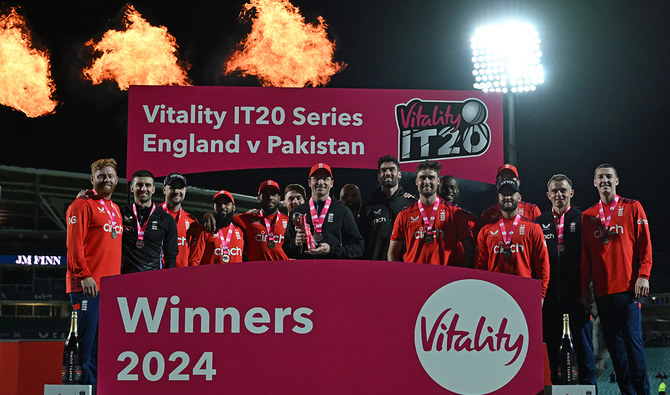
The two out-and-out quicks were reunited for the first time in The Oval on Thursday, with both Archer and Wood playing their part as England won by seven wickets to seal a 2-0 T20 series victory over Pakistan.
Archer made the key breakthrough to dismiss in-form Pakistan captain Babar Azam for 36, sparking a collapse that saw the tourists slump from 59-0 to 157 all out.
And Wood, timed at a rapid 96 mph (154 kph) in his first spell, returned to produce two searing bouncers that captured the wickets of Azam Khan and Naseem Shah.
Spin-bowling all-rounder Livingston struck twice in an over before England’s top order spent time in the middle, with captain Jos Buttler (39) and Phil Salt (45) looking in especially fine touch.
“A 2-0 victory going into the World Cup is great,” said Livingstone after England won the only two matches of a four-game series where any cricket was possible following washouts in Leeds and Cardiff.
“I think what was better was what we actually got out of that, especially having Jof and Woody gives us that sort of extra edge that we haven’t had before, which is pretty cool.”
Injuries have blighted the careers of both Archer and Wood, but the 30-year-old Livingstone added: “Any team that has them, before you even start the game you feel like you’re one step ahead.
“We know pace can work one of two ways: it can get you wickets and it can go for runs. They’re not always just going to blow teams away but I think having those two is a pretty big weapon and CJ (Chris Jordan) has been bowling beautifully as well.”
England will hope their renewed confidence is justified following a miserable defense of their 50-over World Cup title in India last year, which led to questions being raised over the positions of skipper Buttler and white-ball coach Matthew Mott.
But the England hierarchy kept faith with the duo, who had some credit in the bank after steering the team to glory at the 2022 T20 World Cup in Australia, with Livingstone insisting: “I think we’re in a much better place than we were six months ago, which is pretty exciting for all of us.”
Livingstone, meanwhile, said he was finally free of pain after struggling with a longstanding knee injury.
“It’s not been the most enjoyable 18 months of trying to play with a niggle,” he said.
“It kind of drains your spirit, drains your enjoyment of cricket,” added Livingstone, who revealed he had been in low spirits at at the end of the Indian Premier League.
But an injection appears to have done the trick for his knee and revived Livingstone’s morale.
“It’s much better,” he said. “I feel like I’ve got a smile on my face and that’s all that really matters to me.”


Archer, Wood’s ‘extra edge’ excites England’s Livingstone after Pakistan series win
https://arab.news/6knkj
Archer, Wood’s ‘extra edge’ excites England’s Livingstone after Pakistan series win

- Both Archer and Wood playing their part as England won by seven wickets to seal a 2-0 T20 series victory over Pakistan
- England hope their renewed confidence is justified following a miserable defense of World Cup title in India last year

Pakistan’s Balochistan on high alert as nearly 2,000 enter from Iran amid Middle East conflict
- Hundreds of Pakistani students fled Iran this week as escalating hostilities spread to major cities
- US, Israel escalation against Iran has disrupted air travel and heightened military activity in region
ISLAMABAD: Nearly 2,000 Pakistanis have returned home from Iran via Pakistan’s southwestern Balochistan province, Chief Minister Sarfraz Bugti said on Thursday, as provincial authorities remain on high alert amid the conflict in the Middle East.
Iran has been rocked by joint US and Israeli strikes since Feb. 28 that killed Supreme Leader Ayatollah Ali Khamenei. It has responded by retaliatory missile attacks targeting American military bases across the Gulf.
The escalation has disrupted air travel, heightened military activity along Iran’s southern coastline and turned strategic locations such as Bandar Abbas, near the Strait of Hormuz that supplies roughly 20 percent of global oil, into flashpoints.
Hundreds of Pakistani students this week fled Iran due to escalating hostilities spilling across key population centers, forcing them to abandon studies and undertake perilous overland journeys back home.
“In view of the ongoing tense situation in Iran, the entire relevant machinery of the Balochistan government is fully on high alert and activated,” Bugti said in an X post on Thursday.
“The influx of Pakistanis along with foreigners through the Pakistan-Iran border continues, and they are being provided with all possible facilities and necessary assistance at the Taftan border,” he continued. “So far, a total of 1,979 individuals have entered Pakistan via the Taftan border, including 37 diplomats.”
However, Tahir Andrabi, a Pakistani foreign office spokesman, confirmed that nearly 1,200 Pakistanis had so far returned from Iran since the hostilities began.
Returning Pakistani students described sirens, incoming missile attacks, outgoing missile launches and the constant fear of further escalation.
The students’ journey home has proved arduous. From Bandar Abbas, they had to travel east through Iran’s Sistan-Baluchestan province to the Gabd-Rimdan border crossing into Balochistan. The route, normally a commercial corridor, has become a key evacuation pathway for the roughly 35,000 Pakistanis currently residing in Iran.
“I cannot put those scenes into words,” said Misbah Hussain, a 22-year-old medical student from Pakistan’s coastal district of Badin, describing the attacks near her hostel at the Hormozgan University of Medical Sciences in the Iranian coastal city of Bandar Abbas.
“Missiles landed a short distance from where we were staying,” she said, “and continued during our journey back. We could see missiles hitting along the way. There were moments when we felt we might not survive.”
Officials estimate that some Pakistani students still remain in Iran. With airspace disruptions and ongoing hostilities, they face the difficult decision of staying in a volatile environment or risking long overland travel to reach safety.


