

At UNSC, Pakistan warns competition for critical minerals could fuel global conflict

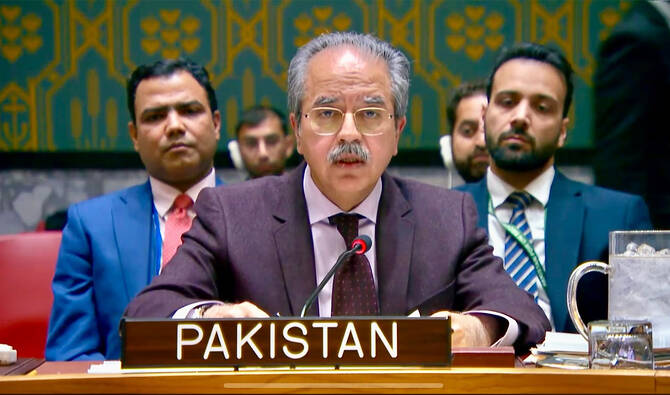
Pakistan's Permanent Representative, Ambassador Asim Iftikhar Ahmad, is addressing the UN Security Council briefing on “Energy, Critical Minerals, and Security” in New York, US, on March 5, 2026. (AN photo)
Short Url
Updated 06 March 2026
Follow

At UNSC, Pakistan warns competition for critical minerals could fuel global conflict

  • The demand for critical minerals has surged worldwide due to rapid expansion of electric vehicles, advanced electronics and clean energy technologies
  • Pakistan’s representative says all partnerships in critical minerals sector must be ‘cooperative and not exploitative’ and respect national ownership

ISLAMABAD: Ambassador Asim Iftikhar Ahmad, Pakistan’s permanent representative to the United Nations (UN), has warned that intensifying global competition over critical minerals could become a new driver of global conflict, urging stronger international cooperation and equitable access to resources vital for the world’s energy transition.

The warning comes as demand for critical minerals and rare earth elements surges worldwide due to the rapid expansion of electric vehicles, advanced electronics and clean energy technologies, with governments and companies increasingly competing to secure supply chains while raising concerns that this may lead to geopolitical rivalries in the coming years.

Speaking at a Security Council briefing on ‘Energy, Critical Minerals, and Security,’ Ahmad said experience showed that the risks of instability increased where mineral wealth intersected with weak governance, entrenched poverty and external interference.

“Access to affordable, reliable and sustainable energy is essential for development, stability and prosperity. The global transition toward renewable energy, electric mobility, battery storage and digital infrastructure has sharply increased the demand for critical minerals,” he said.

“This upsurge has generated new geopolitical and geo-economic pressures. If not managed responsibly, competition over natural resources can affect supply chains, aggravate tensions, undermine sovereignty and contribute to instability.”

In several conflict-affected settings, he noted, illicit extraction, trafficking networks and opaque financial flows have fueled armed conflict and violence, weakened state institutions and deprived populations of legitimate revenues.

“The scramble for natural resources and its linkage to conflict and instability is therefore not new,” Ahmad told UNSC members at the briefing. “Pakistan believes that natural resources must serve as instruments of economic development and shared prosperity, and not coercion or conflict.”

He urged the world to reaffirm the right of peoples to permanent sovereignty over their natural resources, saying all partnerships in the critical minerals sector must be cooperative and not exploitative, respect national ownership, ensure transparent contractual arrangements and align with host countries’ development strategies.

“In order to prevent the exploitation of mineral-producing countries and regions, particularly in fragile and conflict-affected settings, support their capacity-building for strengthening domestic regulatory institutions, combating illicit financial flows, ensuring environmental safeguards, and promoting equitable benefit-sharing with local communities,” he asked member states.

“Promote equitable participation in global value chains. Developing countries must be enabled to move beyond extraction toward processing, refining and downstream manufacturing. Technology transfer, skills development and responsible investment are essential to avoid perpetuating structural imbalances.”


Pakistan consults banks on financial stability as Middle East conflict rattles global markets

Updated 5 sec ago
Follow

Pakistan consults banks on financial stability as Middle East conflict rattles global markets

  • Finance minister says government monitoring global supply chains, energy markets amid regional tensions
  • Banks pledge coordination with government and central bank to ensure uninterrupted financial services

KARACHI: Pakistan’s finance minister held consultations with the country’s banking sector on Wednesday to review potential economic risks from the escalating Middle East conflict and ensure financial stability, according to a government statement.

The virtual meeting between Finance Minister Muhammad Aurangzeb and senior representatives of the Pakistan Banks’ Association (PBA) came as tensions involving the United States, Israel and Iran have driven volatility in global oil and financial markets, raising concerns for import-dependent economies such as Pakistan.

Islamabad has already faced pressure from rising fuel prices and potential supply disruptions in energy markets, prompting officials to closely monitor global developments and assess possible impacts on inflation, external accounts and broader macroeconomic stability.

“The discussion focused on the evolving economic and financial situation in light of prevailing regional developments and the importance of close coordination between the government, the State Bank of Pakistan, and the banking sector to ensure financial stability and uninterrupted financial services,” the finance ministry said in a statement after the minister's meeting with PBA officials. 

Aurangzeb told banking leaders the government had established a high-level coordination mechanism involving key economic ministries and institutions to continuously review developments in global markets, particularly in supply chains and energy.

He said authorities were conducting regular scenario analysis to evaluate possible implications for inflation, external accounts and overall economic stability while ensuring the continuity of essential supplies.

“The government remains engaged with relevant stakeholders and international partners as part of its efforts to safeguard the country’s economic interests,” the minister said, according to the statement.

Aurangzeb also emphasized the importance of coordinated decision-making and operational resilience within the financial sector during periods of uncertainty, encouraging banks to continue supporting businesses and customers while maintaining responsible risk management.

PBA Chairman Zafar Masud briefed the finance minister on the banking sector’s internal consultations and preparedness measures in response to the evolving situation, the statement said. 

Masud said the banking industry had set up a coordination framework for timely consultation and information sharing among financial institutions, aimed at ensuring the smooth functioning of financial services and payment systems.

He added that banks would remain in close engagement with the State Bank of Pakistan and other stakeholders while maintaining regular consultations within the industry to monitor developments and support financial market stability.