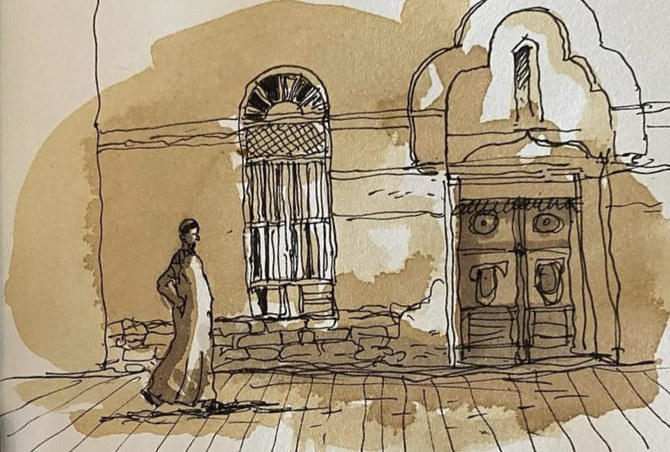

JEDDAH: Joel Alessandra, the renowned French comic book artist, travelled through Saudi Arabia recently so that he could portray the nation’s rich culture and heritage.
Known for his innovative use of coffee and watercolors in his drawings, Alessandra’s visit was facilitated by the French Embassy and the Alliance Francaise Saudi Arabia.
Having visited Riyadh, Alkhobar and AlUla, Alessandra found himself captivated by the charm of Al-Balad, Jeddah’s old town.

“This part of the city of Jeddah is the one that inspired me the most. We feel the atmosphere of a time when pilgrims stopped here, we perceive this fervent activity, there is an atmosphere of a centuries-old tradition that is still palpable,” Alessandra told Arab News.
The ancient architecture was a rich source of inspiration for his sketches, including the patina-covered walls and the intricate doorways. Alessandra’s drawings during his days in Jeddah aimed to capture the essence of Al-Balad's vibrant past and present.
He also held a live performance in Jeddah, where he recreated scenes from Al-Balad, offering spectators a glimpse into his artistic process.
“The subject was an improvised walk in Al-Balad, based on my sketches from the afternoon, I reproduced them in watercolor on the screen. Scenes of life in the street, buildings from past centuries, mosque minarets from the neighborhoods you pass through,” he said.
For Alessandra, travel serves as a constant wellspring of inspiration. Drawing from his experiences across Africa, he said “it is the atmosphere and the people of a country that shape my way of drawing, my real inspiration is taken on the ground.”
Reflecting on his recent visit to the Kingdom, Alessandra said he was amazed by Saudi Arabia’s burgeoning cultural scene and the enthusiasm for artistic expression among its youth.

While Alessandra’s sketches convey a deep appreciation for Saudi Arabia’s cultural heritage, he shies away from conveying explicit messages.
“I just want to convey the emotion felt in front of all the incredible and immensely rich cultural, architectural, and historical heritage. I am lucky to know how to draw and show this emotion through my sketchbooks and my books ... I hope that my readers will also be sensitive to it,” he said.
He said AlUla left him in awe.
“It would be difficult to forget the fascination AlUla had on me. The Nabataean tombs, just imagining a vibrant life there, in the middle of the desert, at this ancient time is simply incredible.
“Also imagining that the Roman Empire pushed its armies so far from Italy is inconceivable.
“But also the old town with its shaded and covered streets. It is a paradise to inspire designers,” he said.

Joel Alessandra
Last year, he ventured out to sketch in the streets of AlUla with female students from the local art school.
“This moment is engraved in my memory as these students were attentive and wanted to produce and learn how to draw their environment. I’m not sure I’ve ever encountered such a desire among young people in other countries.”
His use of coffee as a medium adds depth and richness to his artwork, capturing the nuances of skin tones and desert landscapes.
During his stay in Jeddah, he conducted workshops focusing on the Francophonie, bringing together students from various schools to collaborate on a work of fiction through text and drawings.

Engaging French school students in a collaborative storybook project, Alessandra explored a fictionalized journey of Muslim traveler Ibn Battuta in modern-day Arabia. Through writing and drawing, students reimagined Ibn Battuta’s adventures, blending elements of history and fantasy.
“The quest for a key to access the door of time and allow Ibn Battuta to return to his century, it was very amusing to see how the young people translated this graphically,” Alessandra said.
On his growth as an artist, Alessandra said that constant practice was key, and to aspiring artists, he added: “Draw, draw, and draw some more.”
“Always have a drawing pad in your pocket and train your hand and mind every chance you get. While waiting for the bus, at the cafe, during TV commercials, take advantage of every free moment to scribble in this notebook, there are no issues, just a few lines for practice,” Alessandra added.