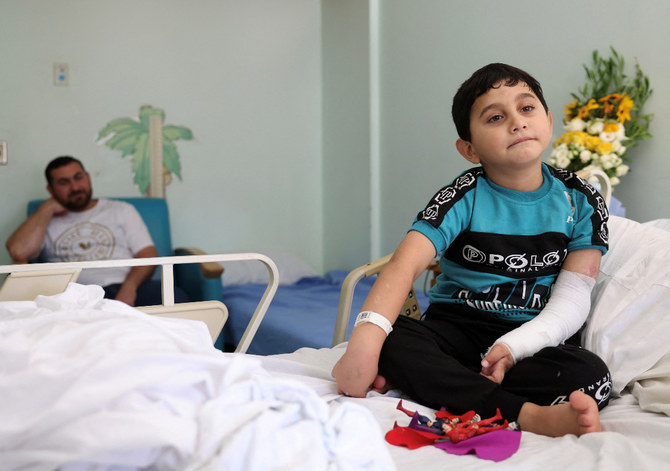
BEIRUT: Five-year-old Adam Afana dreamt of being a police officer “to keep people safe,” his uncle said, before losing his father, his siblings and cousins, and nearly all of his left arm in an Israeli strike seven months ago on Gaza.
Now, Adam is the first Palestinian child wounded in Israel’s war in Gaza to land in Lebanon, where he has been receiving care since Monday at the American University of Beirut’s Medical Center with help from the Ghassan Abu Sittah Children’s Fund.
In a sunlit room in the hospital, Adam plays with superhero action figures and watches videos on an iPad. He laughs, pokes fun at his uncle and the nurses, but only has stilted answers when asked about his journey to safety in Beirut.
“He remembers how he was wounded, his sister and his father — how they were all together. And he starts crying — it’s difficult for him psychologically,” said his uncle Eid Afana, 29, his caregiver in Beirut.
Getting him to Lebanon was no easy task: Adam spent more than six weeks in Gaza after he was wounded, sheltering from bombing and undergoing one emergency surgery on his arm without anaesthesia.
In early December, his uncle managed to enter Gaza City for just two days from Egypt to bring Adam and his mother out via the Rafah crossing. “It was my city and I couldn’t even recognize it. The European hospital was full of people being treated on the floor... The floor was a lake of blood, just body parts. It was a disaster,” said Afana.
They were lucky: Israel’s attack this month on Rafah has cut off the main crossing into Egypt, constricting aid and stopping what had been a trickle of people leaving for medical help.
The family spent nearly six months in Egypt, but Adam’s arm needed specialized care. Thus began the campaign to get him to Lebanon, a country with a precarious sectarian balance and complex history with Palestinian refugees, with severe restrictions on which can enter.
AUB President Fadlo Khoury told reporters earlier this week the university had “extensive discussions” with Lebanese authorities to allow Adam entry — and that they hoped he would be the first of more Palestinian children to benefit from the hospital’s expertise in treating war trauma.
Dania Dandashli from the Ghassan Abu Sittah Children’s Fund told Reuters the organization hoped to treat a total of 50 war-wounded Palestinian children in Lebanon over the next year.
Israel’s ground and air campaign in Gaza has killed more than 36,000 people, including thousands of children, and wounded more than 81,000, health authorities in Gaza say.
The war was triggered by an attack by Hamas militants on Israeli that killed 1200, with more than 250 hostages taken, by Israeli tallies.

Lebanon hospital treats Adam, first wounded Gazan to arrive in Beirut
https://arab.news/gjy63
Lebanon hospital treats Adam, first wounded Gazan to arrive in Beirut
- Adam is the first Palestinian child wounded in Israel’s war in Gaza to land in Lebanon
- Getting him to Lebanon was no easy task
US, UN launch humanitarian fund with $700m for war-ravaged Sudan
- Sudanese flee to Chad but face physical and mental wounds, women grapple with rape trauma
CAIRO, TINE, CHAD: The US and the UN are seeking to rally international support for humanitarian aid to war-ravaged Sudan, kicking off a new Sudan Humanitarian Fund with $700 million.
The Trump administration said it would contribute $200 million to the initiative from a basket of $2 billion it set aside late last year to fund humanitarian projects around the world. Several other participants promised they would make pledges but did not specify amounts.
“Today we are signaling that the international community will work together to bring this suffering to an end, and to ensure lifesaving aid reaches communities in such desperate, desperate need,” said UN humanitarian chief Tom Fletcher, who heads the UN Office for the Coordination of Humanitarian Affairs, or OCHA.
Fletcher co-hosted the fundraising event in Washington with US senior adviser for Arab and African affairs Massad Boulos.
Fletcher said they have set the beginning of Ramadan, on Feb. 17, as a date “to make visible progress on this work.”
Boulos said the US has put forward a “comprehensive proposal” for a humanitarian truce that could be agreed on in the next few weeks.
Sudan has been in the throes of war since 2023, with the Rapid Support Forces paramilitary force and the Sudanese military clashing for power over the country. The UN estimates that over 40,000 people have been killed in the war, but consider that the true number could be many times higher.
The conflict created the world’s largest humanitarian crisis, with over 14 million people forced to flee their homes and with famine declared in several regions of Sudan.
Fighting has concentrated in the Kordofan regions recently after the RSF took over El-Fasher, one of the army’s last strongholds in the Darfur region. But the military has since been making gains in Kordofan by breaking a siege in Kadugli and the neighboring town of Dilling. On Tuesday, the Sudanese military announced that it had opened a crucial road between Kadugli and Dilling.
The RSF launched a drone attack Tuesday that hit a medical center in Kadugli, killing 15 people including seven children, according to Sudan Doctors Network, which tracks the war. Meanwhile, in Tine, neighboring Chad, medical staff treated refugee Mahamat Hamid Abakar for a serious head wound from a drone attack using bandages and compresses outside the city hospital.
The 33-year-old, who fled his native Sudan as war erupted nearly three years ago, had just had a 5 mm metal fragment removed from his skull. Most of the wounded crossing the border are victims of drones, which have been heavily deployed by both sides in the conflict.
Sitting in the back of a pick-up truck, Abakar was traveling at night to deliver flour and sugar from Chad to his family who have stayed in Sudan.
“I was attacked by a drone in the area of Um Baru in Sudan three days ago,” he said, despite difficulties in talking.
Three other occupants of the vehicle — two men and a woman — were burned to death in the explosion.
The travel companion seated next to him died from his injuries the next morning, shortly after being picked up by rescue teams, who transported them to the Chadian border 150 km away.
Set on a hill overlooking a parched river marking the border, the hospital at Tine is on the front line for receiving wounded Sudanese.
“Since the capture of El-Fasher at the end of October, we have taken in a thousand Sudanese,” said Awadallah Yassine Mahamat, a carer from Sudan’s western region of Darfur who volunteers at the hospital after fleeing to Tine a year and a half ago.
El Fasher is the state capital of North Darfur.
“In Darfur, many hospitals, health centers and even pharmacies were destroyed during fighting,” he said, showing photographs on his phone of emaciated and charred bodies at the hospital where he worked before leaving.
Dressed in a thick, black jacket, the man in his 40s said most victims arriving in Chad had fractures following drone attacks.
In recent weeks, the wounded have flooded in from border areas being attacked by RSF forces.
Abakar Abdallah Kahwaya and Mahamat Abakar Hamdan, both aged 27, said they had been fighting for an army-aligned faction led by Darfur Gov. Minni Minnawi.
They have been in hospital for two weeks after being wounded during clashes with the RSF in Girgira, a Sudanese town about 50 km south of Tine.
“We put down our weapons to enter Chad and receive treatment,” said Kahwaya, who has an abdomen wound. “But as soon as we can fight again, we’ll return to Sudan,” Hamdan added.
Mahamat, the volunteer caregiver, stressed that the hospital accepted anyone who was wounded, whether civilian or combatant — but acknowledged the limits of the care the hospital was able to give.
“We’re short on caregivers and they are not sufficiently trained to care for all the wounded,” he said.
But the wounds are not only physical — treating the mental distress of refugees poses a significant challenge.
“The lack of resources and prospects in the camps further increases their vulnerability,” said Kindi Hassan, a mental health official with the International Rescue Committee at the Goudrane camp, which accommodates around 60,000 refugees.
Hassan was helping 30-year-old Asma who escaped an RSF attack on Zamzam, the largest refugee camp in North Darfur, in April.
In tears, the woman recounted the day she spent holed up in a makeshift bunker dug beneath her home before managing to get out of the camp.
She left behind the bodies of 11 family members killed in a bombing.
“Soldiers arrested me and three friends as we were fleeing,” she said, wiping away the tears with her headscarf.
“They beat us with the butts of their rifles until we couldn’t walk anymore and took turns raping us until the morning,” she said.
Medicine now helps to keep at bay the images that had haunted her and stopped her sleeping.
“Mental health is stigmatized and most cases of post-traumatic stress are kept quiet,” Hassan, of the IRC, said.
She said refugees waited a long time before talking about their trauma, adding: “Our response is inadequate to meet the enormous needs.”
Four NGOs are caring for the mental health of victims of conflict in Goudrane camp, including the IRC, which has helped almost 800 people in a year.
If additional resources don’t arrive, the plight of refugees in Chad’s camps risks worsening, warned Hassan, who spoke of an increasing trend of “suicidal thoughts.”
“Some people even go so far as to poison or hang themselves to escape their distress,” she said.