KHADOOR SAHIB: A jailed Sikh separatist leader is contesting India’s general election from prison and drawing good support, his campaign managers said, in what could become a concern for New Delhi which has sought to stamp out any revival of Sikh militancy.
Amritpal Singh, 31, is detained in a high-security prison in Assam, nearly 3,000 km (1,865 miles) from his Khadoor Sahib constituency in Punjab state, where villages and towns are dotted with posters depicting him with swords and bullet-proof vests.
Singh was arrested last year and jailed under a tough security law after he and hundreds of his supporters stormed a police station with swords and firearms, demanding the release of one of his aides.
A win for him in an election to parliament could give Singh some legitimacy and spark concerns of a revival of a militancy that killed tens of thousands of people in the 1970s and 1980s.
“People will make their decision on June 1,” Singh’s father Tarsem, 61, said referring to the voting in the constituency on Saturday. “They will send an important message to those who have maligned his image, to those who are defaming our community and our Punjab.”
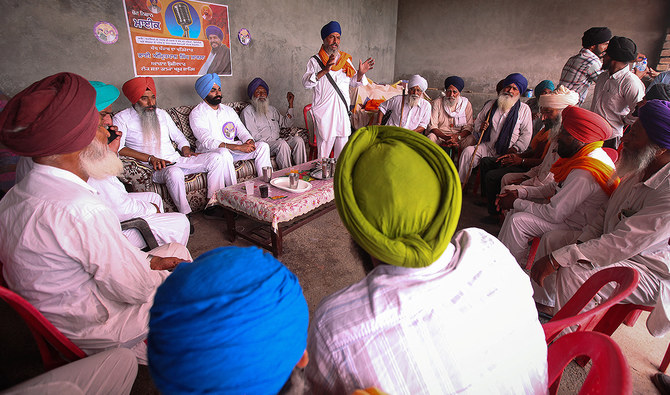
Tarsem Singh spoke inside a Sikh temple set beside wheat fields and a river canal. Portraits of Sikhs who were killed during the militancy in Punjab, called “martyrs” by Singh’s supporters, were pinned on the walls.
Sikhs are the majority community in Punjab but they constitute just 2 percent of India’s 1.4 billion people. Sikh militants began agitating for an independent homeland in the 1970s but the insurgency was largely suppressed by the early 1990s with harsh crackdowns.
However, Sikh separatism has made global headlines in the last year as Canada and the United States have accused India of being involved in assassination plots against Sikhs in those countries, charges New Delhi has denied.
Singh said in a 2023 interview that he was seeking a separate homeland for Sikhs and the people of Punjab, where the religion was founded more than 500 years ago.
SINGH’S ‘TSUNAMI’
To be sure, Singh’s campaign is focused on fighting Punjab’s drug problem, freeing former Sikh militants from prison and protecting the Sikh identity in Hindu majority India. His father and aides are careful to avoid any mention of the idea of a Sikh homeland.
“There is a tsunami in the name of Amritpal Singh, anyone who stands against him will be swept off,” said Imaan Singh Khara, 27, Singh’s lawyer.
Community leaders pushed Singh to contest from Khadoor Sahib, a historical center for Sikhs on the border with Pakistan, despite his initial hesitation, his aides said. Indian law allows undertrials to contest polls.
Singh is contesting as an independent and his main rivals — also all Sikhs — belong to the opposition Congress party, the Sikh-centric Shiromani Akali Dal, Punjab’s ruling Aam Aadmi Party and Prime Minister Narendra Modi’s Bharatiya Janata Party (BJP).
Amritpal Singh may have some support but not enough to win, said BJP candidate Manjit Singh Manna. “People have seen the militancy days, they don’t want those days to return,” Manna said.
Demand for a separate Sikh nation has more support abroad, but a rise in support for Singh risks giving new legs to extremist politics at a time when mainstream parties are wrapped in their own rivalries, analysts say.
“Once you weaken the moderates, people get articulation through these fringe radicals, which is a danger signal,” said Pramod Kumar, chairperson of the Institute for Development and Communication, based in the city of Chandigarh.
“Amritpal may win, in a four-cornered contest he may win.”

Sikh separatist contests India election from jail, a worry for government
Short Url
https://arab.news/5jkys
Sikh separatist contests India election from jail, a worry for government
- Amritpal Singh, 31, is detained in a high-security prison in Assam, nearly 3,000km from his Khadoor Sahib constituency in Punjab
- Singh was arrested last year and jailed after he and hundreds of his supporters stormed a police station with swords and firearms
Iceland joins Eurovision boycott over Israel’s participation
- Decision follows similar moves by Spain, the Netherlands, Ireland and Slovenia over the Gaza war
- Iceland’s national broadcaster says it pulled out 'given the public debate' in the country
LONDON: Iceland’s national broadcaster said Wednesday it will boycott next year’s Eurovision Song Contest because of discord over Israel’s participation, joining four other countries in a walkout of the pan-continental music competition.
Broadcasters in Spain, the Netherlands, Ireland and Slovenia told contest organizer the European Broadcasting Union last week that they will not take part in the contest in Vienna in May after organizers declined to expel Israel over its conduct of the war against Hamas in Gaza.
The board of Iceland’s RÚV met Wednesday to make a decision.
At its conclusion the broadcaster said in a statement that “given the public debate in this country ... it is clear that neither joy nor peace will prevail regarding the participation of RÚV in Eurovision. It is therefore the conclusion of RÚV to notify the EBU today that RÚV will not take part in Eurovision next year.”
“The Song Contest and Eurovision have always had the aim of uniting the Icelandic nation but it is now clear that this aim cannot be achieved and it is on these program-related grounds that this decision is taken,” the broadcaster said.
Last week the general assembly of the EBU — a group of public broadcasters from 56 countries that runs Eurovision — met to discuss concerns about Israel’s participation. Members voted to adopt tougher contest voting rules in response to allegations that Israel manipulated the vote in favor of its competitor, but took no action to exclude any broadcaster from the competition.
The pullouts include some big names in the Eurovision world. Spain is one of the “Big Five” large-market countries that contribute the most to the contest. Ireland has won seven times, a record it shares with Sweden.
Iceland, a volcanic North Atlantic island nation with a population of 360,000, has never won but has the highest per capita viewing audience of any country.
The walkouts cast a cloud over the future of what’s meant to be a feel-good cultural party marked by friendly rivalry and disco beats, dealing a blow to fans, broadcasters and the contest’s finances.
The contest, which turns 70 in 2026, strives to put pop before politics, but has repeatedly been embroiled in world events. Russia was expelled in 2022 after its full-scale invasion of Ukraine.
It has been roiled by the war in Gaza for the past two years, stirring protests outside the venues and forcing organizers to clamp down on political flag-waving.
Opponents of Israel’s participation cite the war in Gaza, where more than 70,000 Palestinians have been killed, according to the territory’s Health Ministry, which operates under the Hamas-run government and whose detailed records are viewed as generally reliable by the international community.
Israel’s government has repeatedly defended its campaign as a response to the attack by Hamas-led militants on Oct. 7, 2023. The militants killed around 1,200 people — mostly civilians — in the attack and took 251 hostage.
A number of experts, including those commissioned by a UN body, have said that Israel’s offensive in Gaza amounts to genocide, a claim Israel has vigorously denied.
Wednesday marked the final day for national broadcasters to announce whether they planned to participate. More than two dozen countries have confirmed they will attend the contest in Vienna, and the EBU says a final list of competing nations will be published before Christmas.
Broadcasters in Spain, the Netherlands, Ireland and Slovenia told contest organizer the European Broadcasting Union last week that they will not take part in the contest in Vienna in May after organizers declined to expel Israel over its conduct of the war against Hamas in Gaza.
The board of Iceland’s RÚV met Wednesday to make a decision.
At its conclusion the broadcaster said in a statement that “given the public debate in this country ... it is clear that neither joy nor peace will prevail regarding the participation of RÚV in Eurovision. It is therefore the conclusion of RÚV to notify the EBU today that RÚV will not take part in Eurovision next year.”
“The Song Contest and Eurovision have always had the aim of uniting the Icelandic nation but it is now clear that this aim cannot be achieved and it is on these program-related grounds that this decision is taken,” the broadcaster said.
Last week the general assembly of the EBU — a group of public broadcasters from 56 countries that runs Eurovision — met to discuss concerns about Israel’s participation. Members voted to adopt tougher contest voting rules in response to allegations that Israel manipulated the vote in favor of its competitor, but took no action to exclude any broadcaster from the competition.
The pullouts include some big names in the Eurovision world. Spain is one of the “Big Five” large-market countries that contribute the most to the contest. Ireland has won seven times, a record it shares with Sweden.
Iceland, a volcanic North Atlantic island nation with a population of 360,000, has never won but has the highest per capita viewing audience of any country.
The walkouts cast a cloud over the future of what’s meant to be a feel-good cultural party marked by friendly rivalry and disco beats, dealing a blow to fans, broadcasters and the contest’s finances.
The contest, which turns 70 in 2026, strives to put pop before politics, but has repeatedly been embroiled in world events. Russia was expelled in 2022 after its full-scale invasion of Ukraine.
It has been roiled by the war in Gaza for the past two years, stirring protests outside the venues and forcing organizers to clamp down on political flag-waving.
Opponents of Israel’s participation cite the war in Gaza, where more than 70,000 Palestinians have been killed, according to the territory’s Health Ministry, which operates under the Hamas-run government and whose detailed records are viewed as generally reliable by the international community.
Israel’s government has repeatedly defended its campaign as a response to the attack by Hamas-led militants on Oct. 7, 2023. The militants killed around 1,200 people — mostly civilians — in the attack and took 251 hostage.
A number of experts, including those commissioned by a UN body, have said that Israel’s offensive in Gaza amounts to genocide, a claim Israel has vigorously denied.
Wednesday marked the final day for national broadcasters to announce whether they planned to participate. More than two dozen countries have confirmed they will attend the contest in Vienna, and the EBU says a final list of competing nations will be published before Christmas.
© 2025 SAUDI RESEARCH & PUBLISHING COMPANY, All Rights Reserved And subject to Terms of Use Agreement.


