

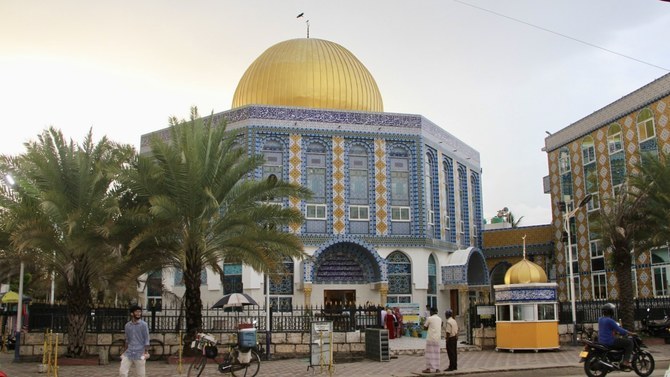
Dome of Rock replica turns remote Sri Lankan town into tourist site

A Dome of the Rock replica is seen in Kattankudy, Sri Lanka, on May 20, 2024. (AN Photo)
Short Url
Updated 31 May 2024
Follow

Dome of Rock replica turns remote Sri Lankan town into tourist site

  • It was inaugurated in Kattankudy, Eastern Province, in 2022
  • The site has since boosted local halal tourism businesses

KATTANKUDY: A bright gold dome mounted on an octagonal blue arcade looks like the Dome of the Rock, but the background is a modern tropical neighborhood in a coastal Sri Lankan town.

The building is a mosque modeled on the seventh-century shrine in the Al-Aqsa Mosque compound in East Jerusalem — the third holiest site in Islam, after the Grand Mosque in Makkah and the Prophet’s Mosque in Madinah.

Built in Kattankudy, a township near the city of Batticaloa in Sri Lanka’s Eastern Province, the three-story replica was inaugurated in December 2022.

Muslims constitute about 10 percent of Sri Lanka’s 22 million population, which is predominantly Buddhist, but in Kattankudy and neighboring areas they are a majority.

“For Friday prayers, around 2,000 to 3,000 people would pray here, on the three stories, and outside also ... In Ramadan, (there is) also a big crowd,” Mahamood Lebbe Alim Mohamed Hizbullah, the mosque’s caretaker and former governor of the Eastern Province, told Arab News.

But the biggest crowds flock to the coastal town during weekends, he said, as the mosque has boosted local businesses offering halal food and accommodation.

Financed from donations, it is becoming a main tourism attraction for the region’s Muslims, most of whom may never be able to visit the original site in Palestine.

“The Muslim community, after the Easter attack, is finding it really difficult to travel,” Hizbullah said, referring to the deadly 2019 bombings on churches in Colombo.

While the attacks were claimed by Daesh militants, they prompted the Sri Lankan government to ramp up restrictions on the Muslim community.

No such restrictions are present in Kattankudy, where most of the establishments and properties are Muslim-run.

“This has become a tourist destination in the Eastern Province ... (Praying here) you feel so comfortable, and you feel you are in a different place,” said Abdul Rahman Mansoor, former deputy mayor of nearby Kalmunai city.

“People like me, we are not going to Palestine, we will not get the chance, but coming here ... gives us confidence and gives us hope.”


World not ready for rise in extreme heat, scientists say

A man drinks water under the sun on a beach in Puerto Madryn, Chubut province, Argentina on January 26, 2024. (AFP)
Updated 5 sec ago
Follow

World not ready for rise in extreme heat, scientists say

  • In a new study, they looked at different global warming scenarios to project how often people in the future might experience temperatures considered uncomfortably hot or cold

PARIS: Nearly 3.8 billion people could face extreme heat by 2050, and while tropical countries will bear the brunt, cooler regions will also need to adapt, scientists said Monday.

Demand for cooling will “drastically” increase in large countries like Brazil, Indonesia, and Nigeria, where hundreds of millions of people lack air conditioning or other means to beat the heat.

But even a moderate increase in hotter days could have a “severe impact” in nations not accustomed to such conditions, such as Canada, Russia, and Finland, said scientists from the University of Oxford.

In a new study, they looked at different global warming scenarios to project how often people in the future might experience temperatures considered uncomfortably hot or cold.

They found “that the population experiencing extreme heat conditions is projected to nearly double” by 2050 if global average temperatures rise 2°C above preindustrial times.

But most of the impact would be felt this decade as the world fast approaches the 1.5°C mark, said the study’s lead author Jesus Lizana.

“The key takeaway from this is that the need for adaptation to extreme heat is more urgent than previously known,” said Lizana, an environmental scientist.

“New infrastructure, such as sustainable air conditioning or passive cooling, needs to be built out within the next few years to ensure people can cope with dangerous heat.”

Prolonged exposure to extreme heat can overwhelm the body’s natural cooling systems, causing symptoms ranging from dizziness and headaches to organ failure and death.

It is often called a silent killer because most heat deaths occur gradually as high temperatures and other environmental factors work together to undermine the body’s internal thermostat.

Climate change is making heatwaves longer and stronger, and access to cooling — especially air conditioning — will be vital in the future.

The study, published in the journal Nature Sustainability, projected that 3.79 billion people worldwide could be exposed to extreme heat by mid century.

This would “drastically” increase energy demand for cooling in developing nations where the gravest health consequences would be felt. India, the Philippines, and Bangladesh would be among the countries with the largest populations affected.

The most significant change in “cooling degree days” — temperatures hot enough to require cooling, such as air conditioning or fans — was projected in tropical or equatorial countries, particularly in Africa.

Central African Republic, Nigeria, South Sudan, Laos, and Brazil saw the biggest rise in dangerously hot temperatures.

“Put simply, the most disadvantaged people are the ones who will bear the brunt of this trend, our study shows for ever hotter days,” said urban climate scientist and research co-author Radhika Khosla.

But wealthier countries in traditionally cooler climates also “face a major problem — even if many do not realize it yet,” she added.

Countries like Canada, Russia, and Finland may experience steep drops in “heating degree days” — temperatures low enough to require indoor heating — under a 2°C scenario.

But even a moderate rise in hotter temperatures would be felt more acutely in countries not designed to withstand heat, the authors said.

In these countries, homes and buildings are usually built to maximize sunlight and minimize ventilation, and public transport runs without air conditioning.

Some cold-climate nations may see a drop in heating bills, Lizana said, but over time these savings would likely be replaced by cooling costs, including in Europe, where air conditioning is still rare.

“Wealthier countries cannot sit back and assume they will be OK — in many cases, they are dangerously underprepared for the heat that is coming over the next few years,” he said.