Slovenia’s government endorses recognition of a Palestinian state, sends to parliament for approval

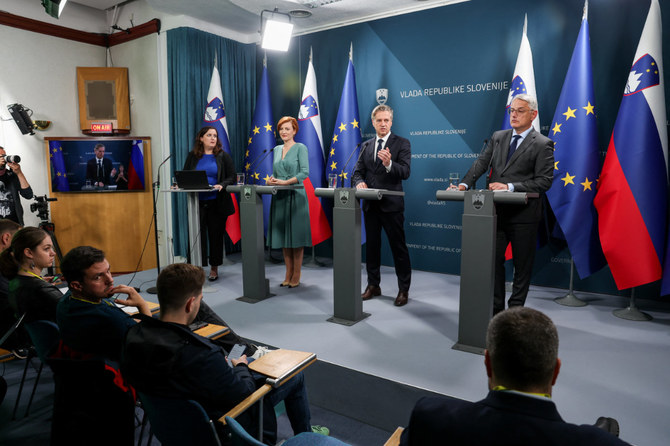
Slovenian Prime Minister Robert Golob, Culture Minister Asta Vrecko and Economy Minister Matjaz Han attend a press conference about the recognition of the Palestinian state, in Ljubljana, Slovenia, on May 30, 2024. (REUTERS)
Short Url
Updated 31 May 2024
Follow

Slovenia’s government endorses recognition of a Palestinian state, sends to parliament for approval

  • “All the world should act in the direction of peace. The way to achieve peace is a two-state solution,” says Prime Minister Robert Golob
  • Slovenia's comes just two days after Spain, Norway and Ireland recognized a Palestinian state, a move that was condemned by Israel

LJUBLJANA, Slovenia: Slovenia’s government on Thursday endorsed a motion to recognize a Palestinian state and asked the parliament to do the same.
Prime Minister Robert Golob said that his government sent the recognition proposal to parliament, which could convene as early as next week.
“All the world should act in the direction of peace,” Golob said after the government session. “The way to achieve peace is a two-state solution.”
“The decision is not directed against anyone, not even Israel, but it is a message of peace,” he added as the Palestinian flag was displayed on the government headquarters in Ljubljana, the Slovenian capital.
Israel’s Foreign Minister Israel Katz said he hoped the Slovenian parliament would reject the government decision.
“The Slovenian government’s decision to recommend that the Slovenian Parliament recognize a Palestinian state rewards Hamas for murder, rape, mutilation of bodies, beheading of babies, and strengthens the Iranian axis of evil while damaging the close friendship between the Slovenian and Israeli people,” he said.
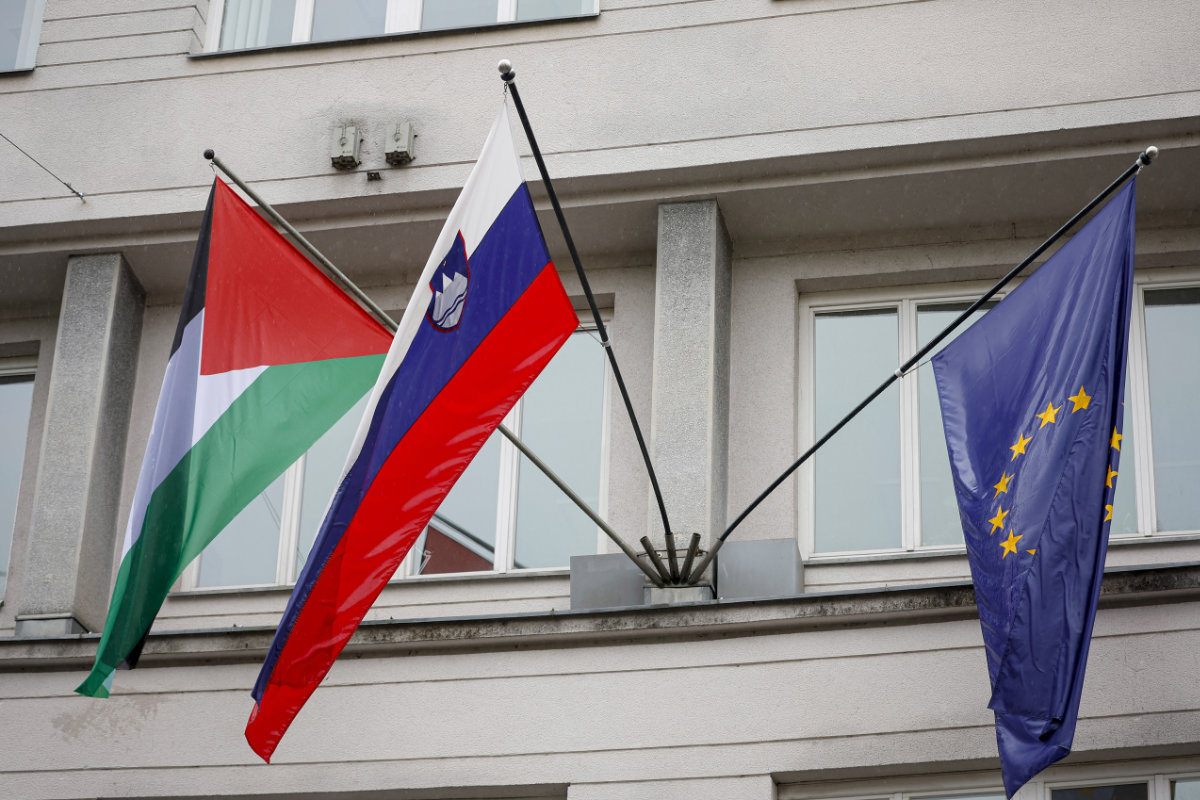


A Palestinian flag flies next to a Slovenian, center, and a European Union flag, right, at the government building in Ljubljana, Slovenia, on May 30, 2024. (AP) 

Parliamentary approval is necessary for the move to take effect. Golob’s ruling liberal coalition has a comfortable majority in the 90-member assembly and the vote should be a formality.
The decision by Slovenia’s government comes just two days after Spain, Norway and Ireland recognized a Palestinian state, a move that was condemned by Israel.
With its move, Slovenia is set to become the 10th member of the 27-nation European Union to officially recognize a Palestinian state. Norway isn’t an EU member, but its foreign policy is usually aligned with the bloc.
Slovenia first began the recognition process in early May, but said it would wait until the situation in the ongoing Israeli-Hamas war in Gaza improved.
Golob said this week that he was expediting the process in reaction to Israel’s latest attacks on Rafah, which have caused more than 1 million Palestinians to flee.
More than 140 countries recognize a Palestinian state — more than two-thirds of the United Nations.
The move to recognize a Palestinian state has caused relations between the EU and Israel to nosedive. Spain and Ireland are pushing for the EU to take measures against Israel for its continued attacks on Rafah in southern Gaza.
Israel launched the assault following the Oct. 7 Hamas-led attack in which militants stormed across the Gaza border into Israel, killing 1,200 people and taking about 250 hostage. Israel’s air and land attacks have since killed 36,000 Palestinians, according to Gaza’s Health Ministry, which doesn’t distinguish between combatants and civilians.


Ukraine, US, Europe still seeking common ground in peace talks, French official says

Updated 4 sec ago
Follow

Ukraine, US, Europe still seeking common ground in peace talks, French official says

  • French presidency official: “The European perspective of Ukraine is clear and it’s a realistic perspective”

PARIS: Ukraine, the United States and European powers are still working to find a joint position that would outline the contours of a peace deal, including security guarantees for Kyiv, that could be taken to Russia, a French presidency official said on Friday.
“Our goal is to have a common foundation that is solid for negotiation. This common ground must unite Ukrainians, Americans and Europeans,” the official told reporters in a briefing.
“It should allow us, together, to make a negotiating offer, a solid, lasting peace offer that respects international law and Ukraine’s sovereign interests, an offer that American negotiators are willing to bring to the Russians.”
The official said there was no joint document yet, but all sides would carry on negotiations in the coming days through various calls and meetings. He did not say whether Washington had set a deadline.
Kyiv is under pressure from the White House to secure a quick peace but is pushing back on a US-backed plan proposed last month that many see as favorable to Moscow.
Britain, France and Germany, along with other European partners and Ukraine, have been working frantically in the last few weeks to refine the original US proposals that envisaged Kyiv giving up swathes of its territory to Moscow, abandoning its ambition to join NATO and accepting limits on the size of its armed forces.
The French official said the talks aimed at narrowing differences with the United States and centered on territory and potential security guarantees for Ukraine once there is a peace accord.
Those discussions include the possibility of a NATO Article-5 type clause involving Washington that would seek to reassure Kyiv in case it was once again attacked by Russia, the official said.
The Europeans have also faced pressure in recent weeks with some American proposals touching on elements that concern NATO and the European Union, including suggestions on fast-tracking Ukraine’s accession to the bloc.
“The European perspective of Ukraine is clear and it’s a realistic perspective,” the official said. “That is what we are committed to and it is up to the Europeans and the Ukrainians to agree on how to proceed.”