

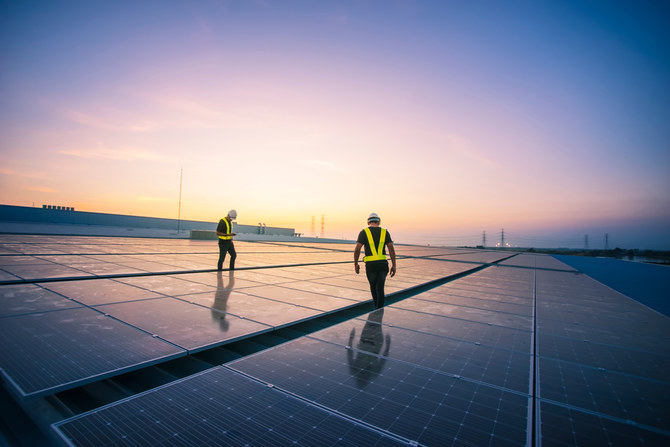
Saudi Arabia leads Middle East’s solar revolution as region eyes renewable future

A recent analysis by Norwegian business intelligence and research company Rystad Energy indicated that along with the UAE and Oman, the Kingdom is poised to lead the Middle East’s solar transition due to several key factors. Shutterstock
Short Url
Updated 30 May 2024
Follow

Saudi Arabia leads Middle East’s solar revolution as region eyes renewable future

RIYADH: Saudi Arabia has achieved a world-record low levelized cost of electricity for solar photovoltaics, reaching $10.4 per megawatt-hour, according to a new report. 

A recent analysis by Norwegian business intelligence and research company Rystad Energy indicated that along with the UAE and Oman, the Kingdom is poised to lead the Middle East’s solar transition due to several key factors. 

The report highlighted the increasing significance of solar power in the energy policies of Middle Eastern countries, attributing this trend to factors such as low hurdle rates, large-scale projects, declining hardware prices, as well as low labor costs and high solar irradiance. 

“The region has exceptional solar energy potential, receiving more than 2,000 kilowatt-hours per sq. m. annually in solar irradiation in countries such as Saudi Arabia, the UAE, and Oman,” the report stated.  

The total solar capacity in the Middle East surpassed 16 gigawatts by the end of 2023 and is projected to approach 23 GW by the end of 2024, the report added.  

Rystad Energy’s projections indicate that by 2030, the capacity will exceed 100 GW, with green hydrogen projects contributing to an annual growth rate of 30 percent. 

Saudi Arabia, the UAE, and Oman are expected to collectively account for nearly two-thirds of the region’s total solar capacity by the end of the decade. 

Furthermore, renewable sources, including hydro, solar, and wind, are anticipated to constitute 70 percent of the Middle East’s power generation mix by 2050, a substantial increase from 5 percent at the end of 2023.  

Despite this growth, the region will heavily rely on natural gas in the short term, with usage peaking around 2030. 

At the end of 2023, 93 percent of the Middle East’s power generation was from fossil fuels, with renewables at 3 percent, and nuclear and hydro at 2 percent each.  

By 2030, it is expected that 30 percent of installed capacity will be from renewables, potentially reaching 75 percent by 2050.  

Rystad Energy predicts significant growth in battery energy storage in the 2030s to support the transition to solar and wind power. The share of gas in power generation is forecasted to decrease from 74 percent in 2023 to 22 percent by 2050.


Council of Economic and Development Affairs reviews budget performance report during virtual meeting

Updated 8 sec ago
Follow

Council of Economic and Development Affairs reviews budget performance report during virtual meeting

JEDDAH: The Council of Economic and Development Affairs held a virtual meeting, the Saudi Press Agency has reported.

At the outset of the meeting, the council reviewed the quarterly report submitted by the Ministry of Economy and Planning, which included updates on the global economy and the impact of geopolitical challenges and volatility in global markets on growth prospects.

The report also addressed the latest developments related to the national economy and future projections through 2027, highlighting its high resilience in confronting global challenges and noting that various economic statistics and indicators point to remarkable growth that further cements the Kingdom’s position among the fastest-growing and most stable economies in the world.

The council reviewed the fourth-quarter performance report of the state’s general budget for fiscal year 2025, submitted by the Ministry of Finance, which provided a comprehensive overview of financial performance during the period, including developments in revenues and expenditures, public debt levels, and an analysis of local and global economic variables and their implications for financial indicators.

The report results showed the continued adoption of a balanced and flexible fiscal policy that supports economic growth and enhances financial sustainability over the medium and long terms, through the use of disciplined and efficient fiscal tools and the continuation of countercyclical spending, directed toward development programs and projects with economic and social impact, contributing to improving the quality of public services, stimulating investment, and strengthening the resilience of public finances.

The council discussed a number of procedural matters, including a draft Government Tenders and Procurement Law, a draft Space Law, and a briefing on steps taken regarding the assignment of the Council of University Affairs to update the regulations necessary for the governance of public and private universities and health colleges, supervise and follow up on them periodically, and update compliance processes in public and private universities and health colleges based on quality standards approved by the Council of University Affairs.

The council was also briefed on the results of the quarterly Real Estate Price Index report, along with two summaries of the monthly Consumer Price Index and Wholesale Price Index reports, and the underlying reports on which the summaries were based.

The council adopted the necessary decisions and recommendations regarding these matters.