ISLAMABAD: The top commanders of the Pakistan army met on Thursday and discussed ‘serious concerns’ about cross-border attacks they said were orchestrated by militants using safe havens in neighboring Afghanistan, as well as the use of social media by “politically motivated” internal actors to sow discord between the military and the public.
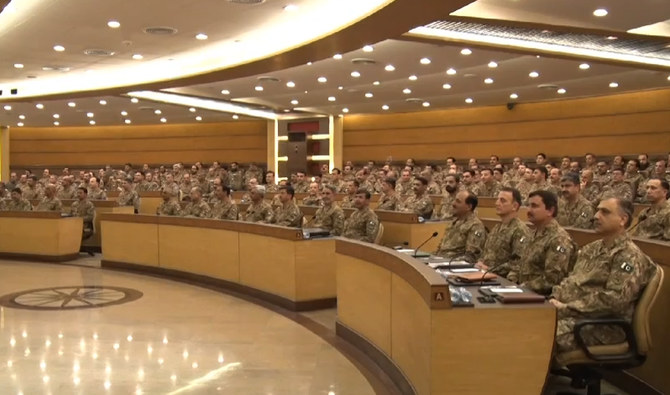
The views were expressed at the 83rd Formation Commanders Conference held at the military’s GHQ headquarters in Rawalpindi and attended by Army Chief General Asim Munir, all corps commanders, principal staff officers and formation commanders of the Pakistan army.
In a press conference held earlier this month, Pakistan’s military had said a suicide bombing in March that killed five Chinese engineers was planned in neighboring Afghanistan, and that the bomber was an Afghan national. Previously also, the government and army have blamed militants harboring in Afghanistan for a surge in attacks in Pakistan.
Relations between Pakistan and Afghanistan have soured in recent months as Islamabad says Kabul is not doing enough to tackle militant groups targeting Pakistan. In March, Pakistan also carried out airstrikes targeting militants on Afghan territory. The Taliban have rejected Islamabad’s accusations, saying Pakistan is responsible for its own security challenges.
Since late last year, Pakistan has expelled almost half a million undocumented Afghan nationals, saying the majority of suicide attacks against its security forces were carried out by Afghans, a charge Kabul rejects.
“The forum expressed serious concerns over continued cross-border violations from Afghanistan and terrorism being orchestrated using Afghan soil, noting that Pakistan’s adversaries were using Afghanistan to target Security Forces and innocent civilians inside Pakistan,” a statement from the army said after the corp commanders’ meeting on Thursday.
Talking about internal challenges, the statement, in a veiled reference to the Pakistan Tehreek-e-Insaf (PTI) party of former Prime Minister Imran Khan, said “politically motivated and vested digital terrorism” had been unleashed by “conspirators duly abetted by their foreign cohorts against state institutions.”
“[It] is clearly meant to try to induce despondency in the Pakistani nation, to sow discord among national institutions, especially the Armed Forces, and the people of Pakistan by peddling blatant lies, fake news, and propaganda,” the statement said.
“However, the nation is fully cognizant of their ugly and ulterior motives and surely the designs of these nefarious forces will be comprehensively defeated.”
The military remains the country’s most powerful institution and has for decades had a huge role in making and breaking governments. Khan accuses the military of a crackdown on him and his party, which the army denies.
Although Khan is widely believed to have been brought to power in 2018 with the backing of the army, he fell out with top generals and by April 2022 was ousted from the PM’s office in a parliamentary vote of no-confidence. He has since led a defiant campaign against the army, which he accuses of working with his political rivals to unseat him.
Tensions between Khan and the army reached a crescendo on May 9 last year when alleged supporters of the PTI attacked and damaged government and military installations. Hundreds of PTI supporters and leaders were arrested following the riots and some continue to remain behind bars as they await trial. The army has also initiated military court trials of at least 103 people accused of involvement in the violence. Many close Khan aides have since deserted him, due to what is widely believed to be pressure from the army, which denies interfering in politics.
“The planners, perpetrators, abettors, and facilitators of 9th May need to be brought to justice for the collective good of the country, and that without swift and transparent dispensation of justice to the culprits and establishing the rule of law, stability in the country will ever remain hostage to the machinations of such elements,” the army statement concluded.
Khan and the PTI say the May riots have been used as a ruse by political rivals and the military to crack down on the party, which is arguably the most popular in Pakistan. Khan has also been indicted under Pakistan’s anti-terrorism law in connection with the violence. A section of Pakistan’s 1997 anti-terrorism act prescribes the death penalty as maximum punishment. Khan has denied the charges, saying he was in detention when the violence took place.
Khan was also handed four court convictions ahead of Feb. 8 general elections, which ruled him out of the polls as convicted individuals cannot run for public office under Pakistani law. Khan says all the cases are motivated to keep him away from politics.


![]()
![]()

Pakistan army top commanders decry cross-border attacks from Afghanistan, ‘digital terrorism’

Short Url
https://arab.news/6e9ne
Pakistan army top commanders decry cross-border attacks from Afghanistan, ‘digital terrorism’
- Army says adversaries are using Afghanistan to target security forces and civilians inside Pakistan
- In veiled reference to ex-PM Khan and his party, army says will defeat “politically motivated digital terrorism”
Latest updates



© 2026 SAUDI RESEARCH & PUBLISHING COMPANY, All Rights Reserved And subject to Terms of Use Agreement.